

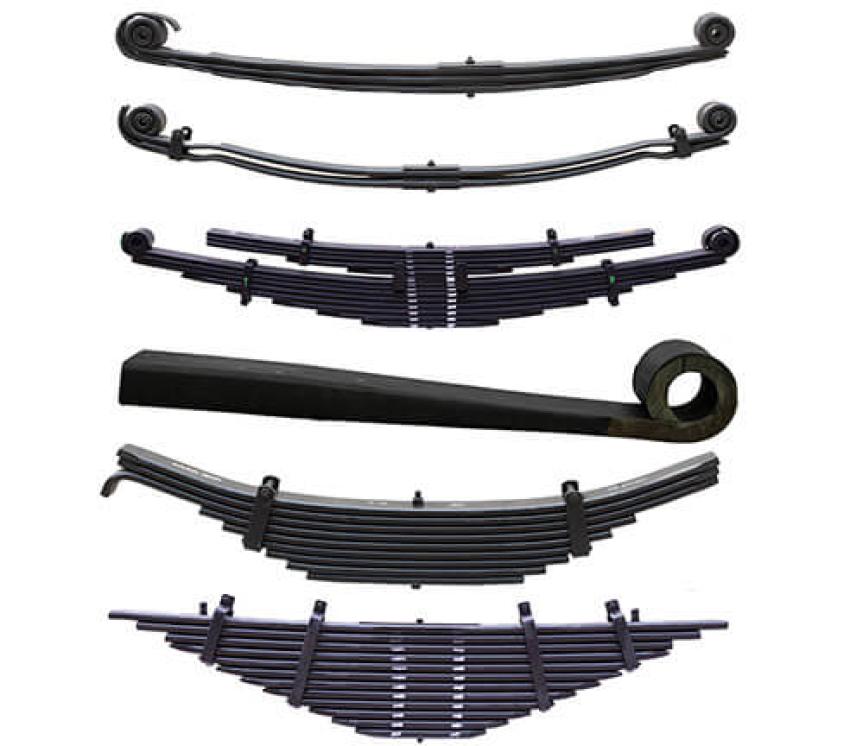
Leaf springs are an important component of suspension systems used in commercial vehicles, trucks, trailers and various heavy-duty applications. Their primary function is to support vehicle loads, absorb road-induced impacts and maintain the required distance between the vehicle chassis and axle. While several design factors influence their performance, leaf spring length plays a particularly important role in determining how the spring bends, deflects and responds to changing loads.
The length of a leaf spring affects its flexibility, stiffness and load-deflection characteristics. A longer spring generally allows greater bending movement under a given load than a shorter spring of otherwise identical design. However, the actual relationship depends on other parameters, including material properties, leaf thickness, width, spring geometry and mounting arrangement.
Understanding this relationship is important when designing suspension systems for vehicles that operate under different loading conditions. The correct spring length helps achieve the required balance between load-bearing capacity, suspension movement, ride comfort and operational stability.
1. Understanding Leaf Spring Length
Leaf spring length generally refers to the distance between the spring's mounting points or eyes, although the overall physical length and the effective working length are not necessarily the same.
In a conventional semi-elliptical leaf spring, the spring is typically mounted at two points. One end is connected to the vehicle chassis through a fixed mounting bracket, while the other is connected through a shackle that allows movement as the spring deflects.
When a load acts on the vehicle, the spring bends and changes its curvature. The effective distance over which this bending occurs influences the amount of deflection produced.
A longer leaf spring has a greater working span over which bending can take place. This generally allows it to accommodate more vertical movement under comparable loading conditions. A shorter spring, on the other hand, tends to offer greater resistance to bending when all other design variables remain unchanged.
However, spring length cannot be considered independently. Its influence must be evaluated alongside the spring's cross-sectional dimensions, material characteristics and suspension configuration.
2. Relationship Between Leaf Spring Length and Flexibility
Flexibility refers to the ability of a leaf spring to bend when subjected to an applied load. It is closely related to spring stiffness, which describes the resistance offered by the spring against deformation.
For a given spring design and material, increasing the effective length generally increases flexibility. This happens because the bending movement is distributed over a longer section of the spring.
A longer spring can accommodate greater curvature changes without requiring the same degree of localised bending that may occur in a shorter spring. This can contribute to smoother suspension movement when the vehicle encounters uneven road surfaces.
In contrast, a shorter spring has a more restricted working span. It generally offers greater resistance to deflection, resulting in a stiffer suspension response.
The relationship can be understood through a simplified engineering principle. For a uniform, rectangular, simply supported beam carrying a central point load, the deflection is:
\[ \delta = \frac{PL^3}{48EI} \]
Where:
- \(\delta\) = maximum deflection
- \(P\) = applied load
- \(L\) = effective span
- \(E\) = Young's modulus of the material
- \(I\) = second moment of area of the cross-section
The equation demonstrates that deflection is strongly influenced by the effective span. For this simplified beam model, deflection is proportional to the cube of the span when other variables remain constant.
A real leaf spring has curved geometry, specific mounting arrangements and, in many cases, multiple leaves or a tapered profile. Therefore, the equation is useful for understanding the underlying principle rather than predicting the exact deflection of an actual suspension spring.
3. How Longer Leaf Springs Influence Suspension Deflection
Deflection is the amount by which a leaf spring changes its shape or position when subjected to an external force.
During vehicle operation, the suspension experiences different loads as passengers, cargo and road conditions change. When a wheel encounters a bump, the spring compresses and bends to accommodate the movement. When the load reduces, it returns towards its original shape.
The length of the spring influences how much movement can occur under these conditions.
A longer leaf spring generally provides greater deflection for a given load when compared with a shorter spring having otherwise identical properties. This increased flexibility can help the suspension respond to road irregularities more progressively.
Some important effects include:
- Greater bending capacity: A longer working span allows the spring to accommodate more bending movement.
- Reduced stiffness: The spring generally offers less resistance to deformation when other design parameters remain unchanged.
- Improved movement accommodation: The suspension can respond more readily to variations in road height and loading.
- Different load-deflection characteristics: The relationship between applied force and resulting movement changes with spring length.
However, greater deflection is not automatically better. A suspension system must provide sufficient stiffness to support the vehicle and prevent excessive movement under its intended operating conditions.
If the spring is too flexible for the application, it may allow excessive suspension travel, affecting vehicle height, stability and load control.
4. Influence of Leaf Spring Length on Spring Stiffness
Spring stiffness is one of the most important characteristics used to evaluate suspension performance. It indicates how much force is required to produce a specific amount of spring deflection.
A spring with higher stiffness requires more force to bend, while a spring with lower stiffness deflects more easily under the same applied load.
Leaf spring length has a direct influence on this characteristic. Generally, increasing the effective length reduces spring stiffness, provided the material, cross-section and loading arrangement remain comparable.
This relationship has several practical implications for suspension design.
Longer leaf springs: These generally offer lower stiffness and allow greater deflection. They can be suitable for applications where increased suspension flexibility is required.
Shorter leaf springs: These generally provide higher stiffness and resist bending more strongly. They may be preferred where packaging limitations or specific suspension requirements call for a more compact spring arrangement.
For commercial vehicles, selecting the appropriate stiffness is particularly important. A suspension that is too stiff may transmit more road shocks to the chassis, while an excessively flexible suspension may allow unwanted movement under heavy loads.
The objective is to achieve a spring length that provides the required balance between load support and suspension movement.
5. Effect on Ride Comfort and Road Shock Absorption
The ability of a suspension system to absorb road irregularities depends partly on how effectively its springs accommodate vertical movement.
When a vehicle travels over uneven roads, its wheels encounter repeated changes in road height. These movements create forces that are transferred through the suspension towards the chassis.
A longer leaf spring can provide greater flexibility, allowing it to bend more readily as the wheels move over road obstacles. This can help reduce the transmission of sudden forces through the suspension system.
For vehicles operating on rough roads, this characteristic can be useful in managing repeated road disturbances.
However, ride comfort does not depend on leaf spring length alone. Shock absorbers, tyre characteristics, spring stiffness, vehicle weight and suspension geometry also influence how road vibrations are controlled.
For example, a longer spring may allow greater deflection, but without suitable damping, the suspension could continue oscillating after encountering a road bump.
Therefore, spring length must be selected as part of the overall suspension design rather than treated as an independent measure of ride comfort.
6. Relationship Between Leaf Spring Length and Load Distribution
Leaf springs are designed to carry vehicle weight and transfer loads between the axle and chassis.
Their length influences the way bending forces are distributed along the spring during operation.
A longer spring generally provides a greater working span, allowing bending to take place over a larger distance. This can influence the distribution of bending stresses throughout the spring.
In comparison, a shorter spring may experience different bending characteristics because of its reduced effective length.
The effect becomes particularly important in heavy commercial vehicles, where suspension systems must support substantial loads under varying operating conditions.
For example, a truck carrying construction materials may experience significant changes in suspension loading depending on its cargo weight and distribution. The spring must accommodate these loads without exceeding its permitted deflection or stress limits.
Selecting an appropriate spring length helps engineers establish the required load-deflection characteristics for the vehicle.
It is important to note that increasing spring length does not automatically increase load-carrying capacity. Load capacity also depends on material strength, cross-sectional dimensions, spring configuration and allowable stress.
7. How Leaf Spring Length Affects Suspension Travel
Suspension travel refers to the distance through which the wheel and axle can move relative to the vehicle chassis.
It includes both compression movement, when the suspension responds to an upward wheel movement, and rebound movement, when the suspension returns towards its normal position.
Leaf spring length influences the amount of bending that can occur during these movements.
A longer spring may accommodate greater deflection for a given load, potentially allowing a more flexible suspension response. However, the actual available suspension travel is also restricted by the mounting arrangement, shock absorber stroke, bump stops and surrounding vehicle components.
If the spring length and mounting geometry are not properly matched, the suspension may reach its movement limits too early.
This can lead to:
- Excessive contact with bump stops.
- Increased stress on spring mounting points.
- Restricted wheel movement.
- Unwanted contact between suspension components.
- Changes in vehicle ride height under load.
Engineers must therefore consider the required suspension travel when determining spring length. The spring should provide sufficient flexibility without allowing excessive movement that could interfere with vehicle operation.
8. The Role of Leaf Thickness and Width in Determining Flexibility
Although spring length is important, its influence on deflection must be considered alongside the cross-sectional dimensions of the spring.
Leaf thickness and width affect the spring's resistance to bending. Even a relatively long leaf spring may be stiff if its cross-section is sufficiently large.
For a rectangular cross-section, the second moment of area about the bending axis is:
\[ I = \frac{bt^3}{12} \]
Where:
- \(b\) = width of the leaf
- \(t\) = thickness of the leaf
This relationship shows that thickness has a particularly significant influence on bending stiffness because it is raised to the third power.
For example, increasing leaf thickness while keeping the other dimensions unchanged substantially increases resistance to bending.
Similarly, increasing leaf width also increases the cross-sectional resistance to bending, although its influence is linear in this simplified relationship.
This explains why two leaf springs of identical length can have considerably different flexibility and deflection characteristics.
In practical suspension design, engineers must evaluate length, thickness and width together to achieve the desired performance.
9. Differences in Length Requirements for Various Vehicle Applications
Different vehicles have different suspension requirements depending on their operating conditions, axle loads, available installation space and intended use.
Consequently, the ideal leaf spring length varies across applications.
Heavy-duty trucks: These vehicles require suspension systems capable of supporting substantial loads while maintaining controlled movement. Spring length is selected according to axle capacity, chassis dimensions and the required load-deflection characteristics.
Trailers: Trailer suspension systems must support cargo loads and accommodate road-induced movement. Appropriate spring length helps establish the required flexibility and suspension geometry.
Buses: Passenger buses require a balance between load support, ride comfort and vehicle stability. Spring dimensions must be matched to passenger capacity and operating conditions.
Agricultural vehicles: Tractors and other agricultural vehicles may operate across uneven surfaces and under changing load conditions. Their suspension arrangements must account for the required movement and operating environment.
The selection of leaf spring length must therefore be based on the vehicle's specific engineering requirements rather than a general assumption that longer springs always perform better.
10. Factors to Consider When Selecting Leaf Spring Length
Selecting the correct leaf spring length requires evaluating several design and operating factors. A spring that provides suitable flexibility for one vehicle may not deliver the same performance in another application.
Some important considerations include:
Vehicle load requirements: The spring must support the intended vehicle weight and maximum permitted axle load without excessive deflection.
Available installation space: The spring must fit within the chassis and suspension arrangement while allowing the required movement during compression and rebound.
Required spring stiffness: Engineers must determine the appropriate stiffness based on the vehicle's load conditions, suspension design and handling requirements.
Material properties: The strength and elasticity of the spring steel influence how the spring responds to bending forces and repeated loading.
Mounting configuration: Spring eye positions, shackle arrangements and axle mounting points determine the effective working length and influence deflection behaviour.
Operating conditions: Vehicles travelling on rough roads or carrying variable loads may require different suspension characteristics from those operating under relatively consistent conditions.
Considering these factors together helps ensure that the selected spring length supports the intended suspension performance.
Conclusion
Leaf spring length is an important design parameter that influences suspension flexibility, stiffness and deflection. A longer effective spring span generally allows greater bending movement and offers lower resistance to deformation, while a shorter span typically produces a stiffer response when other design parameters remain unchanged.
However, spring length alone does not determine suspension performance. Cross-sectional dimensions, material properties, mounting arrangements, vehicle loading and suspension geometry also play important roles.
For commercial vehicles and heavy-duty applications, selecting the appropriate spring length is essential for achieving the required balance between load support, controlled deflection and suspension travel. A properly designed leaf spring helps the suspension accommodate road irregularities while maintaining the vehicle's intended operating characteristics.
Ultimately, effective leaf spring design requires a coordinated approach in which length, thickness, width and mounting configuration are considered together to deliver reliable performance under actual working conditions.