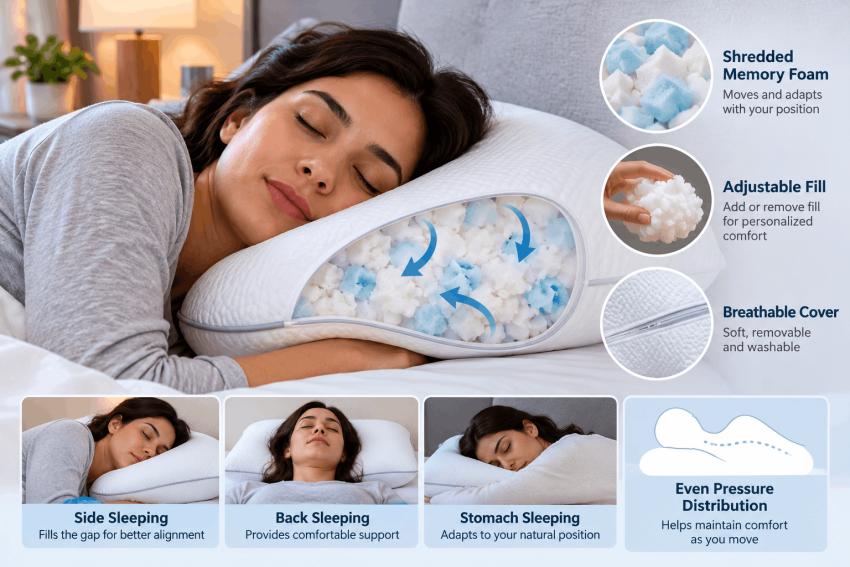
A pillow can feel completely different after several hours of use compared with the first few minutes after you lie down. One reason is the way the filling inside the pillow behaves as pressure is applied and your head changes position during the night.
Two pillows may look almost identical from the outside, yet one may remain relatively stable while another gradually becomes flatter or develops uneven areas. Understanding how pillow fill distribution works can help explain these differences and make it easier to understand why some pillows feel more consistent than others.
What Happens Inside a Pillow?
When you place your head on a pillow, the filling underneath it compresses. The amount of compression depends on the type of material, its structure, and the pressure being applied.
With loose or flexible fillings, some of the material can move away from the area receiving the most pressure. As you change positions, that material may shift again.
This movement is not necessarily a problem. In fact, some sleepers prefer a pillow that can be reshaped during the night. However, others may prefer a more stable surface that maintains its general structure.
The difference comes down to how the filling responds to movement and pressure.
Why Filling Can Shift During Sleep
People rarely remain completely still throughout the night. Even when you fall asleep in one position, you may naturally turn your head, move your shoulders, or change sides.
Each movement changes where pressure is being applied.
If a pillow contains flexible or loose material, the filling may redistribute as you move. One section can become more compressed while another section becomes fuller.
Over several hours, this can change the shape and feel of the pillow. Some sleepers may notice that they need to reposition or fluff their pillow in the morning, while others may prefer a design that requires less adjustment.
Shredded Foam Has a Different Behavior
Shredded memory foam is an interesting example because it consists of multiple pieces rather than one continuous block.
The individual foam pieces can move within the pillow, allowing the filling to respond differently to pressure and movement. Depending on the construction, this can create a more adaptable feel.
For side sleepers, this characteristic can be particularly relevant because the amount of space between the head and mattress can vary depending on shoulder position and body movement. Someone researching the best memory foam pillow for side sleepers may therefore want to understand not just the type of foam used, but also how the filling is arranged inside the pillow.
The overall construction can have as much influence on the experience as the material itself.
Fixed Fill and Adjustable Fill
Not every pillow allows the sleeper to change the distribution of its filling.
A fixed-fill pillow has a predetermined amount of material and generally maintains a specific profile. This can provide a consistent starting point for someone who already knows what type of pillow height they prefer.
An adjustable pillow offers more flexibility. Depending on its design, the sleeper may be able to remove or add some filling to change the overall loft.
This can also influence how the filling is distributed. Instead of accepting the original configuration, the user has some control over how full or compact the pillow feels.
Why Pillow Shape Matters
The shape of a pillow can influence how its filling behaves.
A wide pillow gives the sleeper more surface area to move across, while a contoured design may direct support toward particular areas. Some pillows have gusseted edges that help maintain their overall structure and prevent the filling from spreading too far toward the sides.
The internal construction is therefore worth considering alongside the outside shape.
A pillow that looks simple may have several design elements working together to influence its stability, flexibility, and feel.
Pressure Distribution Can Affect Perceived Comfort
Comfort is not simply about how soft a pillow feels when you touch it. It can also depend on how pressure is distributed when your head rests on the surface.
A pillow that compresses heavily in one small area may feel different from one that spreads pressure across a larger surface.
Memory foam is often used in pillows because it responds to pressure and can conform around the areas making contact. Shredded versions can provide a somewhat different response because the pieces can move independently.
These differences are worth noticing when comparing pillows, especially if you tend to change positions during the night.
Your Sleeping Position Changes the Equation
Sleeping position can influence how a pillow behaves.
A person who sleeps primarily on their back may apply pressure to a different part of the pillow than someone who sleeps mostly on their side. A stomach sleeper may also prefer a different pillow profile.
Side sleepers can place considerable pressure on one section of the pillow because the head rests at an angle relative to the mattress. If the filling moves significantly, the pillow may feel different after repeated position changes.
This does not mean one type of filling is automatically better. It simply shows why pillow construction should match the way you actually sleep.
How to Notice Uneven Filling
If you already own a pillow, you can learn a lot by observing it over time.
Look for areas that remain noticeably flatter than others. Check whether the pillow returns to its general shape after you get up. Notice whether you frequently need to shake, fluff, or reposition it before going to sleep.
These observations can tell you whether the current filling distribution works well with your habits.
You can also pay attention to whether the pillow feels different at the beginning of the night compared with the morning. A noticeable change may indicate that the filling responds significantly to prolonged pressure.
Maintenance Can Help Preserve the Original Feel
Different pillow constructions have different care requirements, so always follow the manufacturer's instructions.
For pillows that can be safely fluffed or repositioned, occasional adjustment may help redistribute the filling. A washable cover can also make routine maintenance easier while protecting the pillow from everyday use.
However, avoid assuming that every pillow should be aggressively shaken, compressed, or washed. The correct maintenance method depends on its specific materials and construction.
Final Thoughts
The way filling moves inside a pillow can have a significant influence on how that pillow feels throughout the night. Pressure, movement, internal construction, pillow shape, and sleeping position can all affect the distribution of material.
Shredded memory foam offers a different experience from a single solid piece of foam because individual pieces can respond to pressure and movement within the pillow. Adjustable designs can provide another level of flexibility by allowing users to modify the amount of filling.
Instead of judging a pillow only by its appearance, consider what happens inside it. Understanding fill distribution can give you a better idea of why a pillow feels stable, flexible, firm, or adaptable—and help you make a more informed decision based on your own sleeping habits.