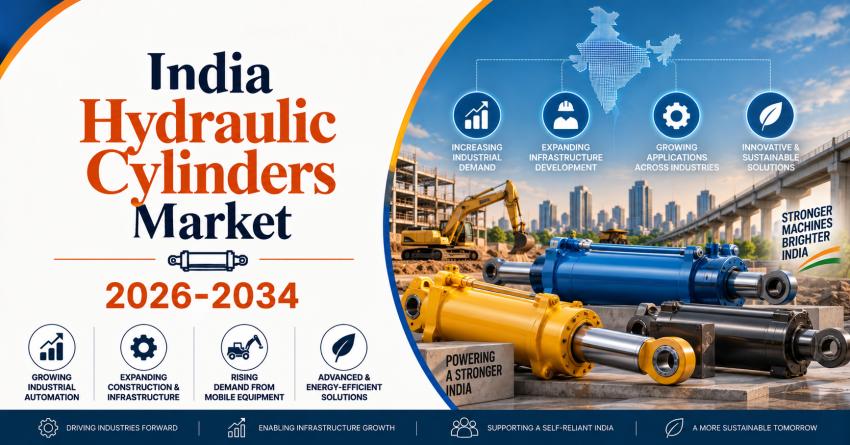
How Is the India Hydraulic Cylinders Market Performing?
The India hydraulic cylinders market is undergoing steady expansion, driven by sustained infrastructure investment, agricultural mechanization, and manufacturing sector growth under the Make in India initiative. Excavators, cranes, tractors, and industrial presses across construction, agriculture, and manufacturing sectors are increasingly deploying hydraulic cylinders as primary actuation components, supporting demand across mobile and industrial applications alike.
Strong government infrastructure programs, including the National Infrastructure Pipeline's INR 111 lakh crore commitment to roads, urban infrastructure, and railways, alongside record tractor sales and PLI-linked manufacturing capacity expansion, are reshaping India's hydraulic cylinder demand landscape.The India hydraulic cylinders market size grew from USD 486.8 Million in 2025 to USD 507.4 Million in 2026 and is projected to reach USD 657.5 Million by 2034, exhibiting a CAGR of 3.29% during 2026-2034.
Growth is being driven by sustained highway and railway construction activity, agricultural mechanization supported by PM-KISAN income support, and Production Linked Incentive-backed manufacturing expansion across electronics, pharmaceutical, and food processing sectors. As India's infrastructure and manufacturing base continues to deepen, the hydraulic cylinders market in India is positioned as a foundational, dependable segment of the country's industrial machinery ecosystem.
Market Snapshot
- Market Size (2025): USD 486.8 Million
- Market Size (2026): USD 507.4 Million
- Forecast Value (2034): USD 657.5 Million
- CAGR (2026-2034): 3.29%
- Leading Segment by Bore Size: 50-150 MM (48.6% share)
- Leading Segment by Application: Mobile (67.9% share)
- Leading Region: West India (33.7% share)
What Growth Factors Are Driving the India Hydraulic Cylinders Market?
- National Infrastructure Pipeline and Construction Equipment Demand:
The National Infrastructure Pipeline, with a projected investment of INR 111 lakh crore (USD 1.5 trillion) for the 2020–2025 period across energy, roads, urban infrastructure, and railways, creates the most sustained multi-year construction equipment demand pipeline in India's history. Each kilometer of highway construction consumes 8-12 excavators operating for 100-150 work days, each excavator incorporating 8-12 hydraulic cylinders requiring replacement at 3,000-5,000 hour intervals, creating recurring replacement cylinder demand that compounds with new equipment cylinder content from fleet expansion.
- Agricultural Mechanization and Tractor Hydraulic Demand:
ndia's agricultural sector is in structural transition toward mechanized operations driven by rural labor shortages, PM-KISAN direct income support of INR 6,000 per year to farmers, and crop insurance incentivizing investment in quality inputs. India's tractor market, the world's largest by volume, is the primary single application driving hydraulic cylinder demand, with each tractor incorporating 4-8 hydraulic cylinders spanning three-point linkage draft control, power steering, front loader, and backhoe attachment cylinders. This sustained equipment deployment is strengthening India hydraulic cylinders market demand across agricultural and allied applications.
- Make in India Industrial Capex and Manufacturing Sector Expansion:
India's manufacturing sector expansion under Production Linked Incentive schemes across 14 sectors is creating industrial press, injection molding machine, and material handling equipment capacity addition that drives industrial hydraulic cylinder demand. PLI-linked electronics manufacturing, pharmaceutical packaging lines, food processing presses, and automotive components expansion all require hydraulic cylinder-equipped machinery.
- Localization of Heavy-Duty and Large-Bore Cylinder Manufacturing:
Indian manufacturers are increasingly focusing on domestic production of large-bore and heavy-duty hydraulic cylinders previously dependent on imports. In August 2024, Wipro Hydraulics inaugurated a state-of-the-art hydraulic cylinder manufacturing facility in Mahindra World City, Jaipur, its first hydraulics unit in Northern India, designed to supply both domestic and international markets.
- Rising Demand for Customized and Smart Hydraulic Cylinders:
OEMs increasingly require hydraulic cylinders tailored to specific pressure, stroke, mounting, load, and environmental requirements across construction machinery, agricultural equipment, and industrial automation. Manufacturers are strengthening engineering and design capabilities to address application-specific requirements, supporting differentiation among domestic suppliers.
What Are the Latest Emerging Trends in the India Hydraulic Cylinders Market?
- Growing Adoption of Smart Hydraulic Cylinders:
Hydraulic cylinders are increasingly being integrated with position sensors, pressure sensors, and electronic control systems, enabling real-time performance monitoring, accurate positioning, and predictive maintenance across automated manufacturing and heavy machinery. Industry 4.0 adoption is expected to further accelerate this trend across India's industrial base.
- Shift Toward Electro-Hydraulic Systems:
Electro-hydraulic technology is gaining traction by combining the high-force capability of hydraulics with electronic precision and control, improving responsiveness, energy management, and automation compatibility across material handling, industrial machinery, and mobile equipment applications.
- Localization of Heavy-Duty and Large-Bore Cylinders:
Domestic manufacturers are increasingly focusing on large-bore and heavy-duty hydraulic cylinders previously dependent on imports, with new manufacturing facilities shortening delivery times and improving customization and aftermarket support under Make in India initiatives.
- Precision Honing and Machining Technology Advancement:
Advanced CNC machining, honing, grinding, and finishing technologies are enabling manufacturers to achieve tight dimensional tolerances, improving sealing performance and supporting smooth cylinder movement in high-pressure and customized applications.
- Electro-Hydraulic Smart Cylinder Retrofit Market Emergence:
The modernization of existing industrial equipment is creating opportunities to retrofit conventional hydraulic cylinders with sensors and electronic controls, enabling real-time position monitoring and predictive maintenance without complete equipment replacement, supported by growing Industry 4.0 adoption.
What Opportunities Lie Ahead for the India Hydraulic Cylinders Market in the Coming Years?
The India hydraulic cylinders market is positioned for steady, dependable expansion through 2034, supported by three compounding structural growth mechanisms spanning infrastructure, agriculture, and manufacturing that provide demand stability across economic cycles. Unlike many industrial equipment categories facing rapid electrification, hydraulic cylinders retain enduring commercial advantage in high-force, high-duty-cycle applications where electric linear actuators cannot economically match the power density and cost-per-Newton of hydraulic actuation.
Companies and investors positioning themselves across large-bore import substitution manufacturing, electro-hydraulic smart cylinder retrofit solutions, and hydraulic cylinder remanufacturing services are well-placed to capture above-market returns as India's National Infrastructure Pipeline, agricultural modernization trajectory, and PLI-driven manufacturing capacity expansion continue to sustain long-term structural demand growth.
How Is the India Hydraulic Cylinders Market Segmented?
By Bore Size:
- 50-150 MM (leading at 48.6% share in 2025)
- <50 MM
150 MM
The 50-150 MM bore size segment dominates as India's most commercially significant hydraulic cylinder category, spanning the actuation force range required by the largest-volume applications including tractor three-point linkage cylinders, compact and medium excavator boom and arm cylinders, and mid-capacity industrial press cylinders.
<50 MM bore cylinders serve light-duty agricultural implements and compact material handling, while >150 MM bore cylinders are growing at approximately 3.60% CAGR, driven by mining, steel, and heavy infrastructure hydraulic systems requiring large-bore import substitution capacity.
By Application:
- Mobile (leading at 67.9% share in 2025)
- Industrial
Mobile hydraulic cylinders, installed on self-propelled or towed equipment operating across varied terrain, command the market majority through combined demand from India's construction equipment fleet, agricultural tractor and implement fleet, and commercial vehicle tipping and crane applications.
Industrial applications, growing at approximately 3.80% CAGR, represent the fastest-growing segment through manufacturing expansion, material handling automation, and processing industry cylinder investment under Make in India capacity additions.
By Region:
- West India (leading at 33.7% share in 2025)
- South India
- North India
- East India
West India leads the market, supported by strong automotive, engineering, construction equipment, and industrial machinery manufacturing across Maharashtra and Gujarat, including Maharashtra's automotive and tractor manufacturing base and Gujarat's Rajkot-Ahmedabad hydraulic component manufacturing cluster.
South India accounts for 28.6%, driven by automotive, agricultural machinery, aerospace, and heavy engineering clusters. North India holds 24.2%, supported by expanding construction equipment and general manufacturing activities, while East India represents 13.5%, concentrated in mining, steel, and heavy industrial operations.
Competitive Landscape
The India hydraulic cylinders market is moderately fragmented, with domestic and multinational manufacturers competing on product quality, customization, durability, pricing, and after-sales support.
Companies including Robert Bosch GmbH (through Bosch Rexroth), Parker Hannifin Corp, Wipro (through Wipro Hydraulics), and Veljan Hydrair Limited are increasingly investing in smart cylinders, electro-hydraulic systems, advanced sealing technologies, and localized manufacturing to strengthen their market positions, reflecting a market in productive tension between global technology leaders and a strong domestic MSME manufacturing base.
Investment & Growth Opportunities
- Large-bore import substitution manufacturing for mining, steel, and heavy infrastructure applications, reducing dependence on imported systems
- Electro-hydraulic smart cylinder retrofit kits enabling existing industrial equipment to incorporate sensors and condition-monitoring technologies
- Hydraulic cylinder remanufacturing and MRO services addressing India's aging construction equipment fleet
- Defense hydraulic cylinder manufacturing supporting domestic self-reliance objectives
- Bio-hydraulic fluid compatible seal and cylinder development aligned with sustainability requirements
- Agricultural precision hydraulics for GPS-guided tractors and farm automation equipment
India Hydraulic Cylinders Market Recent Developments & News
- 2020–2025: The National Infrastructure Pipeline advanced its INR 111 lakh crore investment commitment across roads, urban infrastructure, and railways, sustaining multi-year construction equipment and hydraulic cylinder replacement demand.
- Ongoing: Government PLI schemes across 14 manufacturing sectors, including electronics, pharmaceuticals, food processing, and automotive components, continued driving industrial press and material handling cylinder demand as new factory capacity comes online.
- Ongoing: Domestic manufacturers continued expanding large-bore and heavy-duty hydraulic cylinder production capacity to substitute imports previously sourced for mining, steel, and heavy infrastructure applications.
Source: IMARC Group