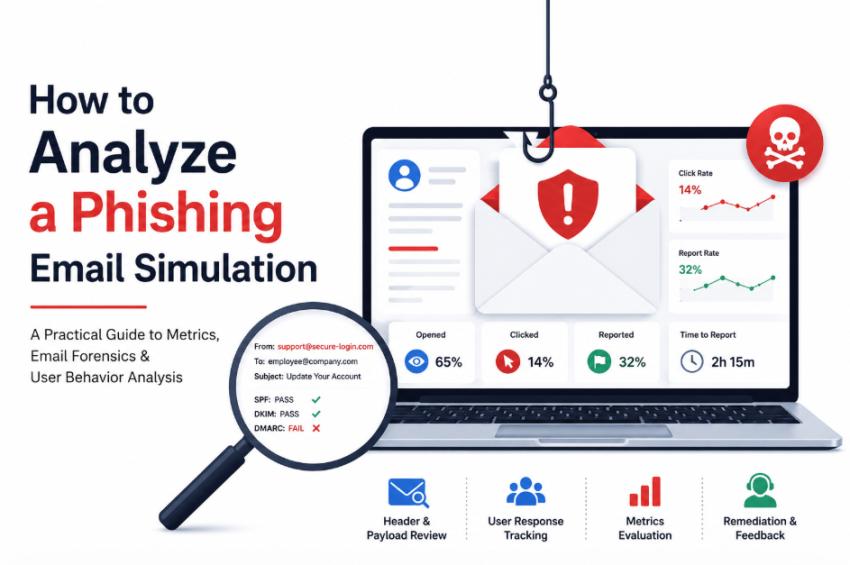
Phishing simulations are widely used to test how employees react when they receive suspicious emails. However, simply sending a simulated phishing message and checking how many users clicked the link does not provide a complete picture of an organization's security readiness.
A meaningful phishing assessment should examine user behavior, technical email evidence, reporting speed, and the reasons certain elements of the message successfully convinced recipients to interact with it. This approach helps security teams identify weaknesses that might otherwise remain hidden behind a simple click-rate percentage.
Look Beyond the Click Rate
Click rate is an important starting point, but it should never be treated as the final result of a phishing exercise.
Security teams should evaluate several indicators together, including:
Percentage of recipients who opened or clicked the suspicious link
Number of users who submitted credentials
Number of employees who reported the message
Time taken by users to report the suspicious email
Departments or groups with higher interaction rates
For example, an organization might achieve a relatively low click rate but discover that most employees who clicked also entered information into the simulated login page. Such behavior represents a considerably greater security concern than the click rate alone suggests.
Examine the Technical Evidence Inside the Email
The next stage involves examining the actual email rather than concentrating only on employee actions.
Email headers contain valuable information about how a message was transmitted. Analysts can inspect routing information, sender details, timestamps, originating infrastructure, and authentication results.
SPF, DKIM, and DMARC information should also be reviewed. These authentication mechanisms can provide useful clues about whether a similar real-world phishing attempt might successfully bypass existing email security controls.
The embedded URLs should also be investigated. Analysts need to understand where a link redirects users, whether multiple redirects are involved, and how closely the destination resembles a legitimate website.
Attachments deserve similar attention. Their file type, metadata, associated URLs, and other characteristics can reveal how convincing or potentially dangerous the simulated attack would have been.
Understand How Employees Respond
Phishing simulation results become considerably more useful when analyzed according to user groups rather than as organization-wide percentages.
Security teams can compare departments, job functions, devices, and response times.
Finance, HR, IT administrators, and senior executives may face different phishing techniques because attackers often customize campaigns according to the information or privileges available to their targets.
Device usage is another useful factor. Employees reading emails on smartphones may have less visibility into complete sender addresses and URLs, potentially making suspicious messages harder to identify.
Most importantly, compare the time to click against the time to report.
If employees interact with suspicious content within seconds while security teams receive the first report much later, the organization may have a significant detection gap.
Use Email Forensics for Deeper Investigation
Analyzing a small number of messages manually may be manageable. The process becomes considerably more complicated when investigators need to examine hundreds or thousands of emails.
Raw headers, MIME information, URLs, message properties, timestamps, and communication patterns can quickly create a large amount of evidence.
Using professional Email Forensics Software can help investigators search and analyze email evidence from a centralized environment. Capabilities such as header analysis, link analysis, timeline examination, advanced searching, and communication analysis can make it easier to identify patterns across a large collection of messages.
This is particularly useful when phishing simulation findings need to be investigated alongside actual suspicious emails or preserved as part of a broader forensic investigation.
Turn Simulation Findings Into Better Training
The final objective should be improvement rather than simply identifying employees who failed a test.
If users clicked because the sender's display name appeared legitimate, explain how to verify the complete sender address. If urgency influenced their decision, show examples of language attackers commonly use to pressure recipients.
Similarly, employees who successfully identify and report suspicious messages should understand which indicators helped them recognize the threat.
Providing feedback shortly after a simulation also gives employees an opportunity to connect the training directly with the email they encountered.
Conclusion
A phishing simulation provides meaningful security intelligence only when organizations investigate what happened after the message was delivered.
Click rates provide one part of the story. Technical email evidence, authentication information, URLs, employee behavior, reporting times, and departmental patterns provide the rest.
By combining these findings with targeted employee training and deeper forensic examination, organizations can transform phishing simulations from routine awareness exercises into practical tools for identifying and reducing email-related security risks.