Artificial intelligence is no longer a pilot project kept in the innovation labs. For enterprises and growth stage startups, it is at the core of product strategy, operational efficiency and competitive positioning.
When leadership teams are evaluating AI Development Services, the first question that comes up is, should we invest? It is how much to invest and what drives that cost in scale.
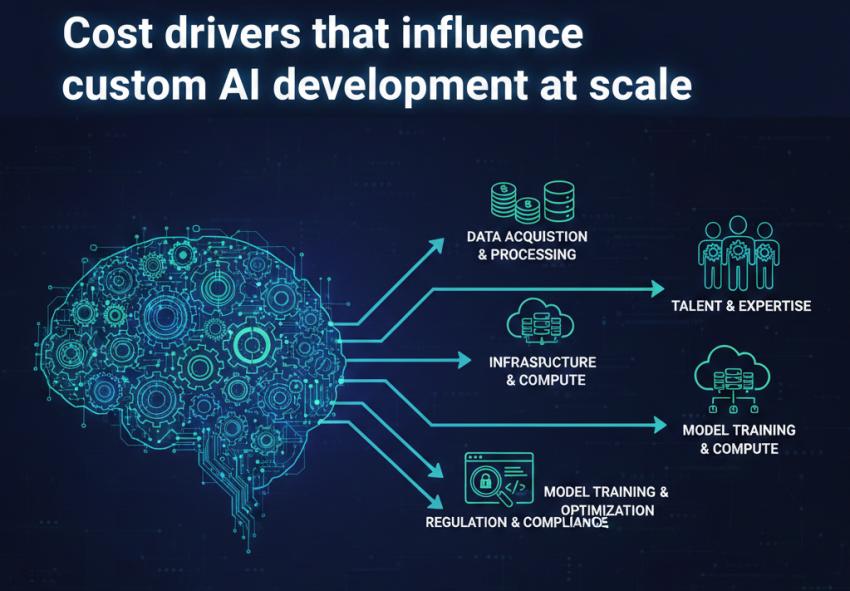
Custom AI systems are quite unlike off-the-shelf tools. They need strategic alignment, domain knowledge, powerful data engineering, and operational planning for the long term. Understanding the true cost drivers helps decision-makers ensure that they have a realistic budget and that they are not underestimating the total investment.
Below is a good breakdown of the big factors behind large-scale AI efforts.
1. Problem Complexity and Scope Definition
The nature of the business problem plays the most significant role in cost.
A narrow use case such as automating document classification is quite different from developing a multi-model predictive analytics engine that is embedded into enterprise workflows.
Costs increase when:
- The problem is cross-departmental
- Real-time decisioning is necessary
- AI needs to be integrated into applications for customers
- Regulatory constraints are in effect
For example, AI in healthcare diagnostics or risk scoring in fintech needs advanced validation, explainability frameworks and compliance layers. According to industry reports from McKinsey and Gartner, AI programs that have a cross-functional impact can incur two to three times greater costs than isolated departmental implementations, incurred as a result of governance overhead and integration.
An experienced AI Development Company will spend a fair amount of time in discovery and solution architecture before development starts. That up-front effort safeguards the integrity of the budget later.
2. Data Availability, Quality, and Preparation
The performance of AI is dependent on data. However, most enterprises underestimate the cost of preparing it.
Data-related costs are typically between 30 to 50 percent of the overall AI project costs, according to research published by leading analytics firms.
Key cost contributors include:
- Data gathering from multiple systems
- Cleaning and normalization
- Annotation and labeling
- Altering missing or inconsistent records
- Building secure pipelines
If your organization does not have structured and accessible datasets, this will raise the investment needed for data engineering to a large amount.
Custom AI Development Services often incorporate dedicated data engineering teams. Without that layer, models can be technically working and yet in production fail.
For global enterprises that operate across regions, data localization laws also add to the complexity. Secure storage, encryption standards and access control frameworks add to infrastructure costs.
3. Model Selection and Technical Architecture
Choosing the right architecture for AI model is a strategic decision in terms of finance.
Options include:
- Traditional machine learning models
- Deep learning architectures
- Large language models
- Hybrid model stacks
Pre-trained foundation models save on training costs but bring in licensing costs and customization. Training proprietary models from scratch needs GPU-intensive compute resources and extended timelines.
At scale, designing infrastructure is important. Distributed computing, cloud optimization, and containerized deployments have an impact on long-term operating expenditure.
Organizations investing in Full-Stack AI Development have integrated expertise in model engineering, backend systems, APIs, and user interfaces. While this approach may seem more expensive at first, it saves on fragmentation and costly rework in the long run.
4. Infrastructure and Compute Requirements
AI workloads require a lot of computational power.
Cloud providers such as AWS, Microsoft Azure, and Google Cloud have their own AI infrastructure for scalability. However, GPU instances, storage systems and high availability clusters have high recurring costs.
Enterprises must evaluate:
- Compute requirements for training
- Expectations of inference latency
- Peak usage forecasting
- Redundancy & disaster recovery
Real-time AI systems, like fraud detection systems or AI-powered recommendation systems, need low-latency inference. That often means increased investment in infrastructure.
Hybrid deployment models of a combination of on-premise and cloud environments add complexity but may be required by regulated industries.
An experienced AI Development Company will design an architecture that is balanced between performance and cost efficiency instead of defaulting on maximum compute capacity.
5. Integration with Existing Systems
AI does not work in isolation. It needs to integrate into ERP platforms, CRMs, Data Warehouses, Customer Portals, and Mobile Applications.
Integration costs increase when:
- Legacy systems lack APIs
- Data Formats are different for different platforms
- Enterprise grade security protocols are required
- Global user bases need to be localized
For decision-makers, integration complexity often makes the difference between proof of concept and a production-ready solution.
Custom AI Development Services usually involve API engineering, middleware development and security configuration. Ignoring this layer causes hidden costs to emerge during the late implementation cycle.
6. Talent and Team Composition
The skillset needed for scalable AI projects is multidisciplinary.
A serious AI initiative involves:
- AI researchers
- Machine learning engineers
- Data engineers
- DevOps specialists
- Security experts
- Product managers
Hiring and retaining this talent internally can cost enterprises that operate in competitive markets more than seven figures per year.
The involvement of a specialized AI Development Company will help you turn fixed talent expenses into a structured investment on a project. The financial model becomes more predictable.
For startups that have venture funding, outsourcing some of their development can be a way to speed time to market without compromising capital efficiency.
7. Governance, Compliance, and Risk Management
Global enterprises are under a strict regulatory environment.
AI systems that process personal data must comply with GDPR, HIPAA, or SOC 2, or region-specific regulations. Compliance frameworks add development as well as legal costs.
Explainability and auditability add to the complexity, as well. Black-box models may not be OK in regulated sectors.
Governance investment includes:
- Bias testing
- Model validation
- Logging and Monitoring Systems
- Risk documentation
These measures are not an option for serious enterprises. They are foundational to long-term sustainability.
External regulatory research also continues to point out that compliance costs for AI can range from 10 to 20 percent of total project budgets in sensitive industries.
8. Ongoing Maintenance and Model Lifecycle Management
AI systems need to be monitored at all times.
Models decay over time as a result of data drift and changing user behavior. Without retraining pipelines performance decreases.
Operational costs include:
- Model retraining
- Performance monitoring
- Security updates
- Infrastructure scaling
- Technical support
This is where long-term ROI has to be calculated correctly. AI is a non-capital outlay. It is an evolving asset.
Organizations that invest in structured AI Development Services generally get MLOps frameworks which automate retraining and monitoring. That cuts down on overhead in the future and stabilizes operational budgets.
9. Time to Market and Strategic Urgency
Speed influences cost.
If leadership requires rapid deployment, teams may:
- Expand the availability of engineering resources
- Increase cloud usage
- Use premium third-party APIs
- Accelerate testing cycles
Aggressive timelines lead to increased short-term expenditures and may be justified by revenue opportunity or competitive pressure.
Well-funded startups are often willing to accept more up-front investment to have a first-mover advantage. Enterprises may trade between speed and the maturity of governance.
Strategic fit is more critical than the raw size of the budget.
Estimating AI Investment at Scale
While the costs of projects vary greatly, enterprise-grade AI work is often in the mid-six figures to multi-million-dollar price range, depending on scope.
Decision-makers should consider the cost from three perspectives:
- Direct expenses for development
- Infrastructure and operation costs
- Strategic business impact
According to benchmarks set by industry analysts from global consulting firms, enterprises that are successful in scaling AI across core processes report returning 20 to 40 percent productivity gains and measurable revenue growth in two to three years.
The real question is not how much AI costs. It is what the cost of inaction looks like in a market where the adoption of AI is soaring.
Making the Investment Work
To manage cost effectively:
- Start with a well-defined business goal
- Invest early in data readiness
- Scalable architecture - choose day one architecture
- Focus on governance and compliance
- Plan for lifecycle management
Partnering with a proven provider of Custom AI Development Services can help to reduce uncertainty and improve financial predictability. A structured engagement model, technical depth and industry knowledge have a huge impact on outcomes.
Final Perspective for Enterprise Leaders
Custom AI development at scale is a strategic investment, not a tactical experiment.
Costs are influenced by complexity, infrastructure, data maturity, compliance requirements and long-term operational planning. Enterprises and ambitious start-ups that think in a disciplined way about AI budgeting and architectural foresight position themselves for sustained competitive advantage.
Well-structured AI Development Services Don't Simple build models. They create scalable digital capabilities in line with measurable business value.
For leadership teams, clarity along lines of cost drivers turns AI from a speculative expenditure to a calculated growth effort.