How to Design a SaaS Product Tour That Drives Engagement
In today's hyper-competitive SaaS landscape, your product has only a few minutes, sometimes seconds to make a strong first impression. If users can't understand the value of your platform instantly, they bounce. And once they're gone, it's almost impossible to bring them back.
This is why a strategically crafted, intelligent product tour is no longer a “nice-to-have” it's a core part of your product strategy and driver of long-term retention.
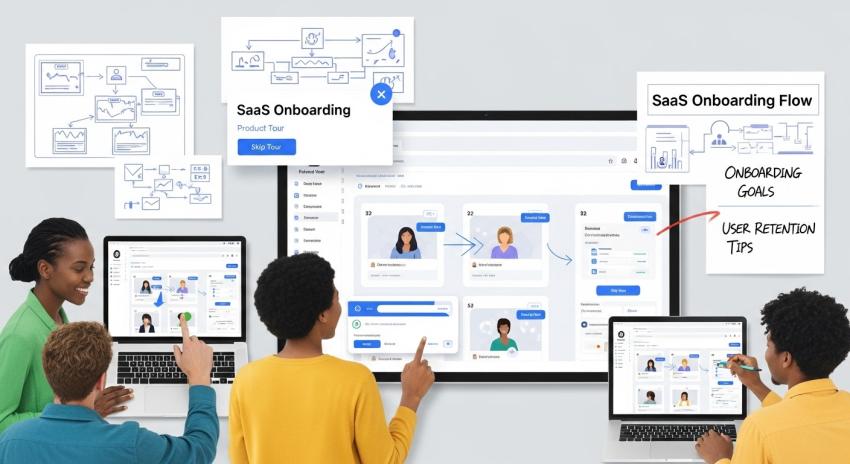
A product tour isn't a walkthrough. It's a value pitch, onboarding engine, and early relationship builder all together. When done right, a product tour helps users:
Understand what the product really does
See the value within the first minutes.
Confidently navigate key features
Take meaningful action without friction
Unfortunately, a lot of SaaS teams still get this wrong. They overwhelm new users with too much information, build extremely generic flows, or treat product tours like a UI tour never as a strategic conversion lever.
In this blog, we'll break down actionable modern strategies to build SaaS product tours that engage, educate, and convert backed by trends shaping the strongest SaaS companies in 2025.
1. Make Your Product Tour User-Specific Right from the Beginning
The era of one-size-fits-all onboarding is gone. In 2025, high-performing SaaS companies personalize onboarding from the very first click. Why? Because users expect tools to adapt to them not the other way around.
It starts with smart segmentation.
Ask a few quick questions at the outset:
What do you do?
What's most important to you today?
What kind of business are you creating or running?
These inputs allow you to generate a personalized tour that aligns with the intent of the user.
What really makes a personalized tour truly effective?
Conditional Logic
Show different features based on the role or goal. A marketer wants to automate campaigns; a founder wants to see high-level analytics. They shouldn’t see the same flow.
Progressive Disclosure
Reveal features only as users demonstrate interest in them. This keeps the experience clean and reduces cognitive load.
Pre-filled templates & demo data
Give the user a head start by auto-populating sample workflows or dashboards relevant to their context.
Micro Surveys & Adaptive Feedback
Short, contextual check-ins allow you to make real-time adjustments to the tour and understand where users struggle.
The result? Users feel understood and guided, not overwhelmed. Personalization has become one of the strongest predictors of product activation and long-term adoption.
2. Turn Product Demos into Evergreen Lead Magnets
While most SaaS companies are still using live demos and hiding product tours inside their help centers, modern buyers like self-serve product education and want to see value before committing.
Enter evergreen interactive demos: always-on, clickable, self-guided tours which emulate your real UI.
These demos are powerful because:
They reduce friction: This means users can try workflows without creating an account.
They organically qualify leads; those who engage deeply tend to convert.
They scale infinitely: One great demo can serve thousands a month.
They reduce the sales cycle: A well-informed prospect requires less hand-holding.
To maximize impact, design your demo for simplicity, curiosity, and outcome-driven storytelling. Quickly show the "aha moment"; leave small breadcrumbs that guide users toward creating an account.
Close the experience with a soft CTA such as “Want to try this for your team?”a nudge that converts without pressure.
3. SEO-Optimized Comparison Pages to Capture High-Intent Traffic
Building comparison pages is one of the most underrated SaaS growth tactics today.
These are pure buying signals: searches like "X alternative", "Y vs Z", or "Best alternatives to X". The user knows what they want just a little reassurance that they are making the best choice.
A high-performing comparison page includes:
A clean, side-by-side comparison table
Real-world feature differences
Transparent pricing sections
Use-case-based recommendations
Customer Testimonials, Reviews, and Logos
Variations with multiple keywords: "X vs Your Brand," "Top X alternatives"
These pages don't need aggressive sales language. Use clarity, honesty, and real-world value instead. Done right, comparison pages outperform ads, generic blogs, and onboarding funnels, especially in those decision moments at the very bottom of the funnel.
4. Create Niche Landing Pages to Match Your ICP
Most SaaS websites still treat all visitors the same. In reality, each will have completely different motivations: a founder, an enterprise CTO, a digital agency.
That's why, in 2025, top companies will build ICP-specific landing pages.
Here's how to do it effectively:
Identify the 2-4 highest-value personas.
Build landing pages specific to each persona's industry, issues, nomenclature, and workflows.
Add case studies reflecting their world.
Direct each segment to their personalized page by utilizing UTM-based campaigns and PPC ads.
Continuously A/B test the messaging and page layout per segment.
It means that these types of pages which talk directly to the user's objectives, pain points, and language convert 2-3x better than generic homepages.
5. Leverage Interactive Demos with AI-Powered Engagement
Static tours are no longer good enough to drive quality signups; buyers today need dynamic product experiences that feel almost human.
This is where AI-powered interactive demos such as those by DemoDazzle excel.
AI-powered demos can:
Guide users feature-by-feature
React to their clicks and hesitations
Answer questions based on real-time prompts
Dynamic content personalization
Provide in-app "mini onboarding" experiences
These include:
Higher demo-to-signup conversions
Shorter sales cycles
Stronger early user confidence
More qualified, self-educated leads
Among lean SaaS teams especially, AI-powered demos offer the fastest way to create sophisticated product experiences without dependence on engineering.
6. Utilize Behavioral Triggers for Real-Time Personalization
Modern users want intuitive and timely experiences. Behavioral triggers deliver that: acting upon user actions in real time. Examples include:
A discount popup after one has stayed on the pricing page for 30 seconds.
A helpful chatbot when users click repeatedly on a confusing feature.
A reminder email sent 15 minutes after an abandoned signup.
AI-powered segmentation enables you to personalize by scroll depth, session duration, feature interaction, or even intent signals. Such contextual nudges reduce friction and dramatically boost conversions.
Conclusion
SaaS marketing in 2025 is not about doing more; it's about doing smarter. Whether you're personalizing product tours, launching evergreen demos, building ICP landing pages, or integrating AI-powered onboarding, the winning strategies share one thing in common:
They are user-centered and data-informed, engineered for conversion.
What modern SaaS buyers want is value upfront, not after commitment. Your job is to remove friction, personalize their journey, and guide them toward clarity not confusion.
Small optimizations like better segmentation, an evergreen demo, and a contextual CTA can unlock massive improvements in both activation and retention.
If you design your product tour with intention, intelligence, and empathy, you won't just onboard users. You'll convert them, educate them, and keep them coming back for more.
Read the full blog - How to Design a SaaS Product Tour That Drives Engagement