

Market at a Glance
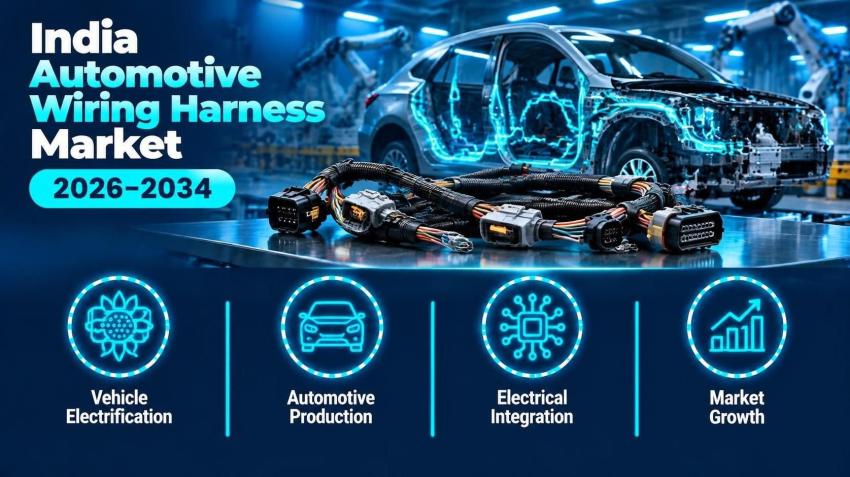
The India automotive wiring harness market trends indicate continued growth, with the market size reaching USD 1.8 billion in 2025 and expected to reach USD 2.4 billion by 2034, exhibiting a compound annual growth rate (CAGR) of 3.55% during 2026–2034.
- Market Size (2025): USD 1.8 Billion
- Forecast Market Size (2034): USD 2.4 Billion
- CAGR (2026–2034): 3.55%
- Leading Application: Chassis Wiring Harness
- Leading Material Type: Copper
- Leading Vehicle Type: Passenger Cars
- Leading Region: South India
Why Is the India Automotive Wiring Harness Market Growing?
- Automotive Industry Expansion and Vehicle Production
Significant growth in India's automotive industry is creating a positive outlook for the wiring harness market. Rising vehicle production across two-wheelers, passenger cars and commercial vehicles is driving baseline demand for organised wire bundles and connectors.
- Electric Vehicle Adoption and High-Voltage Harnesses
The rising adoption of electric vehicles is creating demand for high-voltage wiring harnesses, aluminium conductors and advanced insulation materials. EV safety standards, including AIS-123 for electric vehicle safety, are driving demand for robust, thermal-resistant wiring systems.
- Safety Regulations and ADAS Integration
Increasing road accidents and government focus on automotive safety are driving demand for wiring harnesses that secure safety sensors, automated control systems and blind-spot detection. Functional safety standards are becoming mandatory for harnesses used in ADAS applications.
- Lightweighting and Material Innovation
Manufacturers are focusing on aluminium harnesses and superior grades of conductors, insulators and sheaths to reduce vehicle weight and improve fuel efficiency. These innovations are particularly relevant for EV platforms where weight optimisation directly extends range.
What Are the Key Trends Shaping the India Automotive Wiring Harness Market?
- Aluminium harness adoption: Aluminium conductors are gaining traction as a lightweight alternative to copper, particularly in EV power distribution systems.
- High-temperature and shielded wires: Demand for heat-resistant and shielded wiring is rising as engine bays become hotter and electronic content increases.
- Localisation of connector manufacturing: Domestic manufacturers are expanding production of connectors and terminals to reduce import dependence and improve supply chain resilience.
Evaluate Market Opportunity with the Business Sample Report
Government Support Driving Market Expansion
The Ministry of Road Transport and Highways administers the Automotive Industry Standards framework, which incorporates safety and performance requirements for wiring harnesses. The Bureau of Indian Standards has published IS 7471:2025 for polarity of earth connections and marking of electrical equipment for automobiles, while EV safety standards IS 18590:2024 and IS 18606:2024 provide a regulatory framework for high-voltage harnesses. These standards are driving demand for compliant, high-quality wiring systems.
Segment Insights
Application:
- Body Wiring Harness
- Engine Wiring Harness
- Chassis Wiring Harness
- HVAC Wiring Harness
- Sensors Wiring Harness
- Others
Material Type:
- Copper
- Aluminum
- Others
Transmission Type:
- Data Transmission
- Electrical Wiring
Vehicle Type:
- Two Wheelers
- Passenger Cars
- Commercial Vehicles
Category:
- General Wires
- Heat Resistant Wires
- Shielded Wires
- Tubed Wires
Component:
- Connectors
- Wires
- Terminals
- Others
Regional Insights
- North India
- West and Central India
- South India
- East India
Competitive Landscape
The market features domestic and multinational wiring harness manufacturers including Motherson Sumi Wiring India, LEONI India, Spark Minda and Dhoot Transmission. Competition is intensifying around EV-specific high-voltage harness capabilities, localisation of connector production and supply chain reliability.
Key Opportunities for Businesses and Investors
- EV high-voltage harnesses: Battery electric vehicle platforms require specialised high-voltage wiring, creating a premium growth segment.
- Aluminium conductor manufacturing: Domestic production of aluminium harnesses can reduce costs and support lightweighting trends.
- ADAS sensor wiring: Increasing ADAS adoption in mid-segment vehicles is driving demand for high-density, shielded wiring harnesses.
Frequently Asked Questions
- What are the India automotive wiring harness market trends?
The market is valued at USD 1.8 Billion in 2025 and is projected to reach USD 2.4 Billion by 2034, driven by EV adoption, safety regulations and lightweighting trends.
- What is the projected growth rate?
The market is expected to grow at a CAGR of 3.55% during 2026–2034.
- Which application segment leads?
Chassis wiring harness accounts for the largest market share.
- What are the major challenges?
Raw material price volatility, supply chain disruptions and the need for continuous innovation in high-voltage harness design are key challenges.
Outlook
India's automotive wiring harness market is positioned for steady growth through 2034, supported by vehicle production expansion, EV adoption and safety regulation tightening. Companies that invest in high-voltage harness capabilities, aluminium conductor manufacturing and localised connector production are well placed to capture a growing share of this evolving opportunity.
Source: IMARC Group