

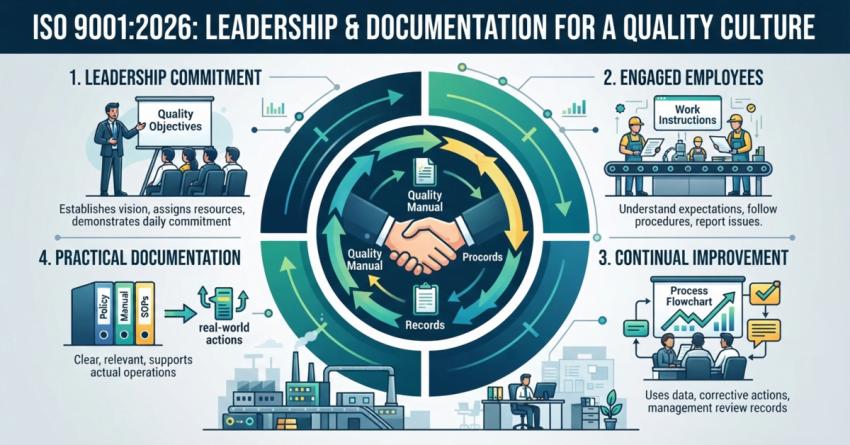
A quality culture begins with leadership, not paperwork. When employees understand quality expectations and managers demonstrate commitment through daily decisions, quality becomes part of how an organization operates. ISO 9001:2026 documentation requirements help communicate responsibilities, control processes, and support continual improvement.
For organizations implementing or updating a Quality Management System (QMS), documentation should support real activities, not just audit preparation.
How Leadership Builds a Quality Culture
Leadership establishes quality objectives, assigns responsibilities, and ensures employees have the resources to perform effectively.
A quality culture develops when commitments appear in everyday practices. For example, a manufacturing manager who reviews customer complaints, investigates recurring defects, and supports corrective actions demonstrates that quality is a shared responsibility.
The ISO 9001:2026 leadership requirements should be considered alongside organizational processes and employee involvement. Documentation can translate management commitments into clear expectations, but leaders must ensure those expectations are followed.
What Documentation Supports Quality Culture and Leadership?
ISO 9001:2026 documentation requirements should reflect the organization's processes, risks, and applicable standard requirements. Useful documented information may include:
· Quality policy: Communicates quality commitments and guides quality objectives.
· Quality objectives: Establish measurable targets for expected performance.
· Quality manual: Describes the QMS scope, structure, and process interactions.
· Procedures and work instructions: Explain controls and help employees perform tasks consistently.
· Management review records: Capture leadership's evaluation of QMS performance, improvement opportunities, and required actions.
· Training and competence records: Help demonstrate that employees have the knowledge and skills needed for their responsibilities.
Documents should reflect actual operations. A procedure employees cannot follow or an objective nobody monitors provides limited value. Keep information proportionate to organizational size, complexity, and process needs.
How to Develop Practical ISO 9001:2026 Documents
Start by reviewing existing processes and identifying where responsibilities, instructions, or records are unclear. Discuss these gaps with process owners and employees who perform the work.
Next, establish a practical documentation structure. Define who prepares, reviews, approves, and updates each document. Ensure that employees can access the current versions and that completed records are retained as required.
A well-prepared ISO 9001:2026 quality manual can help explain the QMS structure, while procedures and supporting forms provide more detailed guidance. The goal is to make documentation useful for employees and management, not to create unnecessary paperwork.
Organizations developing their QMS can explore ISO 9001:2026 documents to support their documentation needs. A documentation package can include editable Microsoft Word templates for the Quality Manual, procedures, SOPs, work instructions, forms, flowcharts, and audit checklists. A compliance matrix and sample management review documents can help organize QMS documentation. Customize resources to actual processes.
Using Documentation to Support Continual Improvement
Documentation should help management understand whether the QMS is achieving its intended results. Internal audit findings, customer feedback, process performance, and corrective action records can reveal recurring problems and opportunities for improvement.
Management review provides an opportunity to evaluate this information and decide what needs to change. Recording decisions, responsibilities, and follow-up actions helps ensure that improvement activities are not overlooked.
Quality culture also depends on employee participation. When workers can report issues without hesitation and see that management responds constructively, they are more likely to contribute to better processes and customer satisfaction.
Conclusion
ISO 9001:2026 documentation requirements are most effective when they support leadership commitment, employee engagement, and consistent processes. A practical QMS connects the quality policy and objectives with everyday activities, management review, and continual improvement.
Organizations can strengthen their quality culture by keeping documentation clear, relevant, and aligned with actual operations. Well-structured documentation provides a useful foundation, while committed leadership turns that foundation into lasting quality performance.