
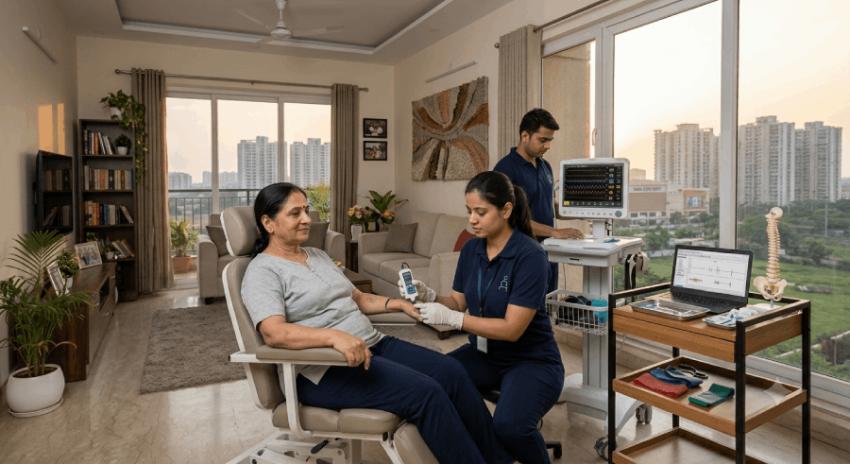
Many people put up with back pain, a stiff neck or sore knees for months because getting to a clinic takes more effort than the pain seems to justify. Physiotherapy at home in Greater Noida removes that effort. This article covers four treatments that can be done at home, namely cupping therapy, dry needling, chiropractic care and arthritis rehabilitation, and explains who usually benefits from each.
Cupping Therapy at Home for Muscle Tightness
In cupping therapy, suction cups are placed on the skin over a tight area of muscle. Both wet and dry cupping are used, and the therapist chooses between them after examining the patient. Most enquiries are about cupping therapy for back pain and cupping therapy for muscle pain, mainly in the neck and shoulders.
A software professional who sits for ten hours a day is a typical case. So is a runner whose calves stay sore after every long session. Both usually find it hard to keep a fixed appointment time, and cupping therapy at home solves part of that, since no travelling is involved.
People report cupping therapy benefits such as less muscle tightness and easier movement. Results differ from person to person, so the therapist should explain what to expect before starting.
Dry Needling for Trigger Points
A trigger point is a small, tight knot in a muscle. It can hurt where it sits and also send pain to other areas. Dry needling uses fine needles to treat these points directly. Patients usually seek it for dry needling for muscle pain, dry needling for trigger points, dry needling for neck pain and dry needling for back pain. Some also try dry needling for sciatica when spasm in the surrounding muscles adds to the problem.
A footballer with a recurring calf knot is a good example, as is a patient several weeks out from surgery whose thigh muscles remain tight. In both cases, stretching alone may not release the muscle.
During dry needling at home, the therapist examines the muscle, treats the trigger points and then gives exercises to follow between sessions. The exercises matter, because the muscle is likely to tighten again without them.
Chiropractor at Home for Spine and Neck Pain
Sitting at a desk all day and commuting long distances put steady strain on the spine. Adults between 30 and 55 commonly ask about chiropractic adjustment for back pain, chiropractic treatment for spine stiffness, a chiropractor for neck pain and spinal manipulation therapy. Those with a slip disc often ask about chiropractic care for slip disc.
The question of chiropractor vs physiotherapist comes up often. A chiropractor mainly adjusts the spine and joints by hand. A physiotherapist builds a longer recovery plan with exercise, movement training and regular checks on progress. Many patients end up needing both. Manual adjustment is not safe for every condition, so the patient’s full history should be shared at the first visit.
For a family whose father finds the car journey painful, a chiropractor at home saves him the trip and saves the family from rearranging their day.
Arthritis Physiotherapy at Home
Arthritis slows down ordinary things like climbing stairs, getting out of a chair or opening a jar. Because going out is tiring, appointments are often missed, and the joints stiffen further. Seniors aged 60 and above with knee, hip or hand arthritis tend to improve when care is regular and supervised.
Arthritis physiotherapy at home usually includes:
- osteoarthritis exercises for elderly patients, set at a level the person can manage
- arthritis exercises for knees and hands to keep the joints moving
- rheumatoid arthritis physiotherapy with supervised joint care
- advice on arthritis pain relief at home, such as how to sit, stand and rest
Knee arthritis treatment at home and arthritis treatment for senior citizens also help adult children who look after a parent. Joint pain physiotherapy at home lets the therapist see the real surroundings, including the height of the bed and the steps at the door, and suggest simple changes there and then.
Problems Home Visits Solve
Families describe much the same difficulties with clinic treatment:
- Travelling to the clinic is hard, especially for seniors and recent surgery patients.
- Sessions get missed, and treatment becomes irregular.
- Visits feel rushed, and the plan feels generic.
- The patient is unsure whether the therapist is properly qualified.
- A family member has to arrange transport and wait for the session to end.
- Nobody can say clearly whether the patient is improving.
- Clinic timings do not match the patient’s day.
A home-visit service answers these in a straightforward way. There is no travel. Sessions can be fixed at convenient times, which supports faster recovery through consistency. Each patient receives a personalised treatment plan, and progress is recorded so it can be reviewed. Treatment is given by certified, RCI-registered therapists, and the comfort and privacy of home help patients relax during the session.
Choosing a Home Care Service in Greater Noida
A reliable home care physiotherapy service begins with an assessment and a clear explanation of the plan. When comparing physiotherapy at home services, families should ask about the therapist’s registration, how scheduling works and how often progress will be reviewed.
Those who search for home physiotherapy near me can book a physiotherapy home visit in Greater Noida without leaving the house. The Best Physiotherapy at home in Greater Noida is the one that offers qualified therapists and dependable follow-up.
Book a Home Visit
Pain that is ignored rarely goes away by itself. Anyone with muscle tightness, a stiff spine or painful joints can contact APRC Home Care to book an assessment and begin a plan at home. Call or send a message today to fix a time that suits the household.
Each of these four treatments suits a different problem, but all of them work better when sessions are regular and planned around the individual. Care at home makes that easier to keep up.