How Is the India Biodegradable Packaging Market Performing?
The market is expanding as environmental awareness rises, regulation tightens on single-use plastics, and consumers prefer sustainable products. Industries including food, e-commerce, and personal care are adopting biodegradable solutions to meet both regulatory and consumer expectations.
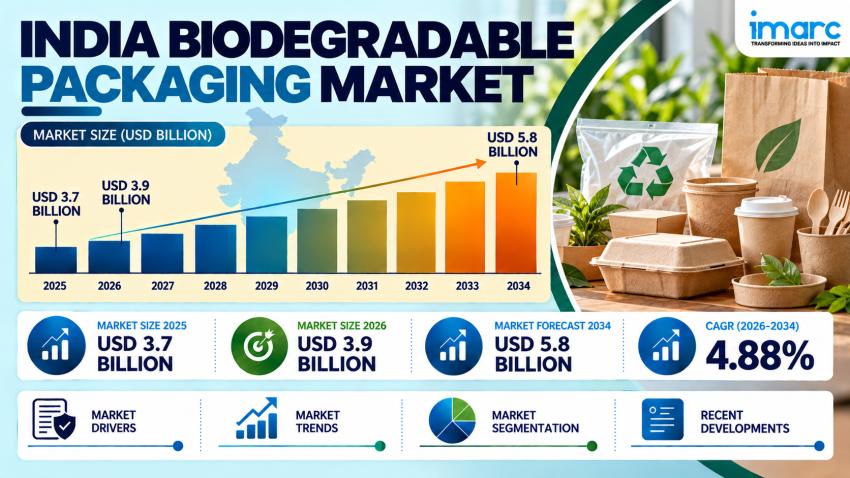
Advances in eco-friendly materials and cost-effective production methods are supporting growth, making biodegradable options more practical for businesses of different sizes. The market grew from USD 3.7 Billion in 2025 to USD 3.9 Billion in 2026 and is expected to reach USD 5.8 Billion by 2034, growing at a CAGR of 4.88% during 2026-2034.
Growth is being driven by government bans on single-use plastics, campaigns such as the Swachh Bharat Mission, and material innovation across cornstarch, bagasse, and polylactic acid (PLA). The biodegradable packaging market in India is increasingly viewed as a key component of the country’s move toward circular and low-waste packaging.
Market Snapshot
- Market Size (2025): USD 3.7 Billion
- Market Size (2026): USD 3.9 Billion
- Forecast Value (2034): USD 5.8 Billion
- CAGR (2026-2034): 4.88%
- Material Types Covered: Plastic and Paper
- Applications Covered: Food, Beverage, Pharmaceutical, and Personal/Homecare Packaging
- Regions Covered: North India, South India, East India, West India
What Growth Factors Are Driving the India Biodegradable Packaging Market?
- Rising Environmental Awareness and Consumer Preference for Sustainable Products
Consumers and businesses are shifting toward alternatives that reduce plastic waste and carbon footprints. Millennials and Generation Z, who prefer brands that match their eco-conscious values, are playing a significant role in the rise of green packaging.
Food and beverage, e-commerce, and personal care companies are leading adoption of compostable and biodegradable formats to meet these expectations while aligning with regulatory standards.
- Government Bans on Single-Use Plastics and Supportive Policy
The Indian government’s ban on single-use plastics and campaigns such as the Swachh Bharat Mission have accelerated the transition toward biodegradable materials, including cornstarch, bagasse, and PLA. Encouraging government regulations give packaging users a clear compliance reason to switch.
Policy direction also encourages investment in domestic manufacturing capacity, drawing both established packaging companies and new entrants into the sector.
- Technological Advancements and Cost-Effective Solutions
Material science developments have produced cost-effective, high-quality biodegradable materials suitable for small to medium enterprises. Manufacturers are investing in research and development for packaging that is environmentally friendly, durable, lightweight, and customizable.
Biopolymer manufacturing advances have reduced costs and improved scalability, which strengthens adoption across more industries.
What Are the Latest Emerging Trends in the India Biodegradable Packaging Market?
- Increasing Demand for Eco-Friendly Packaging Solutions
Brands are moving to compostable and biodegradable formats as sustainability becomes part of purchase decisions. On 11 November 2024, researchers at IISc Bengaluru created a biodegradable foam using non-edible oils and tea leaf extracts, a sustainable substitute for plastic packaging that can decompose within hours and aims to serve the USD 7.9 Billion foam market.
Such innovations are expected to drive investment and position India as a key player in the global biodegradable packaging market.
- Smart Packaging and Transparency Features
QR codes and RFID tags are enhancing the functionality of biodegradable packaging and making it more appealing to companies. On 1 July 2024, Myprotein introduced an Authentication QR Code in India that lets users access origin and expiry information.
This aligns with India’s push for transparency in consumer products and strengthens the case for sustainable packaging in the health and nutrition sector.
- New Product Launches and Circularity
On 24 September 2024, Pakka launched three compostable flexible packaging solutions for chocolates, confectioneries, and FMCG food items, with high barrier properties and heat and cold sealability. On 28 February 2025, Tetra Pak unveiled eco-friendly carton packaging in India using up to 5% certified recycled polymers, promoting circularity.
What Opportunities Lie Ahead for the India Biodegradable Packaging Market in the Coming Years?
The market is positioned for steady growth through 2034, supported by regulation, consumer preference, and material innovation. As production costs fall and technology improves, adoption is expected to expand across food, beverage, pharmaceutical, and personal care applications.
The biodegradable packaging industry in India offers room for companies across the value chain, from biopolymer producers to converters and brand owners. Players that combine cost-effective materials with strong performance and smart features are well placed to capture demand as sustainability requirements become standard.
Explore the Full Report with Charts, Table of Contents, and List of Figures
How Is the India Biodegradable Packaging Market Segmented?
By Material Type
- Plastic (starch-based plastics, cellulose-based plastics, polylactic acid (PLA), poly-3-hydroxybutyrate (PHB), polyhydroxyalkanoates (PHA), and others)
- Paper (kraft paper, flexible paper, corrugated fiberboard, and boxboard)
Biodegradable plastics offer flexible, barrier-capable options for food and consumer goods, with starch-based and PLA materials already in commercial use. Continued biopolymer advances are improving cost and scalability.
Paper-based formats such as kraft paper, corrugated fiberboard, and boxboard serve a wide range of packaging needs, benefiting from familiarity, recyclability, and fit with e-commerce and retail packaging.
By Application
- Food Packaging
- Beverage Packaging
- Pharmaceutical Packaging
- Personal/Homecare Packaging
- Others
Food and beverage companies face strong regulatory and consumer pressure to cut plastic use, driving demand for compostable and biodegradable formats. Pharmaceutical and personal care applications adopt sustainable materials as brands seek to align packaging with their environmental commitments.
By Region
- North India
- South India
- East India
- West India
Demand is shaped by industrial concentration, consumer awareness, and the pace of enforcement of plastic regulations across regions, with urban and manufacturing centers adopting sustainable packaging most quickly.
Competitive Landscape
The report offers an in-depth examination of the competitive landscape, including market structure, key player positioning, leading strategies for success, a competitive dashboard, and a company evaluation quadrant.
Investment & Growth Opportunities
- Biopolymer production and processing using starch, PLA, PHA, and other bio-based materials.
- Compostable flexible packaging for FMCG, confectionery, and food items, where barrier and sealability performance matter.
- Paper-based packaging formats such as kraft paper, corrugated fiberboard, and boxboard for e-commerce and retail.
- Biodegradable foam and protective packaging as a sustainable substitute for plastic foam.
- Smart packaging features including QR codes and RFID tags that improve transparency and trust.
- Biodegradable packaging manufacturers in India that invest in cost-effective scale and certification will be well placed as regulation tightens.
India Biodegradable Packaging Market Recent Developments & News
- February 28, 2025: Tetra Pak unveiled eco-friendly carton packaging in India that uses up to 5% certified recycled polymers, supporting circularity and reducing dependence on fossil-based solutions.
Source: IMARC Group