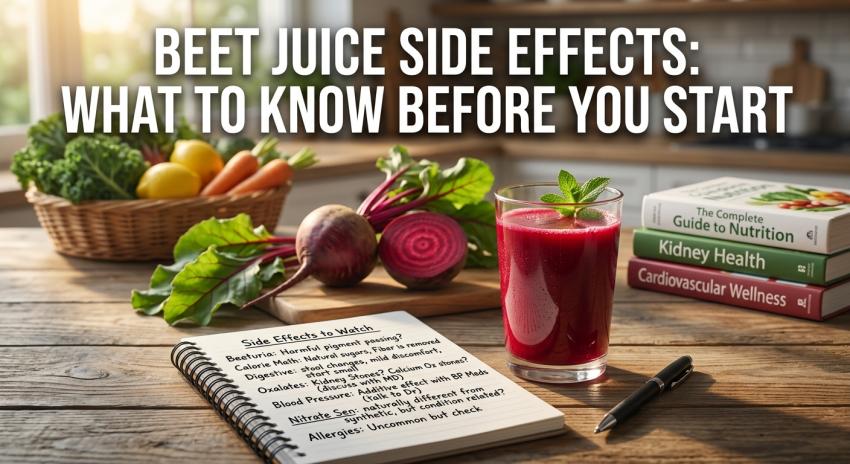
Most wellness content around beet juice focuses entirely on benefits, which leaves an incomplete picture. Here's a more balanced look at what to actually expect, including the side effects and considerations worth knowing before you start drinking it regularly.
Beeturia: The Most Common and Most Harmless Effect
A significant percentage of people experience a pink or reddish tint to their urine or stool after consuming beets or beet juice, a completely benign phenomenon called beeturia. It's not a sign of anything wrong internally — it's simply pigment compounds from beets passing through the body — but it can be alarming if you don't know it's coming, so it's worth mentioning upfront to anyone trying beet juice for the first time.
Digestive Effects
Some people experience mild digestive changes when introducing beet juice, particularly in larger quantities — this can include changes in stool consistency or mild stomach discomfort, generally related to the natural sugars and compounds in beets rather than anything more concerning. Starting with smaller amounts and increasing gradually tends to minimize this.
Oxalate Content and Kidney Stones
Beets contain oxalates, compounds that, in people prone to certain types of kidney stones (specifically calcium oxalate stones), can be a relevant dietary consideration. Anyone with a history of kidney stones should talk to their doctor about whether beet juice, or beets generally, fits appropriately into their diet, rather than assuming it's automatically fine.
Blood Pressure Medication Interactions
Given beet juice's potential effect on blood pressure, anyone taking blood pressure medication should be aware that combining the two could, in theory, have an additive effect. This isn't necessarily dangerous, but it's exactly the kind of interaction worth discussing with a doctor rather than assuming there's no interplay at all.
Nitrate Sensitivity Considerations
While dietary nitrates from vegetables are generally viewed very differently than synthetic nitrates in processed foods, some individuals — including certain populations with specific health conditions — are advised to moderate nitrate intake. This is a case where "natural" doesn't automatically mean "no consideration needed," and it's worth a conversation with a healthcare provider if you have a relevant condition.
Allergic Reactions
True beet allergies are uncommon but not impossible. As with introducing any new food or juice to your diet, paying attention to any unusual reaction the first few times is a reasonable, low-effort precaution.
Pregnancy and Breastfeeding
As with most dietary changes during pregnancy or while breastfeeding, it's worth discussing beet juice specifically with your doctor or midwife rather than assuming general wellness advice applies without exception — this is standard practice for any new supplement or concentrated food product during this period, not a beet-specific concern.
Who should be more cautious overall:
Anyone with a history of calcium oxalate kidney stones
Anyone on blood pressure medication, particularly if considering regular beet juice use
Anyone with a specific medical condition involving nitrate sensitivity
Pregnant or breastfeeding individuals, as a general precaution for any new dietary addition
Anyone with a known beet allergy or sensitivity
How to Start Safely If None of the Above Applies to You
For most healthy adults, beet juice is a low-risk addition to a diet. Starting with a smaller serving, monitoring how you feel over the first few uses, and choosing a straightforward, minimally processed product — such as Beet-It's organic beet juice — rather than a heavily sweetened or additive-laden blend, is a sensible, low-risk approach.