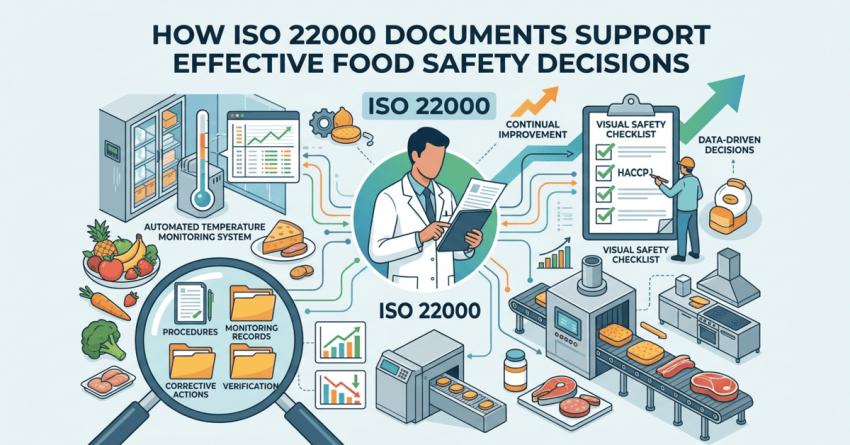
Food safety decisions should be based on reliable information rather than assumptions. For food manufacturers, processors, storage providers, caterers, retailers, and other organizations in the food chain, documented information helps identify hazards, control risks, monitor processes, and improve food safety performance. This is where ISO 22000 documents become valuable. They provide a consistent way to record what is planned, implemented, monitored, and corrected when results do not meet expectations.
Turning Food Safety Information into Useful Evidence
An effective Food Safety Management System (FSMS) is not simply about creating paperwork. Documentation should support how an organization manages food safety in daily operations.
For example, hazard analysis records help teams identify food safety hazards and establish appropriate controls. Monitoring records provide evidence that controls are operating as intended, while corrective action records show how deviations were addressed and followed up.
Together, these records give managers useful information for deciding whether a process requires adjustment, additional monitoring, employee training, or corrective action.
Supporting Consistent Food Safety Controls
Food safety decisions often involve multiple departments and employees. Without documented procedures and defined responsibilities, different people may handle similar situations differently.
ISO 22000 documentation can establish a consistent approach through procedures, work instructions, food safety plans, monitoring formats, verification records, and other documented information. This helps employees understand what needs to be done, when it should be done, and what evidence should be retained.
Such consistency is particularly useful when reviewing prerequisite programs, operational controls, HACCP-based activities, sanitation practices, supplier controls, traceability, and emergency preparedness.
Helping Identify Trends and Recurring Problems
Individual records may seem routine, but reviewing them over time can reveal recurring problems. Repeated deviations, customer complaints, verification failures, equipment issues, or corrective actions may indicate that an existing food safety control needs to be reviewed.
For example, recurring deviations at a particular process step can encourage management to investigate the underlying cause rather than treating each incident separately. This supports continual improvement and helps organizations make decisions based on actual food safety performance.
Making Internal Audits and Reviews More Meaningful
Internal audits are more effective when auditors can examine objective evidence rather than relying only on interviews. Controlled documents, completed forms, monitoring records, corrective action reports, verification results, and audit findings can help demonstrate how the FSMS operates in practice.
Management review activities can also benefit from organized information. When relevant food safety performance data is readily available, management can identify areas requiring attention and make more informed decisions about resources, controls, training, and system improvements.
Building a Practical ISO 22000 Documentation System
Creating an FSMS from the ground up can involve considerable time and effort, particularly when an organization needs to develop procedures, forms, records, manuals, and supporting formats that work together.
A structured documentation solution can provide a useful starting point while allowing organizations to customize documents according to their processes, products, responsibilities, and food safety risks.
Organizations looking to streamline this work can explore ISO 22000 documents that provide a structured foundation for FSMS implementation. A well-organized documentation set can help reduce the time spent developing procedures, forms, records, and other supporting documents from scratch while allowing organizations to adapt them to their specific food safety processes.
Conclusion
Effective food safety decisions depend on reliable information. When ISO 22000 documentation is properly developed, maintained, and used, it can help organizations monitor controls, identify recurring issues, support internal audits, demonstrate evidence, and drive continual improvement. The goal is not simply to maintain documents for certification; it is to make documented information useful for managing food safety in everyday operations.