Retrieval-Augmented Generation (RAG) has become an important architecture for building AI applications that need to work with proprietary, domain-specific, or frequently updated information. Instead of relying entirely on an LLM's pretrained knowledge, RAG retrieves relevant information from an external knowledge base and provides it to the model as contextual evidence before generating a response.
However, effective retrieval does not happen automatically. The quality of the underlying documents, chunks, relevance judgments, and evaluation datasets directly affects how well a RAG system performs. This is where data annotation becomes valuable.
From organizing knowledge bases to labeling query-document relevance and evaluating generated answers, annotation can help AI teams build more reliable retrieval pipelines. For organizations developing enterprise AI applications, LLM & GenAI annotation services can provide the human expertise needed to create structured, high-quality datasets throughout the RAG lifecycle.
What Is Retrieval-Augmented Generation?
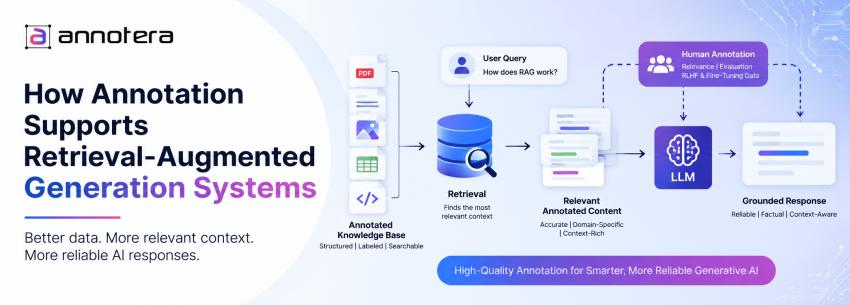
A typical RAG system connects an information retrieval layer with a generative AI model. When a user submits a question, the system searches a knowledge base for relevant content, retrieves selected passages, and places that information into the model's context. The LLM then generates a response based on the retrieved evidence.
For example, consider an enterprise chatbot answering questions about company policies. Instead of expecting the model to memorize every HR document, the RAG pipeline can retrieve the relevant policy section and provide it to the LLM.
The basic workflow can be viewed as:
User Query → Retrieval → Relevant Context → LLM Generation → Grounded Response
Annotation can strengthen several stages of this workflow.
1. Annotation Improves Knowledge Base Preparation
Enterprise knowledge bases often contain PDFs, manuals, reports, FAQs, web pages, support tickets, contracts, and other unstructured information. Before these sources can support RAG, they need to be processed into usable units.
Annotation can help identify:
Document types and categories
Important sections and headings
Key entities and concepts
Metadata and document attributes
Sensitive or restricted information
Duplicate or irrelevant content
Relationships between sections
Well-structured metadata can improve how information is filtered and retrieved. For example, a RAG system for financial services may need to distinguish between policies, regulatory documents, product information, and customer-facing content.
2. High-Quality Chunking Depends on Meaningful Segmentation
RAG systems commonly divide documents into smaller chunks before indexing them. If chunks are too large, retrieval can return excessive or unrelated information. If they are too small, important context may be separated.
Annotation can support semantic segmentation by identifying meaningful boundaries within documents.
Instead of splitting a document only according to character or token counts, teams can identify sections that represent complete concepts. This helps preserve relationships between questions and the information required to answer them. Annotera's own RAG evaluation guidance highlights the connection between chunk boundaries and retrieval quality.
For domain-specific RAG systems, semantic annotation can therefore become part of knowledge-base preparation rather than simply a downstream evaluation activity.
3. Query-Document Relevance Annotation
One of the most important annotation tasks for RAG is determining whether a retrieved document or passage is relevant to a particular query.
Annotators can examine a query alongside candidate documents and assign relevance labels such as:
Irrelevant
Partially relevant
Relevant
Highly relevant
The exact taxonomy can vary according to the application.
These labeled query-document pairs can form ground-truth datasets for evaluating and improving retrieval systems. Microsoft, for example, describes document retrieval evaluation as comparing retrieved documents against relevance ground truth to calculate search-quality measures.
For specialized applications, relevance may also require domain knowledge. A passage containing similar terminology may not actually provide the evidence needed to answer the question. Human annotation can capture these nuanced distinctions.
4. Annotation Helps Train and Evaluate Retrieval Models
Relevance-labeled datasets can be used to assess retrieval performance and, depending on the system architecture, support the optimization of retrieval or ranking components.
Common retrieval metrics include precision, recall, and NDCG. These metrics help determine whether the system is returning useful information rather than simply producing a plausible final response.
For example, if a query should retrieve three highly relevant passages but the system repeatedly returns loosely related documents, annotation data can reveal the retrieval gap.
This creates a feedback loop:
Annotate → Evaluate → Identify Retrieval Gaps → Optimize → Re-Evaluate
The process can be repeated as the knowledge base, queries, and retrieval strategy evolve.
5. Groundedness and Answer-Quality Annotation
Retrieval quality is only one part of RAG performance. A system may retrieve the correct documents but still generate an incomplete or unsupported response.
Human annotators can evaluate generated answers against the retrieved context to determine whether:
The response is supported by the evidence
Claims are factually consistent with the retrieved content
Important information has been omitted
The answer contains unsupported statements
The response actually addresses the user's question
This distinction is important because a RAG system can fail either during retrieval or generation. Separately evaluating these layers helps teams identify the source of the problem.
Claim-level annotation can go further by linking individual statements in an answer to supporting passages. Such fine-grained labels can make debugging and model improvement more targeted.
6. Annotation Supports RAG Evaluation Datasets
Reliable evaluation requires representative test queries and known reference information. Google Cloud recommends building high-quality question sets and golden reference datasets when testing RAG systems.
Annotators can create and label datasets containing:
Query + Relevant Documents + Expected Answer + Evidence + Evaluation Labels
These datasets can cover different query types, difficulty levels, domains, languages, and edge cases.
For enterprise applications, evaluation data should also include questions that have incomplete, conflicting, or unavailable information. Such examples can help test whether a RAG system appropriately handles uncertainty rather than producing an unsupported answer.
7. Human Annotation Complements RLHF and Fine-Tuning
RAG does not eliminate the need for high-quality training data. Annotation can support multiple generative AI workflows alongside retrieval.
For example, preference datasets can capture which responses humans consider more accurate, useful, relevant, or well-grounded. These datasets can contribute to RLHF & fine-tuning data pipelines for improving model behavior.
The distinction is important:
RAG primarily supplies external knowledge at inference time, while fine-tuning changes model behavior or capabilities through additional training. Annotation can support both approaches, depending on the objective.
Combining retrieval datasets with high-quality RLHF & fine-tuning data can help organizations develop AI systems that not only access relevant information but also follow desired response behaviors.
8. Domain Expertise Matters for Enterprise RAG
Generic annotation guidelines may not be sufficient for specialized RAG applications. Healthcare, finance, legal, insurance, manufacturing, and technical support systems often contain terminology and relationships that require subject-matter understanding.
For example, two passages may appear semantically similar but differ significantly in regulatory meaning. Expert annotation can help distinguish these cases and create more meaningful relevance and evaluation labels.
This is one reason organizations increasingly consider specialized LLM & GenAI annotation services when building domain-specific AI datasets.
Building Better RAG Systems Through Annotation
Annotation should not be viewed as a single step at the end of an AI development project. It can support the entire RAG lifecycle—from document preparation and semantic segmentation to retrieval evaluation, response grounding, and continuous quality improvement.
A practical annotation strategy can include:
Define clear annotation guidelines based on the RAG use case.
Prepare and classify source documents before indexing.
Create meaningful semantic chunks that preserve relevant context.
Label query-document relevance for retrieval evaluation.
Develop golden evaluation datasets containing representative queries.
Assess generated responses for relevance, completeness, and groundedness.
Capture failure cases and add them to future evaluation datasets.
Iterate continuously as documents, user queries, and models change.
Conclusion
RAG can connect generative AI models with enterprise knowledge, but the quality of retrieved information remains fundamental to the quality of the final response. Annotation provides a structured way to improve that foundation.
From semantic document segmentation and relevance labeling to groundedness evaluation and preference data creation, annotation gives AI teams the human judgments needed to measure and improve RAG performance.
For organizations developing enterprise-grade generative AI applications, LLM & GenAI annotation services can help transform unstructured knowledge and real-world interactions into high-quality datasets. Combined with carefully designed RLHF & fine-tuning data, these annotation workflows can support more accurate, context-aware, and consistently evaluated AI systems.