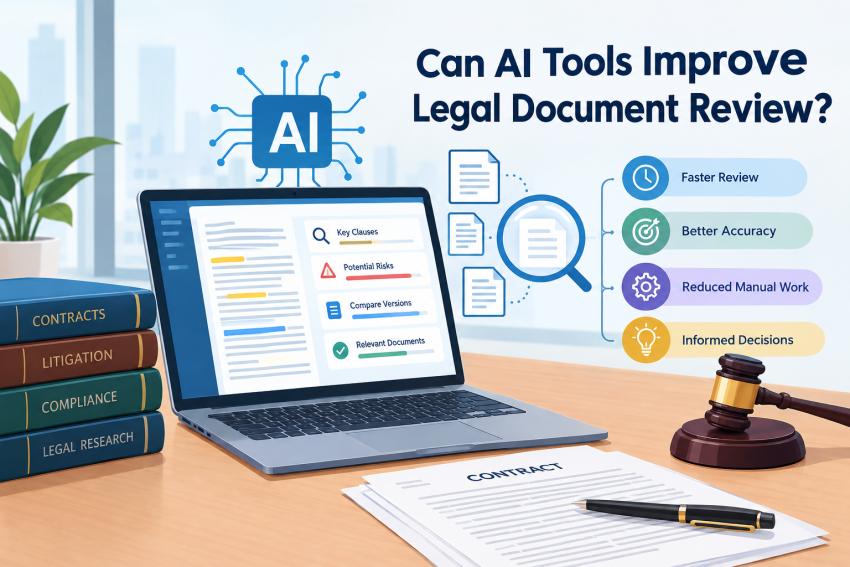
Legal document review is a central part of litigation, transactions, compliance work and corporate legal practice. Lawyers often need to examine contracts, pleadings, correspondence, policies and other records before making important legal decisions. As document volumes continue to increase, traditional manual review can become time consuming and resource intensive.
Artificial intelligence is changing how legal professionals approach this process. Modern AI tools can help identify relevant clauses, organise large document sets, detect inconsistencies and highlight provisions requiring closer attention. Yet AI does not replace legal judgement. Its value depends on how carefully lawyers use it, verify its results and protect confidential information.
Understanding the opportunities and limitations of AI is therefore essential for anyone considering its use in legal document review.
What Is AI Based Legal Document Review?
AI based legal document review uses software capable of analysing text and identifying patterns within legal documents. Depending on the system, it may use natural language processing, machine learning or generative AI to examine information.
A lawyer may use an AI tool to locate termination clauses across hundreds of contracts, identify references to particular obligations or compare provisions in different versions of an agreement. Some systems can also classify documents according to their relevance.
The technology is particularly useful when a legal matter involves a large volume of information. Instead of reading every document in the same sequence, lawyers can use AI to organise the material and focus their attention on areas requiring professional analysis.
How AI Can Make Document Review More Efficient
One of the strongest advantages of AI is speed. A human legal team may spend considerable time searching through thousands of pages for specific information. An AI system can process large document collections much faster.
For example, during due diligence, a company may need to review numerous commercial agreements. AI can assist by identifying clauses concerning change of control, exclusivity, indemnity, termination and liability. Lawyers can then review the relevant provisions in greater detail.
This does not mean every document becomes automatically approved or rejected. Instead, AI can reduce the time spent on repetitive searches and allow legal professionals to devote more attention to interpretation and strategy.
Identifying Important Contract Clauses
AI tools can help locate clauses relevant to a particular legal question. This can be valuable when reviewing lengthy agreements.
A reviewer may ask the system to identify provisions relating to payment obligations, intellectual property ownership, confidentiality, dispute resolution or governing law. The software can then bring relevant sections to the lawyer's attention.
This function may be particularly useful in large contract portfolios. Businesses often have agreements created at different times and by different teams. An AI assisted review can help establish a clearer picture of recurring contractual terms.
However, a clause appearing relevant does not automatically mean its legal meaning is clear. Context remains important. Lawyers must still examine surrounding provisions and understand the commercial relationship between the parties.
Comparing Different Versions of Documents
Document comparison is another area where AI can provide practical assistance.
Legal teams frequently deal with revised contracts, amended agreements and multiple drafts. Identifying every meaningful change can be difficult when documents are lengthy.
AI tools can help compare versions and draw attention to changes in wording. A lawyer can then assess whether a revision affects liability, rights, obligations or commercial risk.
This can improve review efficiency while reducing the likelihood of overlooking a significant amendment during an otherwise repetitive comparison exercise.
Supporting Due Diligence
Due diligence often requires a detailed review of corporate and commercial records. The process may involve contracts, licences, employment documents, intellectual property records and regulatory material.
AI can assist by categorising documents and identifying provisions requiring attention. It may also help establish patterns across a document collection.
For instance, an AI system could identify agreements containing unusual termination provisions or contracts with different approaches to liability. These findings can help lawyers decide where deeper investigation is needed.
The technology therefore works best as an additional layer of review rather than an independent decision maker.
Can AI Detect Legal Risks?
AI can help identify potential areas of legal risk, but its findings should not be treated as definitive legal conclusions.
A system may recognise an unusual clause or identify an inconsistency between two provisions. It may also flag missing information based on predefined criteria. Such findings can be useful starting points for legal analysis.
The final assessment requires professional judgement. A provision may appear unusual but be commercially intentional. Another clause may appear standard but create a significant problem when considered alongside other contractual terms.
This distinction is important because legal risk often depends on facts, context and applicable law rather than wording alone.
AI and Confidential Legal Information
Confidentiality is one of the most important considerations when using AI for legal work.
Legal documents may contain sensitive commercial information, personal data, privileged communications and confidential transaction details. Lawyers must understand how an AI system handles information before uploading documents.
Questions concerning data storage, access controls, retention, encryption and use of submitted information should be considered carefully. Organisations should also establish appropriate internal policies governing AI use.
A convenient tool may not be suitable for confidential legal material simply because it can analyse documents quickly. Data protection and professional obligations must remain central to the decision.
The Risk of AI Errors
AI systems can make mistakes. They may misunderstand language, overlook relevant context or produce an incorrect interpretation. Generative AI systems can also produce convincing but inaccurate responses.
This creates a particular concern in legal document review. A missed clause or incorrect summary could affect negotiations, litigation strategy or compliance decisions.
Human verification is therefore essential. Lawyers should review important findings against the original document. Critical legal conclusions should never depend solely on an automated output.
AI can reduce repetitive work, but accountability for legal advice remains with the legal professional.
How Lawyers Can Use AI Responsibly
Effective AI assisted document review begins with a clear understanding of the task. Lawyers should determine whether AI is being used for document classification, clause identification, comparison, summarisation or another specific purpose.
The system's output should then be reviewed against the source material. Important findings should be independently verified before being incorporated into advice or legal documents.
It is also important to maintain appropriate records of the review process. In significant matters, legal teams may need to understand how information was identified and why certain documents received further attention.
Training is equally important. Lawyers and support staff should understand both the capabilities and limitations of the technology.
AI Does Not Replace Legal Expertise
The growing use of AI does not remove the need for experienced lawyers. Legal review involves more than finding words or matching clauses.
A lawyer must understand the client's objectives, the relevant legal framework, commercial circumstances and potential consequences. These factors require reasoning and professional judgement.
For example, a system may correctly identify a broad indemnity clause. It may not understand why the provision creates a disproportionate commercial risk in a particular transaction. A lawyer can evaluate the clause in context and advise on an appropriate response.
Professionals working with complex disputes may therefore combine AI assisted review with specialist legal analysis. Depending on the nature of a matter, businesses may also seek advice from a best civil lawyer in India when document issues develop into broader civil claims.
AI in Corporate Legal Practice
Corporate legal teams are likely to see increasing use of AI for contract management and document analysis. Businesses regularly handle large volumes of agreements, policies and regulatory records.
AI can support routine review by helping teams locate provisions, identify variations and organise information. This can make legal workflows more manageable, particularly for organisations with extensive contract portfolios.
At the same time, corporate legal departments need clear governance frameworks. These should address confidentiality, data security, human oversight and acceptable use.
Businesses dealing with complex transactions may also require advice from a corporate lawyer India when AI assisted document findings raise questions about contractual obligations, regulatory exposure or transaction risk.
What the Future May Look Like
AI based legal document review is likely to become more sophisticated. Future systems may provide stronger contextual analysis, improved document comparison and better integration with legal workflows.
The most useful developments will not necessarily involve replacing lawyers. Instead, technology may help lawyers spend less time on repetitive document handling and more time on analysis, negotiation and strategic decision making.
This shift could also influence how legal teams allocate resources. Junior lawyers may use AI for preliminary document organisation while senior lawyers focus on complex issues requiring deeper judgement.
Conclusion
AI tools can improve legal document review by increasing speed, organising large volumes of information and highlighting provisions requiring closer attention. They can be particularly useful for contract review, due diligence, document comparison and preliminary risk identification.
However, AI has important limitations. It can make errors, misunderstand context and produce unreliable conclusions. Confidentiality and data protection also require careful consideration.
The most effective approach is therefore not to view AI as a replacement for lawyers. It should be treated as a support tool within a controlled legal workflow. Human review, professional judgement and careful verification remain essential.
As AI becomes more common in legal practice, firms and businesses will need to balance technological efficiency with accuracy, confidentiality and professional responsibility. Used carefully, AI can make document review faster and more structured while allowing lawyers to concentrate on the parts of legal work where human expertise matters most.