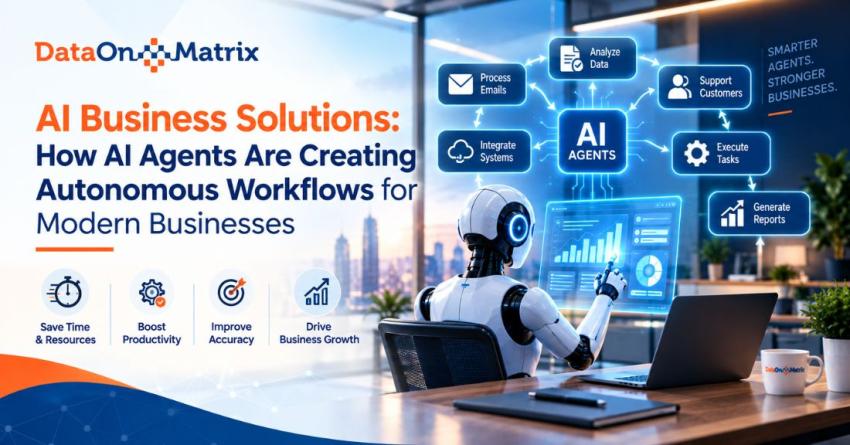
Businesses are moving beyond basic automation toward systems that can understand information, make decisions, and complete tasks with minimal human intervention. AI business solutions are playing a major role in this shift by combining artificial intelligence, automation, machine learning, and AI agents to create more intelligent workflows. Instead of simply following predefined rules, AI-powered systems can analyze situations, select appropriate actions, and continuously improve how business processes are handled.
From customer support and sales to finance, operations, and software development, autonomous workflows are changing how organizations operate. AI agents can connect with business applications, process information, communicate with users, and execute multi-step tasks while employees focus on strategic responsibilities.
What Are Autonomous Workflows With AI Agents?
An autonomous workflow is a business process where AI systems can perform multiple connected tasks with limited human involvement.
Traditional automation generally follows predefined instructions. For example, a workflow may automatically send an email when a customer submits a form. An AI-agent-powered workflow can go further. It may understand the customer's request, identify the appropriate department, retrieve relevant information, prepare a response, update a CRM system, and escalate the case if human assistance is necessary.
AI agents essentially add reasoning and decision-making capabilities to automated workflows.
A typical autonomous workflow may involve:
- Understanding an incoming request
- Gathering information from different systems
- Analyzing available data
- Making a context-based decision
- Executing one or more actions
- Checking the outcome
- Escalating complex situations to employees
This makes AI agents particularly valuable for repetitive but decision-heavy business processes.
Why AI Business Solutions Are Becoming More Important
Modern businesses generate enormous amounts of data through websites, applications, customer interactions, internal systems, and digital channels. Employees often spend significant time moving information between platforms, reviewing documents, answering repetitive questions, and completing administrative tasks.
AI business solutions can reduce this operational burden by connecting intelligent systems with existing business processes.
The biggest advantage is not simply automation. It is the ability to create workflows that can understand context and respond dynamically.
For example, an AI system supporting a sales team could analyze a new lead, evaluate its potential, identify relevant company information, personalize an outreach message, record the interaction in a CRM, and notify a salesperson when the lead shows strong buying intent.
This type of workflow can help organizations improve productivity without requiring every process to be manually managed.
How AI Agents Work Inside Business Workflows
AI agents typically combine several technologies rather than operating as isolated chatbots.
A business AI agent may use:
1. Natural Language Processing
Natural language technology allows agents to understand emails, customer questions, documents, conversations, and other forms of human communication.
2. Large Language Models
Large language models provide the reasoning and language capabilities required to interpret information, generate responses, summarize content, and support decision-making.
3. Business Data
AI agents become more useful when they can securely access relevant business information. This may include customer records, product catalogs, internal documents, analytics, or knowledge bases.
4. APIs and Business Applications
Agents can connect with CRM, ERP, help desk, communication, analytics, and other systems through APIs. This enables them to perform actions instead of simply generating text.
5. Workflow Orchestration
An orchestration layer determines which tools and processes an AI agent should use and in what sequence.
Together, these components allow organizations to move from simple AI assistants toward systems capable of completing end-to-end workflows.
Examples of Autonomous AI Workflows
The practical applications of AI agents are expanding across industries.
1. Customer Service
An AI agent can classify customer requests, search a knowledge base, retrieve account information, generate an appropriate response, and route complex issues to a human representative.
This can reduce response times while allowing support teams to focus on cases requiring empathy or specialized expertise.
2. Sales and Lead Management
AI agents can analyze incoming leads, enrich customer information, identify buying signals, draft personalized outreach, update CRM records, and notify sales representatives about high-value opportunities.
3. Finance and Accounting
AI-powered workflows can help process invoices, extract information from financial documents, categorize transactions, identify unusual patterns, and prepare information for human review.
4. Human Resources
AI agents can assist with employee questions, onboarding workflows, document processing, interview scheduling, and internal knowledge management.
5. Marketing
AI systems can analyze campaign performance, identify audience trends, generate content variations, summarize reports, and support personalized customer engagement.
6. IT Operations
AI agents can monitor alerts, investigate routine incidents, retrieve technical information, recommend solutions, and escalate problems when required.
These applications demonstrate that autonomous workflows are not limited to a single department. They can become part of an organization's broader operating model.
The Role of Generative AI in Autonomous Workflows
Generative AI has significantly expanded what business automation can accomplish.
Traditional automation works well when inputs and outputs are predictable. However, many business processes involve unstructured information such as emails, documents, conversations, and natural-language requests.
Generative AI development services can help businesses build systems capable of processing these types of inputs and generating useful outputs.
For instance, an AI agent can read a customer email, determine the customer's intent, retrieve information from internal systems, formulate a response, and trigger another workflow.
This combination of generative AI and workflow automation creates a more flexible approach to business process management.
Building AI Agents With the Right Development Strategy
Organizations considering autonomous workflows need more than an AI model. They need a reliable technology architecture, secure integrations, appropriate data access, monitoring, and clearly defined business objectives.
Companies may work with ai development services in usa providers to design and implement AI-powered solutions based on their operational requirements.
A development partner can help with:
- AI architecture planning
- AI agent development
- API integrations
- Data and knowledge management
- AI model integration
- Workflow automation
- Security implementation
- Performance monitoring
- Testing and deployment
For organizations with complex requirements, a dedicated software development team can provide continuous engineering support. This model can be useful when a company needs to develop, test, improve, and maintain multiple AI-powered workflows over time.
AI Product Development for Scalable Solutions
Some organizations need more than an internal automation project. They may want to turn an AI capability into a customer-facing product.
This is where ai product development services become valuable.
An AI product may include intelligent search, conversational interfaces, recommendation systems, document analysis, automated decision support, or AI-powered workflow management.
Successful AI products need to balance innovation with usability, reliability, scalability, and data security. A strong product strategy therefore considers the complete user experience rather than focusing only on the underlying AI model.
Why Custom AI Development Can Be Better Than Generic Tools
Off-the-shelf AI platforms can be useful for simple use cases, but they may not address specialized business requirements.
Custom ai development services allow organizations to design AI systems around their own workflows, data structures, applications, and operational goals.
A customized solution can be designed to:
- Connect with existing software
- Follow company-specific processes
- Use proprietary knowledge
- Apply business-specific rules
- Support unique customer experiences
- Scale as requirements change
This does not mean every business needs a completely custom AI model. In many cases, the better approach is to combine existing AI models with custom applications, integrations, business logic, and data systems.
The Importance of AI Consulting Before Implementation
Technology alone does not guarantee successful AI adoption. Businesses need to identify where AI can create measurable value before investing in development.
Ai consulting services can help organizations evaluate processes, identify automation opportunities, assess technical requirements, and prioritize AI initiatives.
For larger organizations, ai consulting services for business can also support AI roadmaps, governance, implementation planning, and technology selection.
A consulting-led approach can answer important questions such as:
- Which workflows should be automated first?
- Where is human oversight still necessary?
- What business data should AI access?
- Which AI architecture fits the use case?
- How will performance be measured?
- What security controls are required?
This helps businesses avoid implementing AI simply because the technology is available.
AI Transformation Services and Long-Term Business Change
Autonomous workflows can become part of a broader digital transformation strategy.
Ai transformation services focus on integrating AI across business functions rather than treating each AI project as an isolated experiment.
For example, a company could begin with an AI customer-support agent and gradually introduce AI into sales, marketing, finance, operations, and internal knowledge management.
Over time, these connected capabilities can create an AI-enabled operating environment where employees and AI agents work together.
A software development company in New York or another technology partner may support this transformation by combining software engineering, cloud technologies, automation, data systems, and artificial intelligence.
AI Software Consulting for Smarter Technology Decisions
Organizations often have many choices when adopting AI. They can use commercial platforms, integrate third-party models, build custom applications, or combine multiple technologies.
An ai software consulting service can help businesses evaluate these options based on cost, scalability, security, integration requirements, and expected business value.
The goal should not be to implement the most advanced technology available. Instead, businesses should select technology that solves a real operational problem and produces measurable results.
This is particularly important as AI platforms and models continue to evolve rapidly.
What Businesses Should Consider Before Deploying AI Agents
Before introducing autonomous workflows, organizations should establish clear boundaries for AI decision-making.
Important considerations include:
1. Data Security
AI agents may interact with sensitive business information. Access controls, encryption, permissions, and appropriate data governance are essential.
2. Human Oversight
Not every decision should be fully autonomous. High-risk or sensitive actions may require human approval.
3. Accuracy
AI-generated outputs should be tested and monitored, particularly when they influence financial, legal, operational, or customer-facing decisions.
4. Integration
AI agents should work effectively with existing systems rather than creating disconnected technology silos.
5. Monitoring
Businesses need mechanisms to track agent performance, errors, costs, and workflow outcomes.
6. Measurable Objectives
Every AI project should have clear success metrics, such as reduced processing time, improved customer response rates, lower operational costs, or increased employee productivity.
The Future of Autonomous Business Workflows
AI agents are likely to become increasingly integrated into everyday business operations. Instead of interacting with AI only through a chatbot, employees may work alongside AI systems that continuously monitor tasks, recommend actions, and execute approved processes.
The future will likely involve collaborative workflows where humans provide strategic direction while AI agents handle information-heavy and repetitive operational activities.
Consulting ai services can help businesses prepare for this transition by identifying practical opportunities, establishing AI strategies, and creating implementation roadmaps.
The organizations that benefit most will not necessarily be those that adopt the greatest number of AI tools. They will be the businesses that identify meaningful problems and build reliable AI systems around them.
Frequently Asked Questions
1. What are AI business solutions?
AI business solutions are software systems that use artificial intelligence to solve business problems, automate processes, analyze information, support decisions, and improve operational efficiency.
2. How do AI agents improve business workflows?
AI agents can understand requests, analyze information, interact with software systems, make context-based decisions, and execute multiple tasks with limited human intervention.
3. Are AI agents the same as traditional automation?
No. Traditional automation generally follows predefined rules, while AI agents can interpret unstructured information, reason about tasks, and adapt their actions based on context.
4. Do businesses need custom AI development?
Not always. Some businesses can use existing AI platforms, while organizations with specialized workflows or integration requirements may benefit from custom AI applications.
5. What role does AI consulting play in business transformation?
AI consulting helps businesses identify suitable use cases, evaluate technology options, create implementation strategies, manage risks, and align AI investments with measurable business objectives.
6. Can AI agents completely replace employees?
AI agents are generally more valuable as productivity tools than as blanket replacements for employees. Human oversight remains important for complex, sensitive, and high-impact decisions.
7. What is the first step toward implementing autonomous workflows?
The first step is to identify a specific business process where AI can produce measurable value. Businesses can then evaluate the data, integrations, security requirements, and level of automation needed.
Conclusion
Autonomous workflows represent the next stage of intelligent business automation. By combining AI agents, generative AI, business data, software integrations, and workflow orchestration, organizations can create systems that do more than automate individual tasks.
The real opportunity lies in connecting these capabilities to meaningful business objectives. Whether the goal is faster customer service, better lead management, improved operational efficiency, or a new AI-powered product, a structured implementation strategy is essential.
With the right combination of ai consulting services, software engineering, automation, and AI technology, businesses can move from experimenting with artificial intelligence to building practical systems that continuously support their operations and growth.