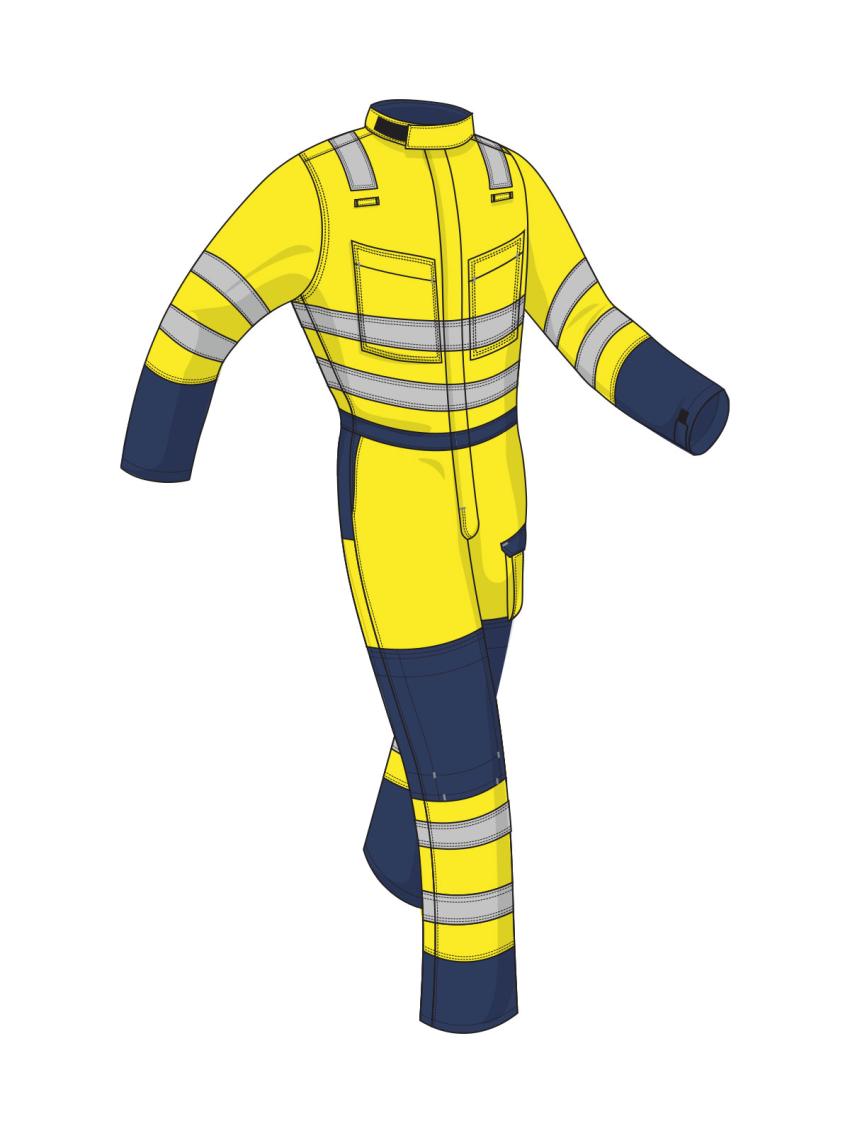
If you've ever picked up an FR coverall and seen a number like "12 cal/cm²" stitched into the label, you've looked at the single most important piece of data on the entire garment. It's also the number most workers — and, frankly, a fair number of buyers — misread or misunderstand. Getting it wrong doesn't just mean discomfort or a wasted purchase. It means a worker could be wearing PPE that looks protective but is rated for a fraction of the arc flash energy they're actually exposed to.
What "Arc Rating" Actually Measures
Arc rating is a measure of how much thermal energy a fabric can absorb during an electric arc flash before that heat is predicted to cause a second-degree burn to the skin underneath it. It's expressed in calories per square centimeter (cal/cm²), and it comes from a specific, standardized test: ASTM F1959, the Standard Test Method for Determining the Arc Rating of Materials for Clothing.
During this test, a fabric sample is exposed to a controlled electric arc at increasing energy levels while sensors behind the fabric record how much heat passes through. The results are plotted against the Stoll Curve, a burn-injury prediction model that identifies the point at which heat transfer through the fabric would cause a second-degree burn with a 50% probability.
There are actually two possible outcomes from this test, and this is where most confusion starts:
- ATPV (Arc Thermal Performance Value): the incident energy level at which the fabric transmits enough heat to reach the Stoll Curve burn threshold, while the fabric itself stays intact.
- EBT (Energy Breakopen Threshold): the incident energy level at which the fabric physically breaks open — meaning a hole of at least 1.6 cm² forms — before it transmits enough heat to cause a burn on its own.
Every fabric hits one of these two thresholds first. Fabrics with strong thermal insulation but weaker structural integrity tend to break open before they'd otherwise cause a burn (EBT applies). Fabrics that are more heat-resistant structurally but transmit heat more readily hit the burn threshold first (ATPV applies). Per ASTM F1506 — the standard that governs labeling of arc-rated clothing — whichever value is lower is the one that gets reported as the garment's official "Arc Rating." If the EBT is the limiting factor, the label will explicitly note "Arc Rating (EBT)" instead of ATPV. Neither is inherently better protection; it's simply which failure mode the fabric hits first.
What Should Actually Be on the Label
Under ASTM F1506, an arc-rated FR coverall's label is required to carry specific information, not just a number. When you're reading a label — or specifying what you want printed on garments you're sourcing — look for:
- The Arc Rating value in cal/cm², labeled as either ATPV or Arc Rating (EBT).
- Compliance statement referencing ASTM F1506 (and, for garments sold into markets governed by NFPA 70E, a note confirming suitability for that standard).
- Fabric composition — the fiber blend (e.g., inherently FR aramid, FR-treated cotton, modacrylic blends), since this affects both comfort and how the garment ages.
- Care instructions — critical, because incorrect laundering is one of the most common ways FR protection degrades over a garment's service life.
- Manufacturer, lot/style number, and size — needed for traceability if a garment is later recalled or investigated after an incident.
If a garment is sold for international markets that reference IEC 61482-2 (common in installations following IEC/IS-based electrical codes), you may also see a Class 1 or Class 2 rating alongside or instead of a cal/cm² figure — this is a different test methodology (box test rather than open-arc test) and the two numbers are not directly interchangeable, so don't assume a Class rating and an ATPV figure mean the same thing without checking which standard applies to your site.
A Worked Example: Reading a Real Label
Picture a typical coverall label reading something like this:
Arc Rating (ATPV) 12 cal/cm² — Tested per ASTM F1959 — Meets ASTM F1506 — 88% Cotton / 12% High-Tenacity Nylon, FR-treated — Size: L — Machine wash warm, no fabric softener, no bleach
Reading this correctly means pulling out several distinct facts, not just the headline number:
- "ATPV" tells you the failure mode. This garment reached the burn threshold before it broke open, so 12 cal/cm² is the point at which the fabric itself, still intact, is predicted to let through enough heat to cause a second-degree burn.
- "Tested per ASTM F1959" and "Meets ASTM F1506" confirm the rating came from the correct standardized test and that the label itself is compliant — a garment claiming "arc-rated" without referencing these standards should raise a flag.
- The fabric composition line matters as much as the number. FR-treated cotton blends behave differently over their lifespan than inherently FR aramid or modacrylic fabrics — treated fabrics can lose protection if laundered incorrectly, while inherently FR fibers carry their protection in the fiber itself and are more forgiving of wash errors.
- The care instructions aren't boilerplate. Bleach and fabric softeners are common causes of premature FR degradation, and a label that specifies "no bleach, no fabric softener" is telling you exactly how a garment can lose its rating before it visibly wears out.
Only after checking all of this does the 12 cal/cm² figure become meaningful — and only in the context of what your job site's actual required rating is, which brings us to the next question: how much cal/cm² protection does a given task actually demand?
Matching the Label to the Hazard: PPE Categories
A number on a label is meaningless without knowing what number your job site actually requires. This is where NFPA 70E — the standard most commonly referenced for electrical safety work practices — comes in. NFPA 70E gives two legitimate methods for determining required PPE, and it's important not to blend them:
Method 1 — Incident Energy Analysis. A qualified person (usually through an arc flash study) calculates the actual incident energy, in cal/cm², that a worker could be exposed to at a specific piece of equipment, at a specific working distance. The selected garment's arc rating must meet or exceed that calculated number. A result of "6.2 cal/cm²" is not rounded up to a category — the garment simply needs an arc rating of 6.2 cal/cm² or higher.
Method 2 — PPE Category (Table) Method. Where a full incident energy study hasn't been done, NFPA 70E's task/equipment tables assign one of four PPE categories, each with a defined minimum arc rating:
PPE Category
Minimum Arc Rating
Category 1
4 cal/cm²
Category 2
8 cal/cm²
Category 3
25 cal/cm²
Category 4
40 cal/cm²
There is no Category 5 — work above 40 cal/cm² requires specific engineering controls, de-energization, or specialized equipment-specific PPE selection rather than simply reaching for a "higher category" garment.
The two methods are alternatives for a given task, not two steps of one conversion — a site should be consistently using one approach or the other for a given piece of equipment, based on what its electrical safety program specifies.
Common Mistakes Buyers and Workers Make
Assuming a single coverall's rating is the whole story. If a coverall is worn as part of a layered system — say, over FR base layers, or under a separate arc flash jacket — the system's combined arc rating is what matters, and it is not simply the sum of each layer's individual rating. Layered systems must be tested together (or use manufacturer-published system ratings) because air gaps, fabric interactions, and heat venting between layers change the result in ways that can't be predicted by addition alone.
Confusing "flame resistant" with "arc rated." All arc-rated fabric is flame resistant, but not all FR fabric is arc rated. A coverall can be genuinely flame resistant (self-extinguishing, won't continue burning after the ignition source is removed) without ever having gone through ASTM F1959 arc testing. If a job specifically involves electrical arc flash exposure — as opposed to flash fire or general combustible-dust environments — the coverall needs a documented arc rating, not just an FR claim.
Ignoring wash-and-wear degradation. Arc rating is established under controlled test conditions on new, correctly laundered fabric. Contamination from oils, solvents, or non-FR detergents; excessive wear; and improper laundering can measurably reduce a garment's real-world protective performance even though the label number never changes. Garments should be inspected regularly and retired based on visible degradation, not just calendar age.
Over-specifying "more is safer." Selecting a much higher arc rating than the job requires isn't free — heavier, multi-layer FR systems increase heat stress, reduce mobility, and can themselves become a safety hazard in hot environments or physically demanding tasks. The goal is matching PPE to the calculated or table-assigned hazard, not maximizing the number on the label.
The Bottom Line for Procurement Teams
When you're sourcing FR coveralls for a facility, the arc rating label is not a marketing spec — it's a safety-critical data point that needs to be cross-checked against an actual arc flash risk assessment for the tasks your workers perform. Before ordering, confirm: which standard the rating was tested to (ASTM F1959/F1506 vs IEC 61482-2), whether the number is ATPV or EBT, whether the garment will be worn alone or as part of a layered system, and whether the rated value meets or exceeds the incident energy your site's electrical safety documentation actually requires.
A coverall with the right cal/cm² number, worn correctly and maintained properly, is one of the most effective protections a worker can have against an arc flash event. A coverall chosen without understanding what that number means is, at best, a guess.