Businesses are increasingly adopting artificial intelligence to improve everyday operations. While traditional automation is useful for repetitive and predictable tasks, AI-powered systems can handle more complex processes involving changing information, multiple applications, and different business requirements.
AI agents are becoming an important part of this transformation. An AI agent can be designed to perform a specific responsibility, such as analyzing information, retrieving data, classifying requests, preparing reports, or assisting with customer interactions.
AI Agents in Business Workflows
One of the biggest advantages of AI agents is their ability to support multiple stages of a workflow. Instead of requiring employees to manually move information between different systems, AI-powered processes can help coordinate tasks and provide information at the appropriate stage.
For example, a business could use AI to analyze a customer request, retrieve relevant account information, categorize the request, and prepare a response for an employee to review.
Coordinating Multiple Agents
As businesses introduce more AI agents, coordination becomes increasingly important. Different agents may have different responsibilities and may need to access different systems or data sources.
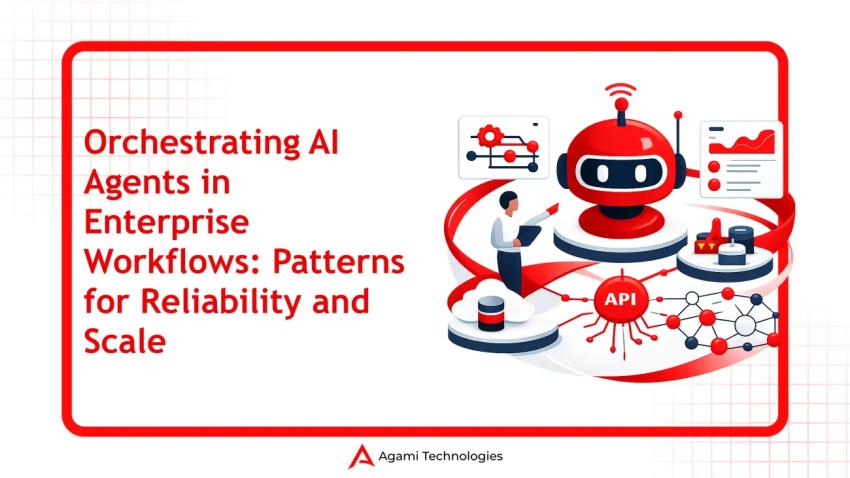
AI agent orchestration helps coordinate these activities by determining how tasks are assigned, how information is transferred, and how the workflow should respond when something goes wrong.
For organizations interested in learning more about enterprise AI-agent architectures, workflow patterns, reliability, and scalability, this detailed resource provides additional information:
AI Agent Orchestration: Enterprise Workflows, Patterns, Reliability & Scale
https://agamitechnologies.com/blog/orchestrating-ai-agents-enterprise-workflows-patterns-reliability-scale
Building Reliable AI Automation
Reliability should be considered before deploying AI into important business processes. AI systems can encounter unexpected inputs, incomplete information, API failures, or incorrect outputs.
Businesses can reduce these risks through validation, error handling, retry mechanisms, monitoring, access controls, and human review. These measures help ensure that automation does not operate without appropriate safeguards.
Monitoring AI Workflows
Businesses also need visibility into how their AI workflows operate. Monitoring can help teams understand which tasks were completed, where errors occurred, how long processes took, and whether individual agents are performing as expected.
Good observability makes troubleshooting easier and helps organizations continuously improve their automated workflows.
Scaling AI Across the Enterprise
Once an AI workflow has demonstrated reliable results, organizations can gradually expand it to other departments and processes. Modular agents can make this expansion easier because individual components can be modified without redesigning the complete system.
However, businesses should consider security, data access, infrastructure capacity, and integration requirements before scaling automation.
Human Oversight Remains Important
AI agents can automate many repetitive activities, but human expertise remains valuable. Employees can review exceptions, approve important actions, and handle situations that require business judgment.
Combining AI automation with human oversight can create a balanced approach where technology handles routine work while people remain responsible for important decisions.
Conclusion
AI agents are creating new opportunities for businesses to improve workflow automation. By combining specialized AI capabilities with effective orchestration, monitoring, security, and human oversight, organizations can build workflows that are more flexible and efficient.
The best approach is to start with a clearly defined business process, evaluate the results, improve reliability, and gradually expand AI automation as the organization gains experience.