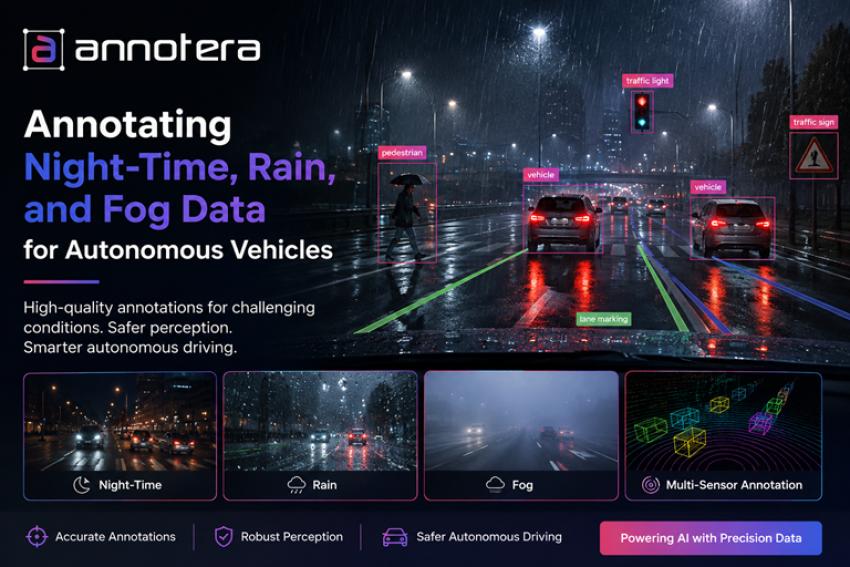
Autonomous vehicles are expected to operate safely across a wide range of real-world conditions—not only on clear, sunny roads. Night-time driving, heavy rain, dense fog, glare, reflections, and reduced visibility can significantly change how vehicles perceive their surroundings. For AI systems to respond reliably in these situations, they need training data that accurately represents challenging environmental conditions.
This is where specialized data annotation becomes essential. Carefully labeled images, video, LiDAR, and sensor data help autonomous driving systems distinguish road users, obstacles, lane markings, traffic signs, and environmental conditions even when visibility is compromised. High-quality data annotation for autonomous vehicle applications enables perception models to learn from the difficult scenarios they are most likely to encounter in the real world.
Why Adverse-Weather Annotation Matters
Autonomous vehicle perception systems rely on machine learning models trained on enormous volumes of sensor data. If the training dataset primarily contains clear-weather and daytime scenes, the resulting model may struggle when conditions change.
For example, a pedestrian wearing dark clothing may be difficult to identify at night. Rain can create reflections and distortions on cameras, while fog can obscure objects and reduce contrast. Lane markings may become difficult to distinguish, and LiDAR returns can be affected by environmental conditions.
Annotating these scenarios helps AI models understand not just what an object looks like under ideal conditions, but how that object appears when visibility, lighting, and sensor quality deteriorate.
Annotating Night-Time Driving Data
Night-time scenes present several challenges for autonomous vehicle perception. Low illumination reduces image contrast and can make pedestrians, cyclists, road edges, and other objects difficult to distinguish.
Annotation teams can label important elements such as:
Pedestrians and cyclists
Vehicles and motorcycles
Traffic signs and signals
Lane markings and road boundaries
Streetlights and illuminated objects
Road obstacles and debris
Headlights and taillights
Annotators may use bounding boxes, polygons, semantic segmentation, or instance segmentation depending on the requirements of the AI model.
Night-time datasets should also capture different lighting conditions, including urban streets, poorly illuminated roads, tunnels, intersections, and areas with strong headlight glare. Including these variations creates a more representative training dataset and helps models become less dependent on ideal lighting.
Labeling Rain-Affected Scenes
Rain introduces multiple visual and sensor-related complications. Water droplets on camera lenses, wet road surfaces, windshield reflections, splashes, and reduced contrast can all affect perception.
For annotation teams, rain data requires careful identification of objects despite partial visibility. A vehicle may be partly obscured by spray, while lane markings may appear distorted because of reflections on wet asphalt.
Useful labels can include:
Vehicles partially obscured by rain or spray
Pedestrians carrying umbrellas
Road lanes and markings
Puddles and wet-road regions
Traffic signs and signals
Roadside objects
Water accumulation and splashes
Annotators should maintain consistent rules for partially visible objects. For instance, annotation guidelines should clearly define whether an object remains eligible for labeling when only a portion of it is visible.
Consistency is particularly important because inconsistent labels can introduce noise into the training dataset and negatively affect model performance.
Annotating Fog and Low-Visibility Conditions
Fog is one of the most difficult conditions for autonomous perception because it reduces visibility and contrast across an entire scene. Objects that are clearly distinguishable in normal conditions may appear as faint silhouettes or partially disappear into the background.
Annotation teams may need to identify:
Vehicles at different visibility distances
Pedestrians and cyclists
Lane boundaries
Traffic signs
Road edges
Obstacles
Background and drivable areas
Distance and visibility can become particularly important when working with LiDAR or multimodal sensor data. Annotation protocols should define how to handle objects that are barely visible, partially obscured, or detectable through one sensor but not another.
The Role of Multimodal Sensor Annotation
Modern autonomous vehicles do not depend on cameras alone. They commonly combine information from cameras, LiDAR, radar, GPS, and other sensors to build a more complete understanding of their surroundings.
This makes sensor-specific annotation and sensor fusion particularly valuable.
For example, a pedestrian may be difficult to see in a foggy camera frame but still generate useful information through LiDAR. Similarly, radar may provide valuable object information during heavy rain or low-visibility conditions.
Annotating corresponding objects across multiple sensor streams allows machine learning systems to learn relationships between different modalities. This can support more robust perception and improve the vehicle's ability to reason about its environment when one sensor becomes less reliable.
Key Challenges in Adverse-Condition Annotation
Annotating night, rain, and fog data requires more than simply applying standard labeling techniques. Several challenges need to be addressed.
Ambiguous object boundaries: Low visibility can make it difficult to determine the precise boundaries of pedestrians, vehicles, and other objects.
Partial occlusion: Rain, fog, spray, glare, and darkness can hide portions of objects.
Sensor variation: Different sensors may capture the same scene differently, requiring carefully synchronized and consistent labels.
Long-tail scenarios: Rare events such as heavy fog, sudden downpours, glare, or nearly invisible pedestrians may be underrepresented in datasets.
Annotation consistency: Large-scale projects require detailed guidelines and quality-control processes to ensure different annotators interpret difficult scenes consistently.
Addressing these challenges requires a combination of experienced annotators, robust annotation guidelines, automated quality checks, and human review.
How Data Annotation Outsourcing Supports Scale
Building and maintaining large adverse-weather datasets internally can require substantial resources. Companies developing autonomous driving systems may need thousands or millions of labeled frames covering different locations, weather conditions, sensor configurations, and traffic scenarios.
Data annotation outsourcing can provide access to specialized annotation teams and scalable workflows without requiring organizations to build a large in-house labeling operation.
An experienced annotation partner can support projects involving image annotation, video annotation, LiDAR labeling, semantic segmentation, object tracking, and sensor-fusion datasets. Outsourcing can also help organizations scale annotation capacity when new datasets become available or when models require additional examples of challenging edge cases.
For autonomous vehicle developers, the goal should not simply be producing more labels. The priority should be producing accurate, consistent, diverse, and model-relevant training data.
Best Practices for High-Quality Annotation
Several practices can improve the reliability of adverse-condition datasets:
Create detailed annotation guidelines: Define rules for partial visibility, occlusion, reflections, glare, and uncertain objects.
Include diverse conditions: Capture different levels of darkness, rainfall, fog density, road types, and traffic environments.
Use multiple annotation formats: Select bounding boxes, polygons, segmentation, tracking, or cuboids according to model requirements.
Apply multi-level quality assurance: Combine automated checks, peer review, and expert validation.
Track difficult edge cases: Build dedicated datasets for rare but safety-critical scenarios.
Maintain sensor synchronization: Ensure labels remain correctly aligned across camera, LiDAR, radar, and other sensor streams.
These practices help create datasets that better reflect the complexity of real-world autonomous driving.
Building Safer Autonomous Driving Systems With Better Data
Autonomous vehicles cannot learn reliable perception from idealized road conditions alone. Night-time scenes, rain, fog, glare, reflections, and partial visibility represent critical parts of the driving environment and should be reflected in training datasets.
High-quality data annotation for autonomous vehicle systems gives developers the structured information needed to train perception models against these challenging scenarios. With the right annotation methodology, quality controls, and scalable workflows, organizations can strengthen model robustness while reducing the risks associated with data gaps.
At Annotera, we help AI companies build high-quality annotated datasets across image, video, LiDAR, and multimodal use cases. Our scalable annotation workflows are designed to support complex computer vision and autonomous vehicle applications where accuracy, consistency, and coverage matter.
Ready to strengthen your autonomous driving AI with better training data? Partner with Annotera to build accurate, scalable, and high-quality datasets for real-world perception challenges.