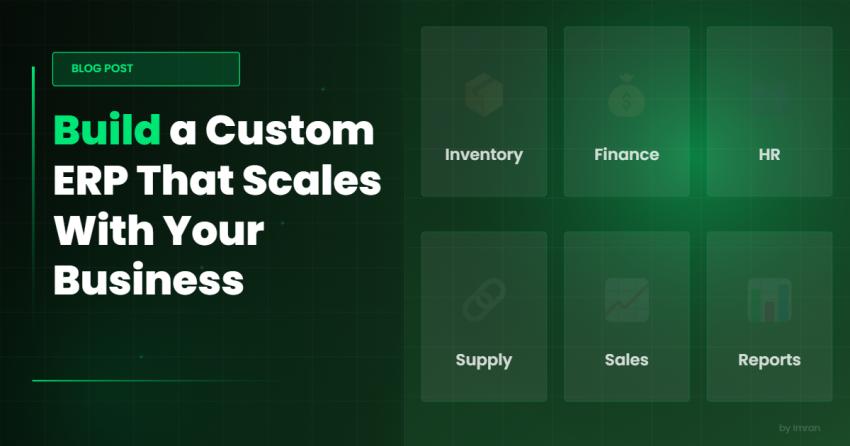
Most businesses don't outgrow their ERP because it stops working. They outgrow it because it was never built to grow in the first place.
You add a new warehouse, a new product line, or a new region — and suddenly the software that used to save time is now the thing slowing everyone down.
The Problem With "Good Enough for Now"
A lot of companies pick ERP software based on what fits today's team size and today's processes. That works fine, until it doesn't:
- New modules cost extra and still don't fit your workflow
- Reports take longer to generate as data volume grows
- Integrations with new tools become patchwork fixes
- Teams build workarounds because the system can't handle new processes
- Every update risks breaking something that used to work fine
None of this shows up in year one. It shows up in year three, right when you can least afford the disruption.
Why Scalability Has to Be Designed In, Not Added Later
Scalability isn't a feature you bolt on later. It's a decision made at the architecture level, before a single screen gets designed.
This is where custom ERP development services make a real difference. Instead of adapting your business to fit rigid software, the system gets built around how your business actually operates — and how it's likely to operate two or five years from now.
A scalable ERP is built with:
- Modular architecture so new functions plug in without rebuilding the core system
- Cloud-based infrastructure that handles growing data and user loads without performance drops
- API-first design for smooth integration with new tools as your tech stack evolves
- Flexible workflows that adjust as processes change, not rigid templates
- Multi-location and multi-currency support built in from day one, even if you're single-location now
What Growth Actually Looks Like on the Ground
Growth rarely announces itself politely. It shows up as a sudden spike in orders, a new hire every week, or a second facility opening faster than planned.
A properly built ERP absorbs that without falling over:
- Adding users doesn't mean slowing down the system for everyone else
- New departments get their own workflows without custom code from scratch
- Reporting stays accurate even as transaction volume multiplies
- Data stays consistent across every branch, warehouse, or team
This is the actual value of working with a Custom ERP Software Development company — not just solving today's problem, but building something that won't need replacing the moment things get busier.
Why India-Based Development Makes Sense for Growing Businesses
Businesses scaling within India face specific realities — GST compliance, regional tax variations, multilingual operations, and local vendor ecosystems that off-the-shelf global platforms often handle poorly.
Working with a provider offering custom ERP software solutions India businesses can rely on means these details are already accounted for, not treated as edge cases discovered after go-live.
Arobit Business Solutions Pvt. Ltd. builds systems this way — with growth accounted for at the planning stage, not patched in as an afterthought once the business has already outpaced its software.
Conclusion
The cost of a rigid ERP doesn't show up on day one. It shows up months later, in the form of delays, workarounds, and a system that fights your business instead of supporting it. If you're planning to grow — and most businesses are — it's worth building software that expects that growth, rather than one that needs to be replaced because of it.
Frequently Asked Questions
How do I know if my current ERP won't scale with my business? Common warning signs include slow report generation as data grows, needing manual workarounds for new processes, high costs for adding users or modules, and integration headaches every time you add a new tool. If your team spends more time working around the system than working with it, that's usually a sign it wasn't built to scale.
Is a custom ERP more expensive than off-the-shelf software in the long run? Off-the-shelf software often looks cheaper upfront, but licensing costs, add-on modules, and workarounds add up over time. A custom ERP has a higher initial investment but avoids repeated re-platforming costs later, since it's built to handle growth from the start rather than needing replacement.
How long does it take to build a scalable custom ERP system? It depends on the number of modules, integrations, and departments involved. A phased rollout — starting with core functions like inventory and finance, then adding modules over time — usually takes a few months for the initial phase, with full deployment spread across a longer roadmap based on business priorities.