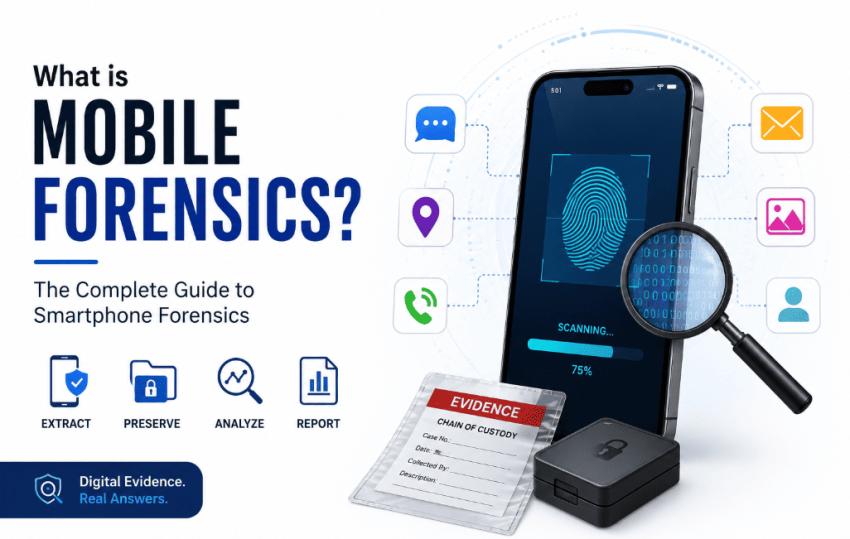
Smartphones have transformed the way people communicate, work, and store information. Every call, message, email, photo, application, and location update leaves behind digital traces. While these records help users stay connected, they also become valuable evidence during cybercrime investigations, legal disputes, and corporate inquiries.
Mobile forensics is the discipline that enables investigators to recover, preserve, and analyze this digital evidence without compromising its integrity. As smartphones continue to evolve with stronger encryption and cloud integration, forensic techniques have become more advanced than ever.
Table of Contents
Understanding Mobile Forensics
Why Smartphones Are Valuable Evidence Sources
How a Mobile Investigation Is Performed
Common Evidence Recovered from Smartphones
Challenges in Smartphone Investigations
Email Evidence in Mobile Investigations
Conclusion
Understanding Mobile Forensics
The term What is Mobile Forensics refers to the forensic process of collecting, preserving, examining, and reporting digital evidence from smartphones, tablets, and similar mobile devices using legally accepted procedures.
Unlike ordinary data recovery, forensic investigations ensure that every piece of information remains authentic and unchanged throughout the examination. This allows investigators to present reliable evidence during legal proceedings or corporate investigations.
Why Smartphones Have Become Important Sources of Evidence
Modern smartphones store an enormous amount of personal and professional information. Instead of carrying separate devices for communication, navigation, banking, photography, and entertainment, users perform everything from a single device.
As a result, smartphones often contain evidence that helps investigators answer important questions.
Examples include:
Communication records
Browsing activities
GPS movements
Social media interactions
Business documents
Cloud synchronized files
Email conversations
Multimedia content
These digital artifacts help reconstruct user activities and establish accurate timelines.
How Mobile Investigations Are Conducted
Professional forensic investigations generally follow several structured stages.
Device Preservation
Immediately after seizure, investigators isolate the device from wireless networks to prevent remote access, synchronization, or deletion of evidence.
Device Identification
The examiner records information including:
Manufacturer
Model
Operating system
Security configuration
Installed applications
Storage capacity
This information determines which forensic acquisition method should be used.
Data Collection
Specialized forensic software creates an exact forensic image of the device. Investigators always work on the forensic copy while preserving the original device as evidence.
Examination
The collected information is carefully analyzed to identify evidence related to the investigation. Multiple data sources are correlated to understand user behavior and digital activity.
Reporting
Finally, investigators prepare a detailed forensic report explaining the methods used, evidence discovered, timestamps, and conclusions while maintaining chain of custody documentation.
What Can Mobile Forensics Recover?
Depending on the condition of the device and available access, investigators may recover various forms of digital evidence, including:
SMS and MMS messages
Contact information
Call history
Emails
Photos and videos
Audio recordings
Browser history
Download records
Notes and reminders
GPS locations
Application databases
Calendar events
Deleted files when recoverable
Cloud synchronization information
Metadata associated with files
Much of this information helps establish who performed certain activities and when those activities occurred.
Challenges Faced During Mobile Forensics
Although forensic technology has improved significantly, smartphone investigations remain challenging due to several factors.
Strong Encryption
Modern Android and iOS devices protect user data using advanced encryption technologies.
Frequent Operating System Updates
Mobile operating systems receive regular security updates, requiring forensic tools to adapt continuously.
Cloud Storage
A significant portion of user information now resides in cloud platforms rather than local device storage.
Secure Messaging Applications
Many communication apps use end-to-end encryption, making evidence collection more complex.
Device Diversity
Thousands of smartphone models exist, each with different hardware and software configurations that require specialized handling.
Why Email Evidence Should Never Be Ignored
Although messaging applications receive much attention, email remains one of the most valuable sources of digital evidence.
Business communications, approvals, financial discussions, contracts, and confidential attachments are frequently exchanged through email accounts synchronized with smartphones.
Investigators often analyze:
Email messages
Attachments
Deleted emails
Email headers
Conversation history
Sender and recipient information
Time-based metadata
For comprehensive examination of email communications, many investigators rely on specialized Email Forensics Software capable of indexing large mailbox collections, recovering deleted emails, and generating detailed forensic reports suitable for investigations.
Conclusion
Smartphones have become one of the richest repositories of digital evidence available today. Every interaction leaves behind valuable artifacts that can help investigators reconstruct events, verify claims, and uncover hidden information.
Whether the investigation involves cybercrime, internal misconduct, fraud, or legal disputes, mobile forensics provides a reliable and scientifically accepted method of preserving and analyzing digital evidence. As mobile technology continues to evolve, forensic methodologies will remain essential for uncovering the truth while maintaining the integrity of digital evidence.