What Affects the Cost of Custom Enterprise LMS Development?
A purpose-built enterprise learning management system assists businesses in consolidating human resource training, simplifying tasks of administration, observing compliance, and stimulating personnel advancement. Contrary to more generic systems, it is shaped in accordance with the company’s processes, security standards, organization, and learning goals. An experienced enterprise LMS development company can help build such a solution around these specific needs.
The price of a custom enterprise LMS can differ from one application to another. A simple solution that caters solely to internal courses would be less expensive than a sophisticated solution including various AI functions, analytical tools, and integrations, with many users.
Being informed about the key aspects affecting the cost enables businesses to plan the budget to determine priorities and eliminate extra expenses for development.
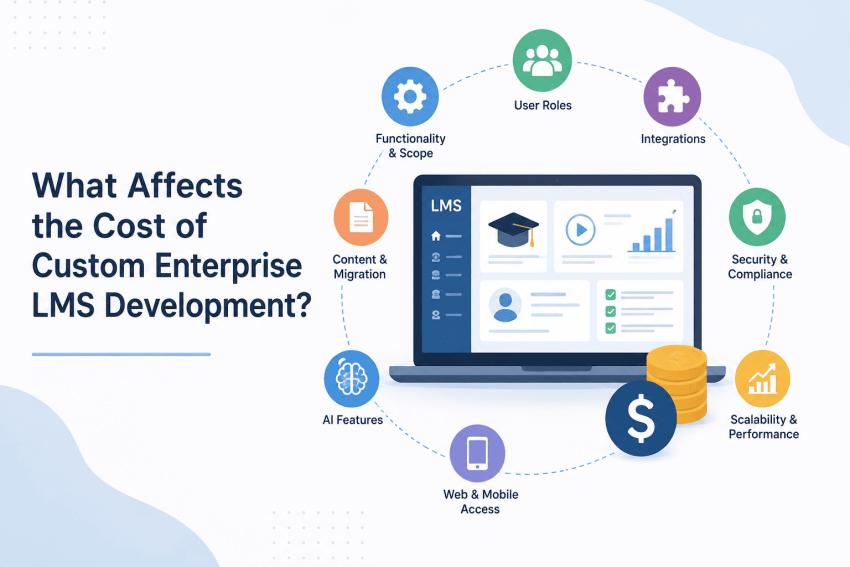
LMS functionality and project scope
The number and complexity of functionalities is the main factor affecting the cost. The simplest LMS usually consists of course management, exams, certificates, notifications, and progress monitoring.
Advanced systems can provide personalized learning paths, skills monitoring, compliance operations, elements of gamification, social learning, automatic enrollment processes, and extensive reporting.
Any additional functionality demands analysis, design, development, and testing. Therefore, users need to distinguish between the must-have features and those which can be incorporated later.
Number of user roles
Corporate LMSs regularly have users such as staff, trainers, supervisors, HR personnel, admins, service providers, and agents.
These roles are most possibly going to require their unique permissions, dashboards, and processes. Staff gets to access training classes and individual results, while the managers may need certain reports, permits, and knowledge shortage information.
The complexity of permission structure requires more resources in terms of writing code and testing since sensitive employee data should be kept safe.
UI and UX Designing
Standard interfaces are cheaper than custom designs. Costs may increase when there is a need for branded dashboards, interactive learning experiences, complex visualizations, and animations.
Accessibility options may also affect the price. These options require additional work in design and testing.
Strong UX is needed because people tend not to engage with hard-to-use platforms.
Integration with third-party software
An organization might have its own LMS that is integrated with existing systems utilized by the company, like, for example, HR software, CRM solutions, identification management tools, video conferencing systems, storage systems, and business intelligence systems as a basis.
Prices for integration depend on the quality of the API, data format, synchronization frequency, documentation, and security requirements. Old software may need additional development when modern APIs are not accessible.
Content migration and standards
Organizations migrating to a new learning management system may need to transfer their users' profiles, courses, assessment scores, certificates, and history.
The cost of migration depends on many factors, such as how much data needs migrating and what kinds of data it is. If the information is inconsistent or old, then it needs to be cleaned up, transformed, or validated.
Using standards such as SCORM, xAPI, and LTI can increase the complexity of the process, but they make it possible to reuse content and link up with external learning solutions.
Security and compliance
Enterprise LMS platforms allow for the processing of employee data, training records, and professional credentials. The security characteristics of common LMS platforms are comprised of role-based security access, single sign-on authorization, multi-factor authentication, encryption, audit, and backup logs.
Costs for implementing LMS platforms can be greater in regulated sectors such as healthcare, finance, and government as the requirements for data security, documentation, and auditing become much more stringent.
Performance and scalability
The anticipated user count will determine how complex the architecture of the system has to be. While a system for a few hundred users requires minimal infrastructure, a platform designed to cater to several thousands of learners needs more resources.
The development team has to factor in a number of parameters, including the number of simultaneous users, video streaming capabilities, reporting load, data load, and even the projected growth of the system.
Web and mobile coverage
A responsive website is usually less expensive than creating separate web, iOS, and Android apps.
Mobile applications have their own design, development, testing, implementation, and maintenance costs. Some functions such as offline learning, downloadable materials, notifications, and synchronization might make the cost even higher.
Organizations should determine whether the use of a responsive web LMS is enough or whether the workers need mobile applications.
AI-powered features
Artificial intelligence makes it possible to benefit from features such as course suggestions, content creation, quiz building, skills gap analysis, summaries, and conversational learning assistants.
To ensure the use of these characteristics, the user has to think about model integration, data preparation, testing, monitoring as well as security controls.
Development team and delivery model
Size and location of a development team and delivery model.
The ultimate budget is determined by various parameters of the team of specialists, along with the chosen delivery model. The LMS project requires business analysts, designers, developers, QA engineers, DevOps specialists, and project managers among other professionals.
An experienced enterprise and EdTech development team may charge more, but it is able to eliminate technical risks, avoid mistakes in the architecture of the project, and offer the best solutions.
Wrap up
The price of tailor-made LMS solutions for organizations varies with features and functions, number of users, design, level of information security, scalability capacity, and mobile access.
In the process of project discovery and phased development, a company may save budget resources. The realization of core features first will give the opportunity to accelerate the time of launch and increase the number of improvements achieved based on actual experience and needs.