Introduction
Hair loss normally affects millions globally. It is an inevitable problem experienced by most individuals with ageing. For some, hair fall becomes part of their daily life, while for others it can cause serious psychological and emotional distress. Whether it's gradual thinning, a widening part, or excessive shedding, losing hair can be frustrating—especially when conventional treatments don't deliver the desired results.
Exosome Therapy for Hair Loss has caught the attention of both dermatologists and clinicians in the past decade. The approach focuses on creating a healthier environment for hair follicles that support tissue repair and cellular communication.
Early clinical findings suggest that exosome treatment for hair loss can potentially offer a solution for individuals looking for a minimally invasive and long-term solution.
What is Exosome Therapy for Hair Loss?
Exosomes are nano-sized extracellular vesicles that are naturally released by stem cells. These are tiny biological messengers that carry various bioactive molecules (proteins, microRNAs, lipids, cytokines, and growth factors). For hair restoration, exosomes are used to deliver these regenerative signals directly to the target area of the scalp. They boost cellular communication and activate dormant hair follicles. It pushes the hair follicle from the telogen to the anagen phase. The goal isn't to replace damaged cells but to encourage existing hair follicles to function more effectively.
This is one of the key differences between exosome therapy and stem cell therapy. Stem cell therapy involves living cells, whereas exosome therapy uses the signalling molecules produced by those cells. Because of this, exosome therapy is often described as a cell-free regenerative approach.
How Exosomes May Support Hair Growth?
Healthy hair follicles naturally cycle through phases of growth, rest, and shedding. In conditions like androgenetic alopecia, this cycle becomes disrupted, causing follicles to shrink over time and produce thinner, weaker hair.
Exosomes for Hair Loss Treatment are being studied for their ability to influence this process by supporting the cells responsible for hair growth.
Research suggests that exosomes may:
Stimulate dermal papilla cells, which help regulate the hair growth cycle.
Encourage inactive hair follicles to return to the active growth phase.
Support the formation of new blood vessels, improving nutrient delivery to hair follicles.
Reduce inflammation around the follicles, which may contribute to hair thinning.
Promote a healthier scalp microenvironment
Who May Benefit from Exosome Treatment for Hair Loss?
Exosome therapy is being explored for several types of hair loss, particularly when hair follicles are still present but functioning less efficiently.
It may be considered for people with:
Androgenetic alopecia
Individuals experiencing early-stage hair thinning
Stress or hormonal changes associated with hair loss
Diffuse thinning rather than complete baldness
Individuals looking for a non-surgical hair restoration solution
What Happens During the Procedure?
The exact procedure differs among clinics and the individual's condition. The standard procedure implies an outpatient procedure. The steps include:
Consultation, where the specialist evaluates the pattern of hair loss, scalp condition, and medical history.
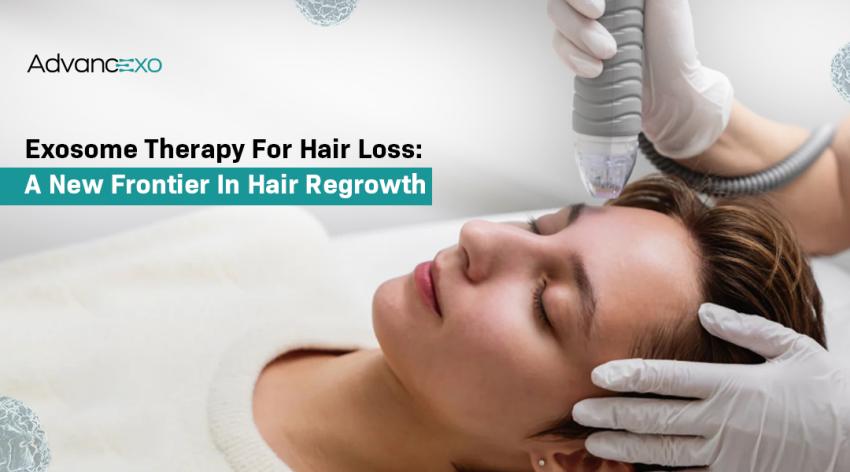
On the day of treatment, the scalp is cleaned thoroughly—a topical numbing cream is applied to improve comfort. The exosome preparation is then delivered to the scalp, either through fine injections or with microneedling, depending on the treatment plan.
The procedure takes 30-60 minutes; most people return to their normal routine the same day. Mild redness or tenderness can occur but usually settles within a day or two.
For the best results, multiple treatment sessions may be recommended, followed by maintenance sessions based on individual progress.
Benefits of Exosome Therapy for Hair Loss
Interest in exosome therapy for hair loss continues to grow because of its regenerative potential and minimally invasive nature.
Some potential benefits include:
Minimally invasive procedure
Minimal downtime
Support for healthier hair follicles
Potential improvement in hair thickness and density
Applies as a combination therapy with other procedures like PRP, microneedling
Exosome Therapy vs PRP: What's the Difference?
Both exosome therapy and platelet-rich plasma (PRP) are regenerative approaches, but they work differently.
PRP is prepared from the patient's own blood and contains platelets that release growth factors to stimulate healing. Exosome therapy delivers naturally occurring extracellular vesicles that carry a wider range of signalling molecules involved in cellular communication.
A larger body of clinical evidence backs PRP for hair restoration. Exosome therapy is a new approach and requires large-scale clinical trial data to determine its safety and efficacy.
Safety, Results, and What to Expect
Current studies suggest that exosomes for hair loss are generally well tolerated when sourced, processed, and administered appropriately.
There are negligible side effects reported that are short-term. This includes redness, slight swelling, or tenderness at the treatment site.
Hair restoration is a gradual process, so visible improvements should not be expected immediately. Many people notice a reduction in hair shedding before seeing changes in hair thickness or density. Since hair grows in cycles, meaningful results often take several months to appear.
Although the early research is encouraging, exosome therapy is still an evolving field. Larger clinical studies are needed to understand better its long-term effectiveness, ideal treatment schedules, and the patients who are most likely to benefit.
Conclusion
The hair restoration treatment regimen has moved beyond conventional methods. Exosome therapy for hair loss supports the body's natural repair processes and produces long-term outcomes.
Although it is not a cure, Exosome Treatment for Hair Loss shows encouraging potential for improving scalp health and supporting healthier hair growth in appropriately selected individuals. As clinical research continues to grow, exosomes may become an increasingly valuable part of personalised hair restoration strategies.