Hair loss doesn't discriminate anymore. Walk into any dermatology clinic in Delhi today and you'll find men in their late twenties sitting next to women in their forties, all dealing with the same frustration — thinning hair that no shampoo or serum seems to fix. Genetics plays the biggest role, but stress, poor nutrition, thyroid issues, and even pollution levels in a city like Delhi can speed up the process.
For people who've crossed the point where medicines and topical treatments can help, a direct hair transplant in Delhi is often the only real path back to a full head of hair. This guide walks through what the procedure actually involves, who it's suited for, and what you can expect to pay — so you're not walking into a consultation blind.
What Exactly Is a Direct Hair Transplant?
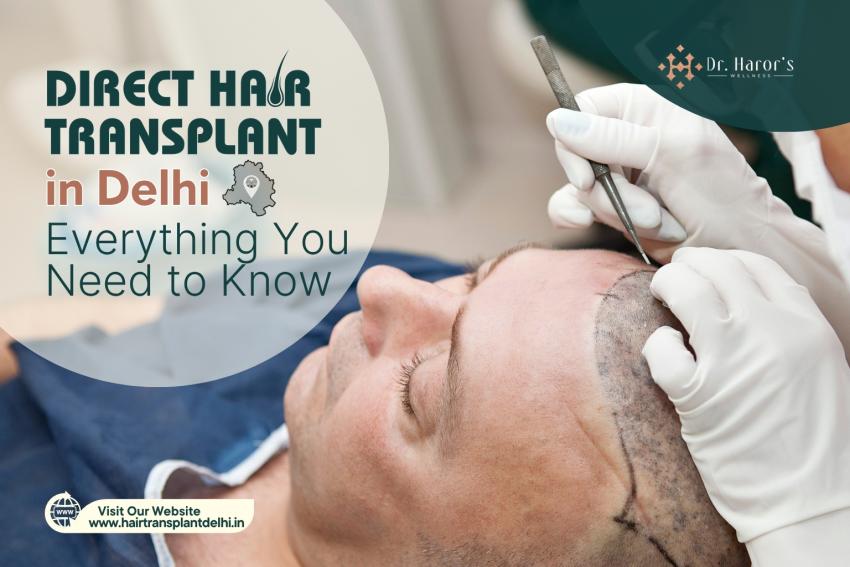
Direct Hair Transplant, commonly shortened to DHT or DHI, is a refined version of the FUE (Follicular Unit Extraction) method. Instead of extracting grafts and setting them aside before implantation, the surgeon uses a specialised tool called an implanter pen — often referred to as a Choi pen — to lift each follicle and place it into the scalp in one continuous motion.
This single-step approach gives the surgeon tighter control over three things that matter most for a natural result: the angle at which hair grows, the direction it flows in, and how deep each graft sits. That level of precision is why the technique has become the go-to choice for anyone wanting a hairline that doesn't look "done."
How the Procedure Actually Unfolds
If you're booking a direct hair transplant in Delhi, here's roughly what the day looks like from start to finish.
1. The Initial Consultation
Before any procedure begins, a good clinic will spend real time understanding your hair loss pattern. This includes checking your donor area's density, asking about family history, reviewing any medications you're on, and figuring out how many grafts your case will realistically need. Skipping this step is one of the biggest red flags to watch for when choosing a clinic.
2. Numbing the Area
Local anaesthesia is applied to both the donor zone (usually the back and sides of the head) and the recipient area where new hair will be placed. This keeps the entire process pain-free, though you may feel mild pressure at times.
3. Extracting the Follicles
Using fine micro-punch tools, the surgeon removes individual follicular units one at a time from the donor region. Because each extraction point is so small, healing is fast and scarring is barely noticeable — a big reason people prefer this over older strip-harvesting methods.
4. Direct Implantation
Here's where DHT separates itself from standard FUE. Each extracted follicle is loaded straight into the implanter pen and inserted into the recipient site immediately, with no gap between extraction and placement. This reduces the time grafts spend outside the body, which in turn improves survival rates and graft density.
5. Recovery
Once the session wraps up, you'll be given clear instructions on how to wash your scalp, which medications to take, and when to come back for a follow-up. Most people return to normal daily routines within a few days, though strenuous exercise and direct sun exposure are usually restricted for a couple of weeks.
Am I a Good Candidate for DHT?
Not everyone who wants a transplant is an ideal fit for one right away. A few things clinics typically look at:
Age — Most surgeons prefer patients to be at least 25, since hair loss patterns before that age can still be changing and unpredictable.
Hair texture — Thicker, coarser hair strands tend to give denser-looking results than very fine hair.
Donor area density — If your donor zone has fewer than roughly 40 follicles per square centimetre, a surgeon may recommend a different approach or additional sessions.
If you're unsure where you stand, this is exactly what the consultation is for — a proper scalp assessment will tell you far more than any online calculator.
Direct Hair Transplant Cost in Delhi
This is usually the first question people ask, so let's get straight to it. The direct hair transplant cost in Delhi generally falls somewhere between Rs. 95 and Rs. 150 per graft, not including applicable taxes. Since each graft can carry one to three hair follicles, a full session commonly ends up costing anywhere from Rs. 1,80,000 to Rs. 2,00,000, depending on your case.
A few things push this number up or down:
Number of grafts needed — More extensive hair loss naturally means more grafts, which increases the total bill.
Degree of baldness — Someone with early-stage thinning will pay noticeably less than someone restoring a fully bald crown or hairline.
Technique used — Because DHI relies on specialised implanter pens and a more hands-on process, it typically costs a bit more than a standard FUE transplant, but the trade-off is usually better precision and graft survival.
It's worth being cautious of clinics quoting prices far below this range — in hair restoration, unusually cheap often means rushed extractions, lower graft survival, or inexperienced technicians handling the procedure.
Frequently Asked Questions
Is a direct hair transplant permanent? Yes. Transplanted follicles are typically taken from areas genetically resistant to balding, so once they take root and grow, they behave like normal, permanent hair.
How long before I see results? New growth usually starts appearing around the third or fourth month, with fuller, more visible results developing between eight and twelve months post-procedure.
Does DHT hurt? The area is numbed with local anaesthesia throughout, so the procedure itself is largely painless. Mild soreness or tightness afterward is normal and manageable with basic aftercare.
How is DHT different from FUE? FUE separates extraction and implantation into two distinct steps, with grafts stored temporarily before placement. DHT combines both into a single motion using an implanter pen, which shortens the time grafts spend outside the scalp and often results in a more natural hairline.
Final Thoughts
Hair loss can wear down confidence quietly, over months and years, until it starts affecting how you show up in everyday life. The good news is that transplant technology has come a long way — a well-performed direct hair transplant in Delhi today can restore not just hair, but a sense of normalcy that many people thought they'd lost for good.
If you're exploring your options, Dr. Haror's Wellness offers detailed consultations and a precision-focused DHI procedure designed around your specific scalp, hair type, and goals. Book a consultation to get a realistic assessment of what's possible for you — and a clear, honest breakdown of cost before you commit to anything.