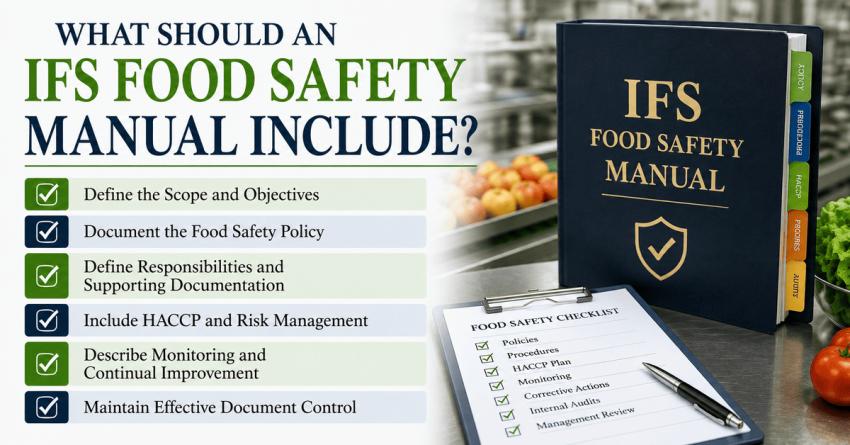
An IFS Food Safety Manual provides the documented framework needed to implement and maintain an effective food safety management system in accordance with IFS Food Version 8. It helps organizations establish consistent processes, demonstrate regulatory compliance, improve product quality, and prepare confidently for certification audits.
Organizations seeking IFS Food certification should ensure their manual accurately reflects their operational procedures, responsibilities, and documented information. A well-structured manual supports effective implementation, simplifies audits, and promotes continual improvement across the organization.
Define the Scope and Objectives
Every IFS Food Safety Manual should begin by clearly defining the scope of the food safety management system. This section identifies the products, production processes, manufacturing locations, and activities covered under the certification. It should also explain the organization's food safety objectives, applicable statutory and regulatory requirements, and customer expectations.
A clearly documented scope helps employees understand the boundaries of the management system while providing certification auditors with a clear overview of the organization's operations.
Document the Food Safety Policy
The manual should include a documented food safety policy that demonstrates top management's commitment to producing safe, legal, and high-quality food products. The policy should align with the organization's strategic objectives and emphasize regulatory compliance, customer satisfaction, employee awareness, and continual improvement.
Management should communicate this policy throughout the organization and review it periodically to ensure it remains relevant and effective.
Define Responsibilities and Supporting Documentation
An effective IFS Food Safety Manual should clearly define the responsibilities of top management, the food safety team, department heads, production personnel, internal auditors, and document controllers. Clearly assigned responsibilities improve accountability and ensure the management system operates effectively throughout the organization.
Rather than describing every operational activity in detail, the manual should reference the documented procedures, forms, and records that support implementation. Organizations looking to simplify documentation and accelerate implementation can benefit from an editable IFS Food Safety Manual that includes professionally prepared procedures, templates, SOPs, HACCP documentation, and implementation records aligned with IFS Food Version 8 requirements.
Supporting IFS Food Safety documents commonly include:
- Food safety procedures
- Standard Operating Procedures (SOPs)
- HACCP documentation
- Supplier approval procedures
- Product traceability and recall procedures
- Corrective action procedures
- Internal audit checklists
- Forms, records, and implementation templates
Maintaining well-organized documentation makes implementation easier while providing objective evidence during certification audits.
Include HACCP and Risk Management
Hazard Analysis and Critical Control Points (HACCP) is one of the most important components of the IFS Food Safety Manual. The manual should explain how food safety hazards and operational risks are identified, evaluated, controlled, monitored, and verified throughout the production process.
It should also reference supporting documentation such as hazard analyses, Critical Control Point (CCP) monitoring records, prerequisite programs (PRPs), verification activities, validation records, and risk assessment reports. Effective HACCP documentation demonstrates a systematic approach to preventing food safety hazards before they affect products.
Describe Monitoring and Continual Improvement
The manual should explain how the organization measures and improves the effectiveness of its food safety management system. This includes internal audits, management reviews, corrective and preventive actions, customer complaint analysis, supplier performance evaluation, and ongoing monitoring of food safety objectives.
Regular reviews help identify nonconformities, improve operational performance, and maintain compliance with IFS Food Version 8 requirements.
Maintain Effective Document Control
An effective document control system ensures employees always use the latest approved versions of manuals, procedures, SOPs, and records. The manual should describe how documents are prepared, reviewed, approved, revised, distributed, and retained.
Proper document control minimizes errors, improves consistency, and supports successful certification and surveillance audits by ensuring documented information remains accurate and up to date.
Conclusion
A well-structured IFS Food Safety Manual is essential for implementing an effective food safety management system and achieving IFS Food certification. By defining the scope, documenting food safety policies, assigning responsibilities, maintaining complete IFS Food Safety documents, implementing HACCP, and controlling documented information, organizations can strengthen compliance, improve operational consistency, and confidently prepare for certification audits.