By Dr. Sowjanya Aggarwal | MBBS, MS (Obs & Gynae), Fellowship in Reproductive Medicine | Founder, Femmenest IVF Centre, Delhi
A transvaginal ultrasound, or TVS as most people end up calling it, is one of those scans we do almost every single day here, and still it is the one patients walk in most nervous about, nearly always for the same reason. Will it hurt. So let me answer that straight away, because there is no sense making you read to the end for it. For the large majority of women TVS is not painful, you feel some pressure, a sense of fullness for a moment, and that is really where it ends. At Femmenest we use it constantly, for tracking fertility cycles, for confirming an early pregnancy, for the ordinary gynae checks. And in our experience the women who know beforehand exactly what is coming are the ones who find the whole thing far less of an ordeal.
What Is a Transvaginal Ultrasound and How Does It Work?
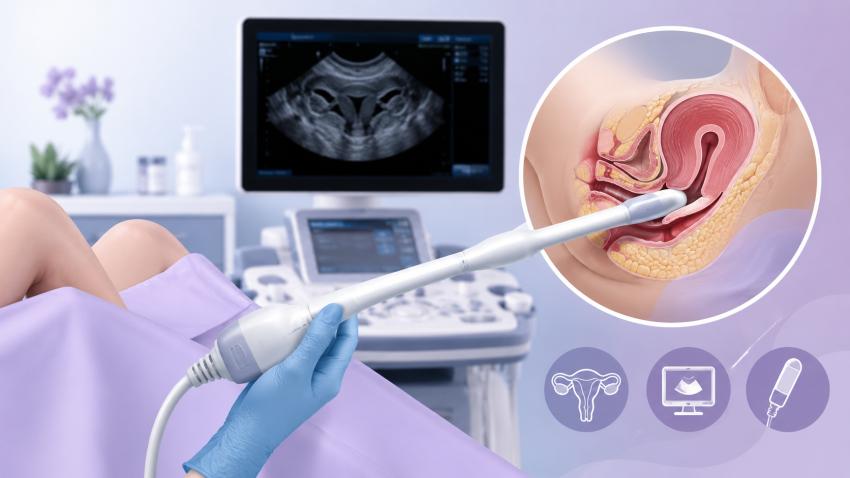
A transvaginal ultrasound is a scan done with a thin, smooth probe, roughly 2–3 cm across at its widest, which is eased gently into the vagina to give us a clear picture of the pelvic organs. Before it goes in the probe is covered with a sterile protective sheath and coated with gel.
Now, an abdominal ultrasound looks at the pelvis from the outside, through the skin, and it wants a full bladder to work. TVS does not bother with any of that. The probe sits right up against the organs we are trying to see. That closeness is the whole point of it, it gives us a much sharper image, and for the small things especially, the ovarian follicles, a pregnancy in its first weeks, a uterine polyp, it picks up detail an abdominal scan would simply skate over.
Why Is a TVS Scan Done?
TVS earns its place because so much of fertility and gynae work leans on it. A few of the things we use it for:
Follicle monitoring: following how the follicles grow and ripen through ovulation induction or an IVF stimulation, which is a core part of the follicular study process that maps that development across several scan days
Ovarian reserve assessment: counting the antral follicles (AFC) to get a sense of the egg supply you have left before any treatment starts
Early pregnancy confirmation: picking up the gestational sac and the foetal heartbeat as early as 5–6 weeks, and it is also how we check whether conception has followed successful follicular maturation
Endometrial thickness assessment: this one matters a great deal for timing an embryo transfer in an IVF cycle
PCOS evaluation: reading the polycystic ovarian picture through ovarian volume and how the antral follicles are spread out
Fibroid and polyp detection: intrauterine polyps and submucosal fibroids show up on TVS far more readily than on an abdominal scan
Abnormal bleeding investigation: to look at the endometrium and find what is structurally behind the bleeding
Obstetric monitoring: the detailed early pregnancy and growth checks too, which sit alongside the comprehensive obstetric ultrasound services offered at Femmenest IVF Centre.
Is Transvaginal Ultrasound Painful?
This is the one everybody asks, and it deserves an honest, plain reply.
For most women, no. TVS does not hurt. What you feel is mild pressure, or a brief sense of fullness as the probe is turned to look at one structure and then another. It is nothing like a speculum examination, and in a straightforward case there is no sharp or intense pain in it at all.
Some women do find it more uncomfortable than that. Usually those with one of the following:
Vaginismus: the vaginal muscles tighten on their own, and we manage this with a gentle, patient-led pace, and you can ask us to stop at any point
Active pelvic infection: when there is a lot of acute inflammation going on we tend to put the scan off for the time being
Advanced endometriosis with dense adhesions: the pelvic tissue is already tender, so it can be more sensitive as the probe moves
Significant vaginal dryness or vulvodynia: here we use extra lubrication and go slower
If any of that sounds like you, do tell the doctor or the sonographer before we begin, so we can adjust how we go about it.
Who Should Not Have a TVS?
In India we generally do not perform TVS on women who have not been sexually active, and that is out of respect for cultural norms and for the patient's own preference. When that is the case:
Transabdominal ultrasound (done over a full bladder through the wall of the abdomen) is the usual alternative we turn to
MRI is used where we need detailed soft tissue information and neither of the other two will do
Raise it openly with your doctor when you book. There is genuinely nothing here to be embarrassed about.
How Should You Prepare for a Transvaginal Ultrasound?
Empty your bladder first. TVS does not want a full one, and in fact a full bladder makes the image worse
Wear something comfortable that is easy to change out of
You do not need to fast
Bring along any earlier scan reports, or whatever cycle information your doctor asked you for
A sanitary pad can be handy for afterwards, since there may be a little lubricant gel
What Happens Step by Step During a TVS?
We ask you to remove your clothing below the waist and give you a modesty sheet on the examination couch
Your legs rest in a slightly bent position, much the same as a routine gynae examination
The doctor or sonographer talks you through each step before doing it, and you can pause or stop whenever you want
The covered, lubricated probe goes in slowly and gently
A little pressure is used as the probe is angled to see each ovary, the uterus, and the endometrial cavity
The imaging itself takes somewhere between 5 and 15 minutes
The probe comes out and the gel is wiped away
What Happens After the Procedure?
You go straight back to your day. Work, driving, exercise, all fine
A bit of light spotting is possible, though it is uncommon and settles on its own
You might notice a small amount of lubricant gel, which is perfectly normal
Your doctor will usually go over the findings with you in that same appointment