Paper business cards had a good 200-year run. Here's why the next decade belongs to digital — and the data to back it up.
Walk into any conference this year, and you'll notice something: fewer wallets snapping open, more phones tilting toward each other. That shift isn't accidental. It's the result of a slow, steady realization among professionals that the paper card in their pocket is quietly working against them.
For a growing number of sales representatives, founders, recruiters, and consultants, digital business cards have evolved from a "nice-to-have novelty" to the standard networking tool. But is this just another tech trend riding the sustainability wave, or is the change truly warranted? In all honesty, the data on paper business cards is worse than most people think, and the advantages of digital business cards go much beyond "it's more modern." I have spent years observing how people exchange contact information at gatherings.
This article breaks down the real comparison — cost, waste, follow-up rates, first impressions, and practical limitations — so you can decide which format actually earns a place in your networking strategy.
What Are Digital Business Cards, Exactly?
A digital business card (sometimes called a virtual business card or electronic business card) is a shareable online profile that holds the same information as a printed card — name, title, company, phone, email — but in a format that can be sent instantly via QR code, NFC tap, text message, or link. Instead of handing someone a piece of cardstock, you hand them a live, editable, trackable version of your professional identity.
The system differs depending on the platform. Some rely on NFC-capable cards or phone cases that send your information with a single tap. Others use a QR code to access a mobile-optimized landing page. In any case, instead of having a card in a drawer that needs to be manually inserted, the recipient usually ends up with your contact information saved on their phone.
This is also where a newer category of tools comes in — not just cards that get shared, but systems built around what happens after the exchange. Platforms like RoloScan approach the problem from the receiving end: instead of just issuing you a digital card, they use AI-powered OCR to scan any card (paper or digital) you're handed, pull out the contact fields automatically, and sync the lead straight into a CRM like Salesforce, HubSpot, or Zoho. For someone working a trade show floor and collecting forty contacts a day, that distinction matters — a nice-looking digital card solves your outbound problem, but a capture-and-sync tool solves the "what happens to all these leads afterward" problem, which is arguably the bigger one.
Digital vs Paper Business Cards: The Core Comparison
Let's get to the numbers, because this is where the paper-card argument really starts to fall apart.
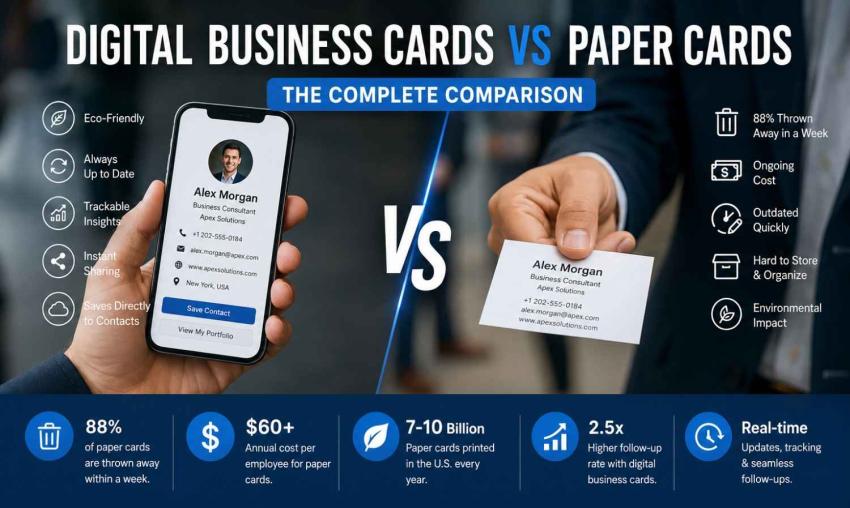
Roughly 88% of paper business cards are thrown away within a week of being handed out, according to data compiled across multiple industry sources, including UPrinting and QRCodeChimp. Of the estimated 7 to 10 billion cards printed annually in the U.S. alone, the overwhelming majority never generate a single follow-up. That's not a marginal inefficiency — it's the dominant outcome of handing someone a paper card.
Compare that to what happens with a digital card. Because the contact saves automatically to the recipient's phone (rather than requiring them to manually type it in later, which most people simply never get around to), the information survives past the initial exchange. Some platforms also report that digital-card recipients convert into follow-up conversations at meaningfully higher rates than paper-card recipients, since the friction of "I'll add this later" is removed entirely.
Expense Over Time
The cost of a typical box of 500 paper cards ranges from $20 to $100, and that's before you account for the ongoing expenses each time your company, title, or phone number changes. When you multiply that by the number of employees on a sales team of 50 or 100, the actual yearly expenditure quickly mounts up. Industry estimates place the annual cost of paper cards at approximately $60+ per employee after reprints are taken into account. Digital cards, on the other hand, update quickly and can be "reprinted" for free. The majority of subscription-based platforms have lower annual costs per employee, and some even provide free tiers.
Impact on the Environment
At this stage, sustainability becomes a quantifiable line item rather than just a talking point. Large-scale paper card production uses water and trees, and since most of them end up in landfills within a matter of days, they contribute to needless waste. By simply switching formats, a business with a few thousand employees can eliminate a real, quantifiable amount of paper waste without requiring any behavioral changes beyond forming a new habit.
Quickness and Convenience
One real benefit of paper cards is that they don't need an app, a connection, or a battery. A physical card still works instantly if you're in an area with poor connectivity or meeting someone who doesn't use a smartphone. It's a valid statement and the best defense that proponents of paper cards still have.
Digital Business Card Benefits Beyond the Obvious
The environmental and cost arguments get most of the attention, but the operational benefits are arguably more important for professionals who network heavily.
Updates in Real Time
Change jobs, get promoted, update your phone number — your digital card reflects it instantly for everyone who has ever saved it. A paper card with outdated information isn't just useless; it actively sends people to the wrong place.
Greater Knowledge, Same Compact Size
What you may physically include is limited by a 3.5" x 2" card. With just a tap or scan, you can access your portfolio, case studies, booking calendar, social media connections, and even brief video introductions on a digital profile.
Trackable Engagement
This is the one paper simply can't compete with. Digital cards let you see who opened your profile, which links they clicked, and when they clicked them. That's not a small perk — it turns a passive networking tool into an active source of intent data, something sales and marketing teams increasingly build workflows around.
Quicker Monitoring
Because the contact information lands directly in a phone or, in the case of AI-powered scanning tools, directly into a CRM with a suggested follow-up email already drafted, the gap between "we met" and "we talked again" shrinks dramatically. That gap is exactly where most paper-card relationships quietly die.
Where Paper Business Cards Remain Relevant
Pretending that paper has no more space would be dishonest. A phone tap doesn't have the same cultural significance as a real card exchange in some places, particularly in Japan and parts of East Asia. A card is still expected by some older executives and by extremely conventional companies (such as law firms, private banks, and some government sectors). Additionally, paper just doesn't malfunction as a dead phone battery does in truly offline settings, such as remote job sites or some production floors.
The practical lesson is not that "paper is dead." The reason is that most professionals would be better off using digital as the primary format with a tiny stack of paper cards as a backup, as paper has become the exception rather than the rule.
Making the Switch: What Actually Matters
If you're evaluating a move to digital, the decision usually comes down to two separate needs that get conflated:
Sharing your own information — this is what most "digital business card" products solve. NFC cards, QR-based profiles, and app-based cards like Wave Connect or similar platforms handle this well.
Managing the information you receive — this is a different problem entirely, and it's the one most people underestimate. If you're the one collecting dozens of contacts at events, the bottleneck usually isn't your own card — it's what happens to the pile of cards (paper or digital) you walk away with. This is the gap AI-driven lead-capture tools like RoloScan are built to close: scanning cards or badges, extracting the data with OCR, enriching it, and pushing it straight into your CRM with follow-up drafts ready to send, rather than leaving forty contacts sitting untouched in a phone's camera roll until they're forgotten.
Understanding which problem you actually have — sharing or capturing — will point you toward the right tool faster than any generic "best digital business card app" list will.
Conclusion: Digital Business Cards Are the Practical Default Now
The comparison isn't close once you look at the actual data. Paper cards are thrown away at a rate approaching 9 out of 10, cost more over time, generate real environmental waste, and go stale the moment your information changes. Digital business cards solve nearly every one of those problems simultaneously — lower cost, instant updates, trackable engagement, and dramatically better odds of surviving past the initial handshake.
Paper does not instantly vanish, though. In 2026, most professionals should adopt a digital-first, paper-as-backup approach. For those who are overwhelmed with contacts after a conference or trade show, using an AI-powered capture tool in conjunction with a digital card truly transforms networking into follow-up rather than a stack of cards that no one ever gets around to.