Introduction
Hair loss is experienced by both men and women with ageing. For some individuals, hair loss becomes part of their ageing, while for others it can be emotionally and psychologically stressful. There are various causes of hair loss, among which androgenetic alopecia (genetic cause)remains the leading cause of progressive hair thinning worldwide. The condition is also often male- or female-pattern hair loss. This condition develops gradually and is influenced by genetics and hormones. For many people, the emotional impact can be just as significant as the physical changes, affecting confidence and quality of life.
Medical and hair transplantation are well-established treatment options, but they do not promise hair rejuvenation naturally. The emergence of stem cell therapy for androgenetic alopecia indicated new possibilities as an advanced hair regeneration solution. It is crucial to understand the hair fall condition and how the regenerative treatment works to choose the Best Treatment For Androgenetic Alopecia.
What Is Androgenetic Alopecia?
Androgenetic alopecia (hereditary hair loss) leads to baldness in both men and women—the hair loss occurs with a combination of genetic predisposition and hormonal activity. The hormone dihydrotestosterone (DHT) plays a central role by gradually shrinking genetically susceptible hair follicles. Over time, affected follicles produce thinner, shorter hairs until they eventually stop generating visible hair.
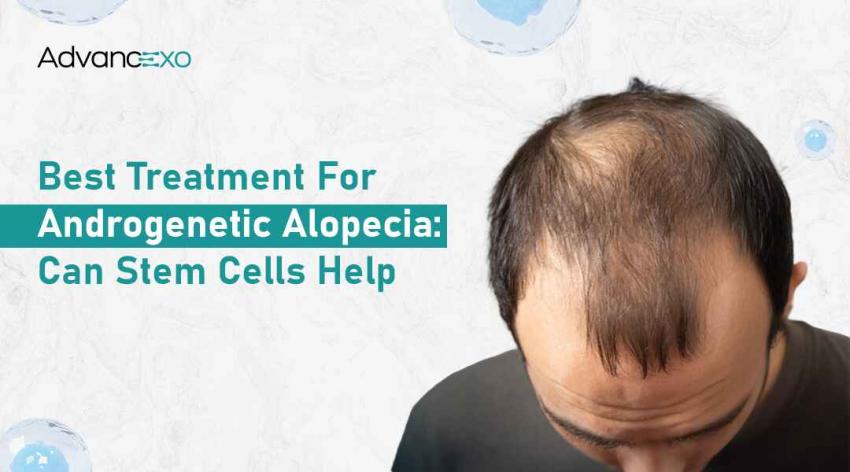
Androgenetic alopecia in men is characterized by a receding hairline and hair thinning at the crown area becomes evident. In contrast, women notice diffuse thinning over the top of the scalp, and the frontal hairline remains intact. The condition develops progressively, and without adequate treatment, it worsens.
Stages of Androgenetic Alopecia
Androgenetic alopecia stages determination enables dermatologists to take adequate treatment options based on the individual's needs.
In men, hair loss is classified using the Norwood-Hamilton scale. This marks a mild recession at the temples to extensive baldness involving the crown and frontal scalp. The progression is gradual, with increasing follicular miniaturization over several years.
Among women, the evaluation is done by the Ludwig classification. The system categorizes hair thinning into three stages based on the degree of diffuse hair loss across the central scalp.
One must understand that in early-stage androgenetic alopecia, the treatment works efficiently as many follicles remain at the active stage. At a more advanced stage, follicles become severely miniaturized or inactive, and treatment options are limited, and the treatment efficacy may require a combination of therapies.
What Is the Best Treatment for Androgenetic Alopecia?
The best treatment for androgenetic alopecia depends on the stage of hair loss, patient age, overall health, and treatment goals.The options includes:
Minoxidil: Medication that promotes hair growth, improves blood flow around the hair follicles and extends the hair growth phase. It is suitable for both men and women.
Finasteride: Oral medication approved for men, reduces DHT production and inhibits enzymes responsible for its formation. Lower DHT levels help slow follicular miniaturization and reduce further hair loss.
Platelet-Rich Plasma (PRP): Involves the collection of the patient's own blood and centrifugation to gain rich plasma. It is injected into the scalp target area. The growth factors released by platelets may stimulate hair follicles and improve hair density in selected patients.
Low-Level Laser Therapy (LLLT): Low-intensity light is used to stimulate cellular activity within hair follicles.
Hair Transplantation: In an advanced hair loss stage, a dermatologist recommends relocating healthy follicles from donor areas to thinning regions.
*These treatments are well-established, but they do not aid in hair rejuvenation
Stem Cell Therapy for Androgenetic Alopecia: How Does It Work?
Stem Cell Therapy For Androgenetic Alopecia is an emerging regenerative approach designed to improve the scalp environment and support healthier hair follicle activity.
Mesenchymal stem cells (MSCs) release a wide range of bioactive molecules, including growth factors, signalling molecules, cytokines, and extracellular vesicles. They stimulate dormant hair follicles and create a supportive scalp microenvironment.
Researchers indicate that stem cell therapy for androgenetic alopecia aids in:
Activation of dormant hair follicles, hair follicle moves from the resting stage to anagen phase
Promote angiogenesis, improves blood, nutrient and oxygen supply
Anti-inflammation around hair follicles significantly reduces follicular damage
Stimulate dermal papilla cells, which actively regulate hair growth
Support collagen remodeling and improve the overall health of the scalp.
Is Stem Cell Therapy the Future of Hair Loss Treatment?
As regenerative medicine continues to evolve, stem cell therapy is becoming an exciting area of research for genetic hair loss treatment. Dermatologists believe that with advancement stem cell therapy can potentially become the best treatment for androgenetic alopecia. Unlike conventional therapies that mainly slow hair loss, stem cell-based approaches seek to restore the biological environment needed for healthier follicle function.
Besides, stem cell therapy is effective for candidates experiencing early to moderate stage hair loss where hair follicles are still alive. In these cases, regenerative signals may help improve follicular activity and enhance the effects of existing treatments.
However, stem cell therapy should still be considered an emerging treatment rather than a definitive cure. The quality of available evidence is improving, but further large-scale clinical studies are necessary before it becomes part of routine clinical practice. Many specialists also believe that combining regenerative therapies with established treatments may provide the most effective outcomes.
Conclusion
Androgenetic Alopecia requires active management at the early stage. FDA-approved medications, PRP, laser therapy, and hair transplantation continue to play important roles in treating different stages of hair loss. With the emergence of stem cell therapy for androgenetic alopecia, new possibilities have opened up in follicular regeneration and scalp repair. Thus, regenerative medicine represents a promising step toward developing personalized and biologically targeted approaches for managing genetic hair loss treatment.