Introduction
The human body and multicellular organisms are made up of trillions of cells. The cells possess unique characteristics and specialized functions dedicated to performing specific tasks. Among various cell types, endothelial and epithelial cells are two of the most important cells and are often confused in biomedical research. While they may appear similar because both form continuous layers of cells, they serve very different purposes within the body.
Understanding the key Difference Between Endothelial and Epithelial Cells is crucial for academicians and researchers to make sound decisions in various research fields and understand how the body maintains health, repairs damage, and responds to disease states.
What Are Epithelial Cells?
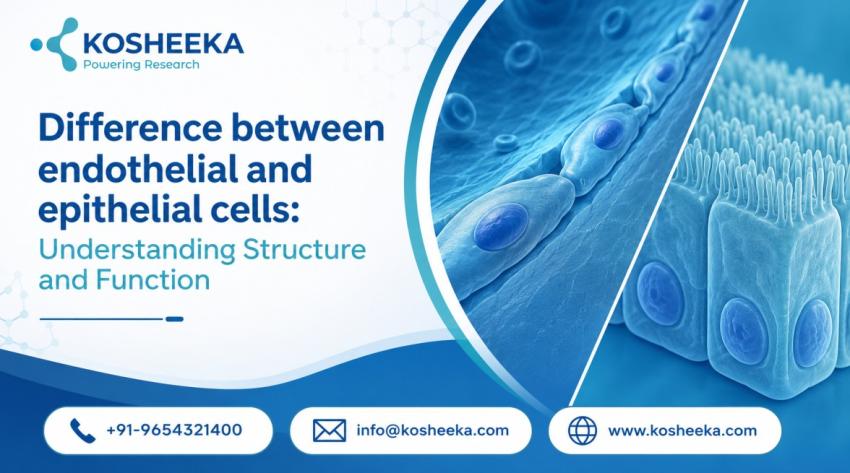
Epithelial cells form epithelium that is responsible for covering the outer body structure, such as skin and major internal organs and cavities. Epithelium acts as a protective covering and the first point of contact against any foreign molecule or pathogenic interaction.
Depending on the location of the cells (skin, digestive tract, lungs, kidneys, etc.), they perform a variety of functions. For instance, in the skin, the cells protect against physical damage or microbes. In the intestine, epithelial cells play a major role in the absorption of nutrients from the food. While in glands, they aid in the secretion of hormones, mucus, or enzymes.
Morphologically, epithelial cells are present in single or multiple layers (stacked structure). The cells are compactly packed and act as a barrier against external agents. They actively control what enters or exits skin. They support essential functions like absorption, secretion, and filtration.
What Are Endothelial Cells?
Endothelial cells form Endothelial Tissue (endothelium), which is one of the largest organs in the human body. These cells are responsible for the inner lining of the blood vessels, lymphatic vessels, and smooth muscle of the heart.
Endothelial cells serve as a highly active interface between circulating blood and surrounding tissues. They help regulate the movement of nutrients, oxygen, immune cells, and signaling molecules throughout the body. Endothelium is a single thin layer that continuously responds to the change in blood flow, inflammation, gas exchange, and maintains tissue homeostasis.
Endothelial vs Epithelial Cells: Key Structural Differences
In terms of location, epithelial cells are found in the skin and line major organs such as the lung, kidney, and gastrointestinal tract, while endothelial cells line the interior of blood and lymphatic vessels.
Regarding function, epithelial cells provide protection, absorption, or secretion, whereas endothelial cells maintain tissue homeostasis, blood flow, and vascular permeability.
Structurally, epithelial cells are tightly packed and can be single layered or stacked, while endothelial cells form a single thin layer of flat cells.
For markers, epithelial cells express cytokeratins, E-cadherins, and EpCAM, compared to endothelial cells which express CD31, VE-cadherin, vWF, and CD34.
In terms of diseases, epithelial cells are associated with carcinoma, cystic fibrosis, and asthma, while endothelial cells are linked to atherosclerosis, hypertension, and diabetic retinopathy.
Functional Differences Between Endothelial and Epithelial Cells
The easiest way to understand these cells is to think about their primary responsibilities.
Epithelial cells focus on protection and exchange with the external environment. They shield tissues from injury, absorb nutrients, get involved in the filtration of waste materials, and secrete enzymes or hormones. Whether in the skin, lungs, or digestive tract, epithelial cells help organs carry out their specialized functions.
Endothelial cells are responsible for managing the body's vascular network. They regulate blood flow, gaseous exchange, maintain vascular permeability, modulate immune response and coordinate inflammatory actions. The cells also release signaling molecules that aid in vasodilation and relaxation.
Another remarkable feature is their involvement in angiogenesis that is vital in wound healing, tissue regeneration, anti-inflammation, immune modulation, and recovery from injury.
Why Endothelial Cells Matter in Health and Disease
Endothelial cells are actively involved in vascular function; their health has a direct impact on overall well-being. In case of endothelial dysfunction, the risk of developing cardiovascular or metabolic diseases increases. For example, individuals with endothelial dysfunction are more prone to develop cardiovascular diseases. cardiovascular diseases, atherosclerosis, hypertension, diabetes-related vascular complications, and chronic inflammation have all been linked to impaired endothelial function.
Human Primary Endothelial Cells in Research
Researchers continue to use human umbilical endothelial cells in various biomedical and regenerative research, including vascular biology. They act as a key model for primary cells. They closely resemble those found in the human body.
Unlike immortalized cell lines, primary cells closely mimic the physiological characteristics of humans. There are a wide range of applications, including the investigation of angiogenesis, vascular inflammation, drug responses, disease mechanisms, etc. Human Primary Endothelial Cells are widely used in drug discovery, tissue engineering, and disease modeling, which aids in bridging the gap between laboratory findings and clinical applications.
Role of Umbilical Cord Endothelial Cells
Umbilical Cord Endothelial Cells have gained significant attention in biomedical and regenerative research. The cells are sourced from donated healthy umbilical cord tissue or blood. These cells have robust potential in regeneration and boosting the repair mechanism. Researchers frequently use them to study blood vessel formation, vascular development, and regenerative processes.
Because they are relatively accessible and highly functional, Umbilical Cord Endothelial Cells have become valuable tools for investigating cardiovascular biology, tissue engineering strategies, and emerging regenerative therapies.
Conclusion
Endothelial and epithelial cells have distinct and unique roles in the body's function. Epithelial cells act as protective and functional barriers across organs and tissues. In contrast, endothelial cells form the inner lining of the vascular system and regulate critical processes such as blood flow, permeability, and tissue repair. Thus, understanding the difference between endothelial and epithelial cells provides important insights into human biology and disease.