Do you know technology is supposed to help your business move faster?
But what happens when your systems fail unexpectedly?
One minute your team is productive.
And the next, employees cannot access applications, customers are experiencing delays, and revenue is slipping away while everyone waits for a fix.
Many businesses still rely on reactive IT support. They address problems only after something breaks.
While this approach may seem cost-effective at first, it often leads to higher expenses, operational disruptions, and frustrated employees.
Proactive IT monitoring changes that equation entirely.
Instead of waiting for failures, proactive monitoring identifies risks, performance issues, and security concerns before they impact your business. The result is greater uptime, lower costs, improved productivity, and a stronger return on investment.
If you're evaluating your IT strategy, understanding the ROI of proactive IT monitoring versus reactive support can help you make a smarter long-term decision.
What Is Reactive IT Support?
Reactive IT support follows a simple model: fix problems when they occur.
A server crashes. An employee reports a software issue. A network outage affects operations. The IT team steps in after the problem has already disrupted business activities.
For many organizations, this approach feels familiar because it appears straightforward. However, it creates a cycle of constant firefighting.
Common characteristics of reactive support include:
- Responding after failures occur
- Unplanned downtime
- Emergency troubleshooting
- Higher repair costs
- Increased employee frustration
- Greater risk of business interruptions
The biggest challenge is that reactive support focuses on symptoms rather than prevention.
So, What Is Proactive IT Monitoring?
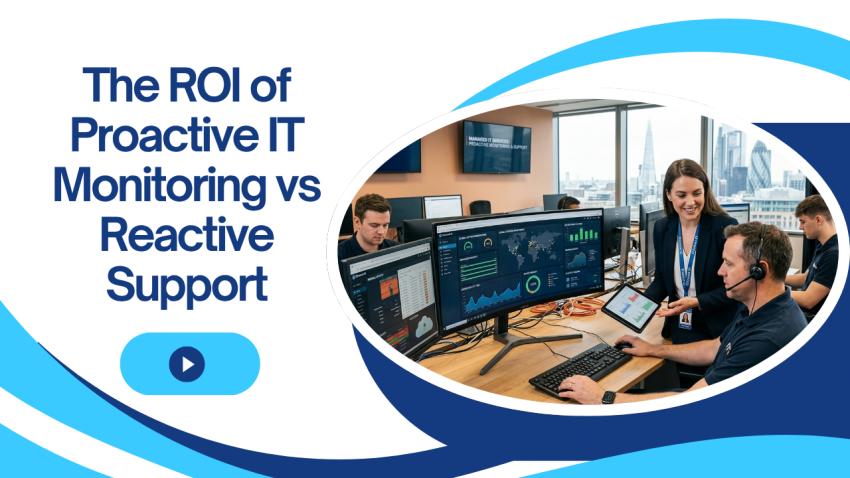
Proactive IT monitoring continuously tracks the health, performance, and security of your IT environment.
Advanced monitoring tools watch servers, networks, cloud applications, endpoints, and infrastructure around the clock. When unusual activity appears, alerts are generated immediately so issues can be resolved before they become serious problems.
Instead of asking, "Why did this fail?"
Proactive IT monitoring asks, "How do we prevent failure in the first place?"
This preventive approach allows businesses to maintain stable operations while reducing risk and improving efficiency.
The Hidden Costs of Reactive Support
Many organizations underestimate how expensive downtime can be.
The costs extend far beyond a repair bill.
Consider what happens when critical systems become unavailable:
- Employees cannot perform their work
- Customer service response times increase
- Sales opportunities are lost
- Project deadlines are delayed
- Customer trust declines
- IT teams become overwhelmed
Even a short outage can create a ripple effect throughout an organization.
According to industry research, the financial impact of downtime often includes both direct and indirect costs, making the true expense significantly higher than most businesses initially estimate.
The problem is not simply fixing the issue. The problem is everything that happens while the issue remains unresolved.
How Proactive Monitoring Delivers Measurable ROI
When evaluating ROI, businesses should look beyond IT expenses and consider operational performance.
Here are the key ways proactive monitoring generates value.
Reduced Downtime
Downtime is one of the most expensive challenges businesses face.
Proactive monitoring identifies warning signs such as:
- Resource bottlenecks
- Network performance degradation
- Hardware failures
- Storage capacity issues
- Application slowdowns
Addressing these issues early prevents outages that could disrupt daily operations.
More uptime means more productivity and more revenue-generating opportunities.
Increased Employee Productivity
Technology issues affect everyone.
When employees spend time waiting for systems to recover, productivity suffers.
Proactive monitoring minimizes interruptions, allowing employees to focus on meaningful work rather than technical obstacles.
Over time, those productivity gains create substantial financial value across the organization.
Lower IT Support Costs
Emergency repairs are almost always more expensive than preventive maintenance.
Reactive support often requires:
- Urgent troubleshooting
- Overtime labor
- External specialists
- Unplanned hardware replacements
Proactive monitoring reduces the frequency and severity of these incidents, helping organizations manage IT costs more effectively.
Improved Cybersecurity Protection
Cyber threats rarely appear without warning.
Many security incidents begin with unusual activity that can be detected early through continuous monitoring.
Proactive monitoring helps organizations identify:
- Unauthorized access attempts
- Suspicious network behavior
- System vulnerabilities
- Performance anomalies linked to security threats
Early detection reduces the risk of costly breaches and strengthens overall cybersecurity posture.
Better Resource Planning
Proactive monitoring provides visibility into system performance trends.
Businesses gain valuable insights into:
- Infrastructure utilization
- Capacity requirements
- Application performance
- Future technology investments
This data-driven approach helps leaders make informed decisions rather than reacting to unexpected problems.
Reactive Support vs Proactive Monitoring: A Simple Comparison
Reactive SupportProactive Monitoring
Fixes issues after failurePrevents issues before failure
Higher downtime riskReduced downtime
Unpredictable costsMore predictable IT spending
Emergency response focusedPrevention focused
Lower visibility into system healthContinuous performance insights
Greater business disruptionImproved operational stability
The difference becomes clear when viewed through a business lens.
Reactive support manages problems.
Proactive monitoring minimizes problems.
Why Modern Businesses Are Shifting Toward Prevention?
Today's business environment depends heavily on technology.
Cloud platforms, remote work, customer portals, collaboration tools, and digital operations all require reliable performance.
As IT environments become more complex, reactive support becomes increasingly risky.
Business leaders are recognizing that prevention is no longer optional. It is a competitive advantage.
Organizations that invest in proactive monitoring often experience:
- Stronger operational resilience
- Better customer experiences
- Improved employee satisfaction
- Reduced technology-related disruptions
- Greater confidence in business continuity
These benefits extend beyond the IT department and positively impact the entire organization.
The Role of Managed IT Services in Proactive Monitoring
Building a proactive monitoring strategy requires expertise, technology, and continuous oversight.
This is where professional support becomes valuable.
A reliable managed IT service provider can monitor infrastructure around the clock, identify potential issues early, and ensure systems remain secure and optimized.
Rather than waiting for critical failures, businesses gain access to ongoing monitoring, maintenance, and strategic guidance.
At Tollanis, our managed IT service approach focuses on helping organizations reduce risk, improve performance, and maximize the value of their technology investments.
By combining advanced monitoring tools with experienced IT professionals, businesses can shift from reactive problem-solving to proactive growth.
Why Tollanis Prioritizes Proactive IT Management
At Tollanis, we understand that technology should support business success, not create obstacles.
Our managed IT service solutions are designed to help organizations maintain reliable operations through continuous monitoring, preventive maintenance, and rapid issue resolution.
Instead of reacting to problems after they disrupt your business, we help identify and address risks before they impact productivity, customer experiences, or revenue.
This proactive approach enables businesses to focus on growth while maintaining confidence in their IT infrastructure.
Final Thoughts
If you're still relying primarily on reactive support, it's worth asking a simple question:
How much is downtime costing your business?
The ROI of proactive IT monitoring extends far beyond reduced support tickets. It impacts productivity, security, operational efficiency, customer satisfaction, and long-term profitability.
Reactive support will always have a role when unexpected issues occur. However, businesses that prioritize proactive monitoring are better positioned to prevent disruptions before they happen.
In today's digital environment, the most cost-effective IT problem is the one that never occurs.
Investing in proactive monitoring is not just an IT decision. It is a business decision that delivers measurable returns year after year.