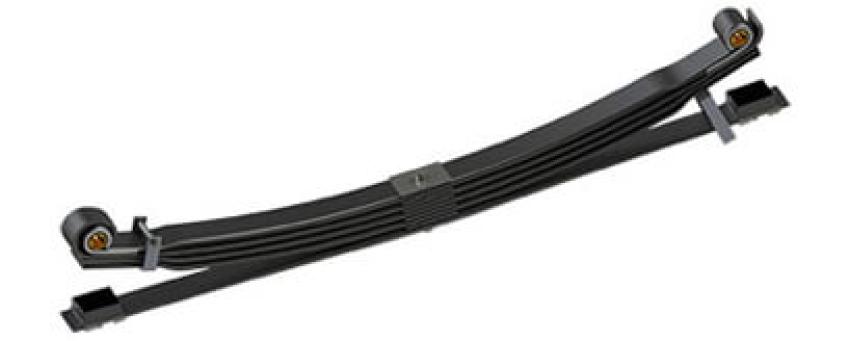
Parabolic leaf springs have become a preferred suspension solution in modern commercial vehicles, trailers, buses, agricultural machinery, and heavy-duty transportation applications. Their lightweight construction, improved ride comfort, reduced interleaf friction, and superior load-carrying efficiency make them a significant advancement over conventional multi-leaf spring systems.
Despite their numerous advantages, parabolic leaf springs are engineered to operate within specific load parameters established during the design phase. When vehicles are subjected to loads beyond their rated capacity, suspension components experience stress levels that exceed intended operating conditions. Among the most affected components are parabolic leaf springs, which play a critical role in supporting vehicle weight, absorbing road shocks, and maintaining axle alignment.
Vehicle overloading remains a persistent challenge across transportation and logistics sectors worldwide. Whether caused by operational demands, improper load management, or economic pressures, excessive loading can significantly impact the structural integrity, fatigue resistance, and overall service life of suspension systems.
This article examines how overloading affects parabolic leaf springs, the engineering mechanisms behind spring degradation, and the long-term consequences for vehicle safety, performance, and maintenance costs.
Understanding Load Distribution in Parabolic Leaf Springs
Parabolic leaf springs are designed with a variable thickness profile that tapers from the center toward the ends. This parabolic geometry enables a more uniform stress distribution along the length of the spring compared to conventional multi-leaf designs.
Under normal operating conditions, the spring performs several critical functions:
- Supporting vehicle and cargo weight
- Absorbing road impacts
- Maintaining axle positioning
- Reducing vibrations
- Improving ride quality
- Enhancing vehicle stability
Engineers determine the optimal spring dimensions, material properties, and load capacities based on expected operational requirements. When loads exceed these specifications, the spring is forced to operate outside its intended design envelope.
What Constitutes Overloading?
Overloading occurs when the total weight carried by a vehicle exceeds its Gross Vehicle Weight Rating (GVWR) or axle load limits specified by the manufacturer.
Overloading may result from:
- Excess cargo weight
- Uneven load distribution
- Repeated operation at maximum capacity
- Improper vehicle selection for application requirements
- Inaccurate weight estimation
Even when overload conditions appear minor, repeated exposure can accelerate suspension deterioration and significantly reduce component lifespan.
Increased Stress Concentration Within the Spring
One of the most immediate effects of overloading is increased stress within the spring material.
Parabolic leaf springs are engineered to operate within specific elastic limits. When excessive loads are applied, internal stresses rise substantially beyond normal levels.
This elevated stress can lead to:
- Localized stress concentration
- Material yielding
- Permanent deformation
- Accelerated fatigue damage
Areas near the spring center bolt, axle seat, and mounting points are particularly susceptible because these locations naturally experience higher stress levels.
Over time, repeated overload cycles create conditions that promote crack initiation and eventual component failure.
Permanent Spring Set and Loss of Camber
Parabolic leaf springs are manufactured with a predefined curvature, commonly referred to as camber.
Camber allows the spring to flex under load and return to its original shape once the load is removed.
Excessive loading can cause:
- Plastic deformation
- Permanent set
- Reduced spring height
- Loss of original geometry
When a spring loses camber, its ability to absorb road shocks diminishes significantly.
Common symptoms include:
- Vehicle sagging
- Uneven ride height
- Reduced suspension travel
- Poor ride comfort
Permanent deformation often indicates that the spring has exceeded its elastic limit and may require replacement.
Accelerated Fatigue Damage
Fatigue is one of the primary failure mechanisms affecting suspension components.
Unlike sudden overload failures, fatigue damage develops gradually through repeated stress cycles.
Every time a vehicle encounters:
- Road irregularities
- Potholes
- Speed bumps
- Dynamic load shifts
the spring undergoes stress fluctuations.
Under overload conditions, these fluctuations become more severe.
Consequences include:
- Faster crack initiation
- Increased crack propagation rates
- Reduced fatigue life
- Premature spring failure
Engineering studies consistently demonstrate that even modest increases in operating stress can dramatically reduce fatigue life.
As a result, overloaded vehicles often experience suspension failures much earlier than anticipated.
Increased Deflection and Suspension Bottoming-Out
Parabolic leaf springs are designed with specific deflection characteristics that balance ride comfort and load-carrying capability.
Overloading increases spring deflection beyond intended limits.
Excessive deflection may lead to:
- Suspension bottoming-out
- Reduced shock absorption
- Increased impact forces
- Higher stress on chassis components
When bottoming-out occurs, the suspension can no longer effectively isolate the vehicle from road shocks.
This creates additional loading on:
- Axles
- Mounting brackets
- Bushings
- Shock absorbers
- Frame structures
The resulting damage often extends beyond the spring itself.
Altered Stress Distribution Patterns
One of the key advantages of parabolic springs is their ability to achieve relatively uniform stress distribution.
Excessive loading disrupts this balance.
As loads increase, certain regions experience disproportionately higher stresses, creating localized weak points.
These stress concentrations may lead to:
- Surface cracking
- Material fatigue
- Edge fractures
- Structural weakening
Once microcracks develop, continued operation under overload conditions accelerates their growth.
Eventually, catastrophic failure becomes increasingly likely.
Impact on Vehicle Handling and Stability
Suspension systems play a crucial role in maintaining vehicle control and stability.
Overloaded parabolic springs may compromise:
- Steering response
- Cornering performance
- Braking stability
- Load balance
Excessive spring deflection alters suspension geometry and axle positioning.
This can lead to:
- Increased body roll
- Uneven tire loading
- Reduced traction
- Poor directional control
For commercial vehicles operating at highway speeds, these effects present serious safety concerns.
Increased Wear of Associated Suspension Components
Overloading rarely affects only the leaf spring.
The additional forces generated by excessive loads place significant stress on surrounding suspension components.
These include:
Bushings
Increased movement and deformation accelerate bushing wear.
Shackles
Higher loads increase shackle stress and fatigue.
U-Bolts
Excessive loading may cause loosening, stretching, or failure.
Shock Absorbers
Shocks must dissipate greater energy, leading to accelerated wear.
Axle Mounting Systems
Continuous overload conditions can damage brackets and attachment points.
Consequently, maintenance costs often rise substantially when vehicles operate beyond rated capacities.
Corrosion and Crack Propagation Risks
Fatigue cracks created by overloading frequently serve as entry points for moisture and contaminants.
Once corrosion begins, the combination of fatigue and environmental degradation can accelerate failure mechanisms.
This process is commonly known as corrosion fatigue.
Consequences include:
- Reduced structural strength
- Faster crack growth
- Lower load-carrying capacity
- Increased failure probability
Protective coatings and regular inspections help mitigate these risks but cannot fully compensate for persistent overload operation.
Economic Consequences of Overloading
While overloading may appear economically advantageous in the short term, it often results in significant long-term costs.
These costs include:
- More frequent spring replacements
- Increased vehicle downtime
- Higher maintenance expenses
- Premature component failures
- Reduced fleet reliability
Fleet operators often discover that the savings gained through carrying additional cargo are outweighed by increased repair and operational costs.
A properly maintained suspension system typically delivers greater lifecycle value than one subjected to chronic overload conditions.
Safety Implications
Suspension failure is not merely a maintenance concern—it is a critical safety issue.
A damaged or failed parabolic leaf spring can contribute to:
- Loss of vehicle control
- Reduced braking effectiveness
- Tire damage
- Cargo instability
- Accidents involving other road users
In severe cases, complete spring fracture may result in axle misalignment or suspension collapse.
For commercial transport operators, preventing overload-related failures is essential for protecting both personnel and public safety.
Preventing Overload-Related Damage
Several strategies can help minimize the impact of overloading on parabolic leaf springs.
Adhere to Manufacturer Load Ratings
Vehicles should always operate within specified axle and gross vehicle weight limits.
Implement Load Monitoring Systems
Modern fleet management technologies enable real-time weight monitoring and overload detection.
Conduct Regular Inspections
Routine suspension inspections help identify:
- Cracks
- Corrosion
- Loss of camber
- Component wear
before major failures occur.
Maintain Proper Load Distribution
Evenly distributed cargo reduces localized suspension stress.
Use Application-Specific Suspension Systems
Vehicles operating in demanding environments should be equipped with springs designed for expected load conditions.
Conclusion
Parabolic leaf springs are highly engineered suspension components designed to provide an optimal balance between load-carrying capability, ride comfort, durability, and vehicle stability. However, their performance depends heavily on operating within prescribed load limits.
Excessive loading subjects these springs to elevated stress levels, accelerates fatigue damage, increases deflection, alters stress distribution patterns, and significantly reduces service life. Beyond affecting the springs themselves, overloading can compromise vehicle handling, accelerate wear of surrounding suspension components, and increase maintenance costs.
For fleet operators, vehicle manufacturers, and maintenance professionals, understanding the consequences of overloading is essential for maximizing suspension reliability and ensuring safe vehicle operation. By adhering to load specifications, implementing preventative maintenance practices, and promoting responsible load management, organizations can protect both their equipment investments and the safety of their operations.