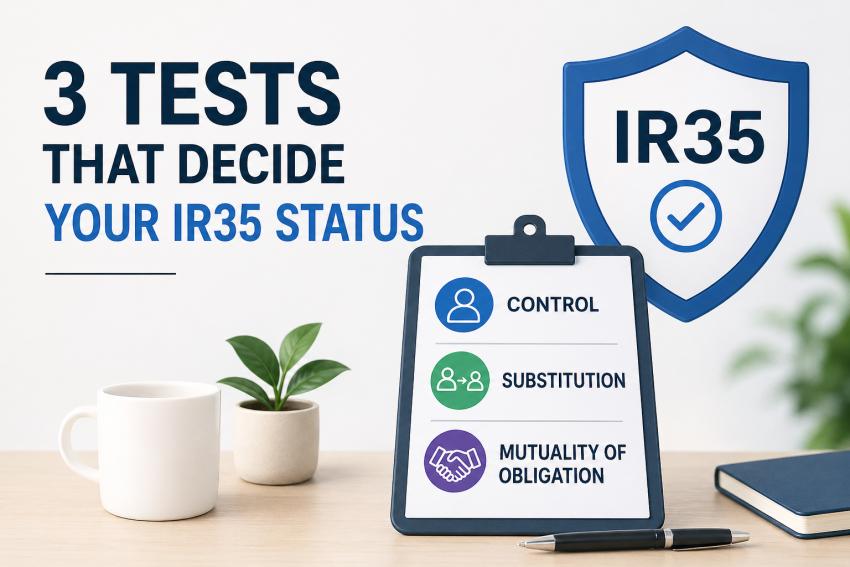
If you are wondering how to determine ir35 status, you are not alone. Many UK contractors struggle to understand where they stand, and the difference can affect how much tax you pay and how your income is treated. The good news is that most IR35 decisions come down to three key tests. Once you understand these, you can quickly get a clear picture of your position.
What IR35 status really means
IR35 decides whether you are working as a genuine contractor or as a disguised employee for tax purposes.
- Inside IR35 means you are taxed like an employee
- Outside IR35 means you operate as a self employed contractor with more flexibility
Getting this right matters. A wrong status can lead to unexpected tax bills, penalties, or reduced take home pay.
The 3 tests that decide your IR35 status
These are the main factors used to assess your contract and working relationship. No single test works in isolation, but together they give a strong indication.
1. Control
This test looks at how much control your client has over your work.
Ask yourself:
- Who decides your working hours
- Who tells you how to complete tasks
- Do you have freedom in how you deliver the work
What it means in practice
- If your client controls your schedule, methods, and tasks, you are likely inside IR35
- If you decide how and when to work, you are more likely outside IR35
Simple example
A contractor who works fixed hours under direct supervision looks more like an employee.
A contractor who delivers a project in their own way shows independence.
2. Substitution
This test checks if you can send someone else to do the work.
Ask yourself:
- Can you provide a substitute if you are unavailable
- Is this right written in your contract
- Would the client accept a replacement in reality
What it means in practice
- No substitution allowed usually points to inside IR35
- A genuine right to send a substitute supports outside IR35
Important point
A clause in the contract is not enough. It must work in real life too. If the client would reject a substitute, the clause holds little value.
3. Mutuality of obligation
This test looks at the expectations between you and your client.
Ask yourself:
- Is the client required to offer continuous work
- Are you expected to accept every task given
- Is the relationship ongoing like employment
What it means in practice
- Ongoing obligation on both sides suggests inside IR35
- Project based work with no future commitment suggests outside IR35
Simple example
If you complete a project and walk away with no further obligation, that supports contractor status.
Why many contractors get this wrong
Even experienced contractors make mistakes when reviewing their IR35 status.
Common issues include:
- Relying only on contract wording
- Ignoring actual working practices
- Accepting blanket decisions from clients
- Not reviewing contracts regularly
A contract may say one thing, but if your day to day work tells a different story, that is what matters most.
Why these 3 tests are not enough on their own
While control, substitution, and mutuality of obligation are the core tests, IR35 status depends on the full picture.
Other factors can also play a role:
- Financial risk
- Provision of equipment
- Integration into the client’s business
That is why many contractors still feel unsure even after checking these tests.
Final thoughts
Understanding IR35 does not have to be complicated. Start with the three key tests, review how you actually work, and then look at the full picture. Small details can make a big difference, so it is worth getting it right.