If you are self-employed or earn rental income in the UK, the way you report tax is changing. The shift from Self Assessment to MTD for Income Tax is something every sole trader and landlord needs to understand now, not later.
For years, Self Assessment meant one tax return each year. You gathered your records, filed before the deadline, and paid what you owed. Simple, but often rushed.
Now, Making Tax Digital for Income Tax introduces a more regular and digital approach. It changes how often you report, how you keep records, and how you stay on top of your tax position throughout the year.
Understanding the difference between MTD for Income Tax vs Self Assessment will help you stay compliant, avoid penalties, and manage your finances with more confidence.
What is Self Assessment?
Self Assessment is the current system used by HMRC to collect Income Tax from:
- Sole traders
- Freelancers
- Landlords
You record your income and expenses, then submit one tax return per year.
How it works:
- Keep records in any format
- Submit one annual return
- Pay tax by 31 January
It is simple but often reactive. Many people only look at their finances once a year.
What is MTD for Income Tax?
Making Tax Digital for Income Tax is a new system that moves tax reporting from yearly to digital and more frequent updates.
It applies to:
- Self-employed individuals
- Landlords with qualifying income
From April 2026, those earning over £50,000 must follow MTD rules, with lower thresholds in later years.
Under MTD, you must:
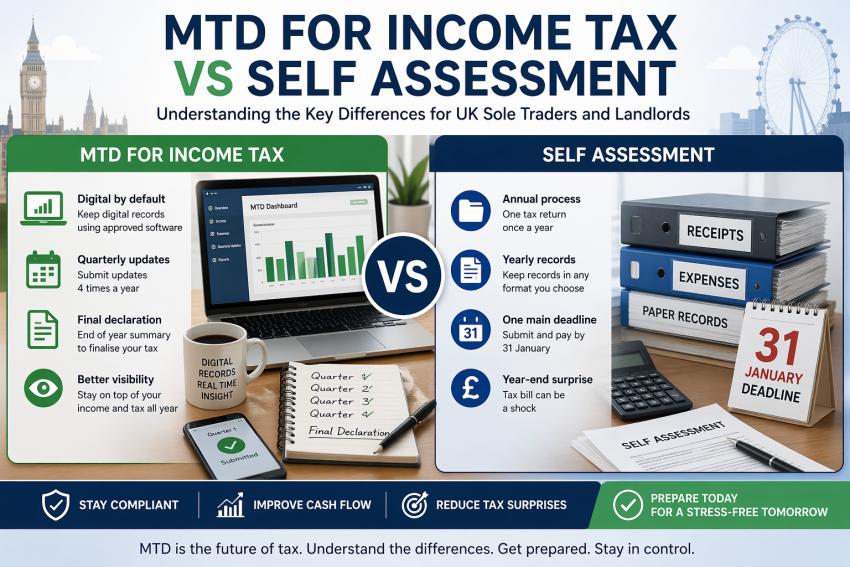
- Keep digital records using software
- Send updates every quarter
- Complete a final year-end declaration
Instead of one submission, you now report multiple times a year.
MTD for Income Tax vs Self Assessment: Key Differences
Here’s where things really change.
1. Reporting Frequency
- Self Assessment: once a year
- MTD ITSA: four quarterly updates + final declaration
This means HMRC gets a regular view of your income, not just a yearly snapshot.
2. Record Keeping
- Self Assessment: paper, spreadsheets, or software
- MTD for IT: digital records only using approved tools
You can no longer rely on manual bookkeeping alone.
3. Deadlines
- Self Assessment: one main deadline in January
- MTD: multiple deadlines throughout the year
This spreads the workload but demands consistency.
4. Tax Payments
A common myth is that tax will be paid quarterly.
That is not strictly true.
- Reporting becomes quarterly
- Payment dates are expected to remain broadly the same for now
5. Accuracy and Visibility
MTD aims to reduce errors and give you a clearer view of your tax position throughout the year.
This helps avoid surprises at year end.
Who Needs to Switch to MTD?
MTD is not optional if you fall within the threshold.
Rollout timeline:
- April 2026: Income over £50,000
- April 2027: Income over £30,000
- April 2028: Income over £20,000
Your qualifying income includes:
- Total business turnover
- Rental income combined
Not profit. Gross income.
What Stays the Same?
Not everything is changing.
- You still calculate your tax liability annually
- You still submit a final declaration
- You still follow HMRC rules on allowable expenses
So think of MTD as an upgrade, not a full replacement.
Why is HMRC Making This Change?
The goal is simple:
- Reduce errors in tax returns
- Improve compliance
- Give taxpayers better financial visibility
Errors in Self Assessment cost billions each year, often due to missed income or poor record keeping.
MTD aims to fix that with real time reporting.
Benefits of MTD for Sole Traders
If you adopt it properly, there are real advantages:
- Better cash flow awareness
- Fewer last-minute tax surprises
- Cleaner financial records
- More accurate tax estimates
It pushes you to stay on top of your numbers.
Challenges You Should Expect
Let’s be honest. This is not effortless.
- You must use accounting software
- You need to update records regularly
- There is a learning curve
But once you build the habit, it becomes part of your routine.
How to Prepare for MTD Right Now
If you want a smooth transition, start early.
Practical steps:
- Move your records to digital software
- Track income and expenses weekly
- Review your finances monthly
- Speak to a specialist accountant
Do not wait until deadlines hit.
Final Thoughts: Do Not Leave This Too Late
MTD for Income Tax is not just another tax update. It changes how you manage your business finances.
If you stay with old habits, you will struggle.
If you adapt early, you gain control, clarity, and confidence.
Want to get MTD right without the stress?
Use Making Tax Digital for Income Tax service to Stay compliant, reduce tax risk, and keep your finances organised all year.
The sooner you act, the easier this shift becomes.