The majority of purchasers spend their money on unnecessary aluminium systems which they do not need. That happens more often than you think.
You might choose an incorrect size, which leads to high costs while you lose essential components. Your construction project becomes weaker because of this decision, which makes future changes impossible.
This guide will help you avoid those mistakes. You will learn how to choose the right aluminium profile & accessories with confidence.
Why Aluminium Profiles Are Everywhere in Malaysian Industries
Walk into any factory, automation setup, or machine frame project in Malaysia, and you'll see aluminium profiles. They're lightweight, strong, and easy to reconfigure. Unlike steel, they don't rust. Unlike wood, they don't warp.
That's why industries across Malaysia use them for machine frames, safety guarding, conveyor systems, and modular workstations.
The demand is growing fast, and so is the number of suppliers. That's where buyers get confused.
The Most Common Mistakes Buyers Make
The first thing we need to discuss before our specifications and dimensions presentation begins is to explain what happens when things go wrong.
Mistake 1: Buying on Price Alone
Low-priced profiles contain weaker alloy materials, which produce thinner wall sections. The two materials appear identical to the observer, but their performance differentials become apparent when they face weight testing.
Mistake 2: Ignoring Accessories Compatibility
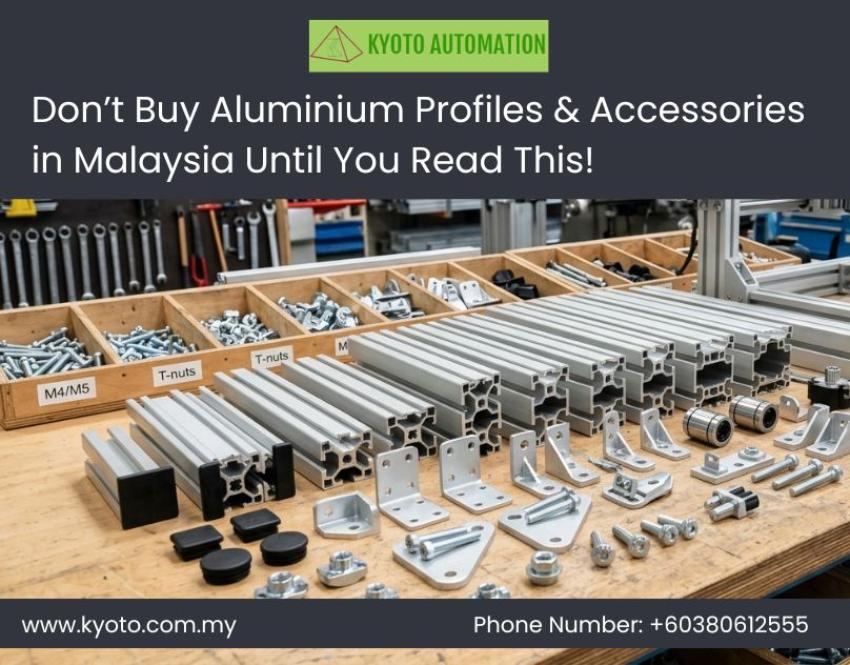
The value of an aluminium profile depends on the quality of its matching accessories. The system requires you to select T-nuts, brackets, end caps, and connectors, which must exactly match your profile series and slot size requirements.
Mistake 3: Not Planning for Future Changes
The design of modular systems enables users to create multiple configurations. The two series you purchased will not function together because they have different operational requirements.
Understanding Aluminium Profile Sizes
First-time buyers encounter difficulties during the process of selecting a size. Profiles come in different cross-sections, slot widths, and series.
The 40x40 Profile: Why It's So Popular
The AL profile 40x40 is one of the most widely used sizes in Malaysia. The product dimensions of 40mm by 40mm make it suitable for various applications, which include machine frames, workbench legs, and enclosure structures.
The product achieves its optimal strength and weight performance. The material provides simple handling and cutting abilities while it works with multiple standard accessories.
When to Go Bigger or Smaller
The smaller (20x20 or 30x30) size should be used for constructing lightweight fixtures, display stands, and supports which will not bear heavy loads.
The larger (40x80 or 80x80 or larger) size should be used for constructing heavy machine frames and structures which must withstand high stress.
Aluminium Profile Series: What Does It Mean?
You'll often see profiles labelled as Series 5, Series 6, or Series 8. This refers to the slot width of the T-slot groove.
Series 5: 5mm slot width, suited for lighter builds
Series 6: 6mm slot width, the most common in Malaysia
Series 8: 8mm slot width, for heavy-duty industrial use
The series determines which T-nuts, bolts, and accessories will fit. Mixing series is one of the most expensive mistakes a buyer can make.
Aluminium Profile & Accessories: What You Actually Need
A profile without the right accessories is just a bar. The accessories are what make your structure functional.
Here's a quick breakdown of the essentials:
T-nuts and bolts: Used to connect accessories to the profile slot
Corner brackets: For joining two profiles at a right angle
End caps: For a clean finish and to protect the profile ends
Hinges and panel holders: For doors, panels, and guards
Casters and feet: For mobile or fixed structures
Connectors: For joining profiles end-to-end or at angles
Always confirm that your accessories match your profile series before ordering. A Series 6 T-nut will not sit correctly in a Series 8 slot.
What to Look for in an Aluminium Profile Supplier in Malaysia
The importance of supplier selection exceeds the understanding of most purchasing agents.
Technical Knowledge
A good supplier helps you choose the right profile and accessories for your specific application. The team proceeds to ask questions which help them learn about load requirements, environmental conditions, and compatibility problems.
Stock Availability
The project schedule suffers because of delays, which create obstacles to progress. The supplier should maintain a continuous inventory of high-demand products, which includes the AL profile 40x40 and its associated components.
Cutting and Fabrication Services
Most professional suppliers offer cutting to length. The practice reduces the time spent at your location while also decreasing material waste. The company provides customers with both drilling services and tapping services.
After-Sales Support
What solutions exist when you encounter a size problem or require additional items for your existing structure? The process becomes easy to handle when a supplier provides strong after-sales support.
Why Kyoto Automation Stands Out
Kyoto Automation operates as the best provider of aluminium profiles and accessories across Malaysia. The company provides complete industrial automation solutions through its extensive collection of aluminium profiles and accessories, which serve machine building and custom fabrication needs. Their product range covers various series and sizes, including the popular AL profile 40x40.
The company distinguishes itself through its inventory management system, which provides customers with access to products and technical assistance. The company provides more than just components because it assists customers in selecting the appropriate parts for their specific requirements.
The engineers and procurement teams who need to complete their work within limited timeframes will experience significant benefits from that particular backing.
Practical Tips Before You Buy
A few things worth doing before you place your order:
Sketch your structure and identify all profile lengths you need
List every accessory required — brackets, T-nuts, connectors, end caps
Confirm the series across all products (don't mix series)
Ask your supplier if cutting services are available
Order slightly more than you need to account for measurement errors
These five steps alone can save you from a second trip to the supplier.
Conclusion
Purchasing aluminium profile & accessories in Malaysia presents an easy task. The process becomes difficult for many people because they attempt to complete it too quickly.
The process becomes easier when you identify your requirements because you select the appropriate dimensions and select the suitable equipment.
You need to spend time establishing your construction requirements. You need to verify product compatibility and quality before making purchasing decisions. The structure maintains its strength while remaining flexible and simple to modify for future needs.
FAQs
Q1. What are the key distinctions between Series 6 and Series 8 aluminium profiles?
Ans. The main distinction exists between the two profiles because their slot dimensions differ. The 6mm T-slot of Series 6 serves as the most common standard used in Malaysia. Series 8 has an 8mm slot, which functions as a structural framework for building larger weight-bearing constructions.
Q2. Is the AL profile 40x40 suitable for machine frames?
Ans. The 40x40 profile ranks among the most commonly used dimensions for constructing small to medium machine frames, workbenches and conveyor structures. The product delivers strong performance because it provides both strength and weight balance, together with widely accessible accessories which users can find throughout Malaysia.
Q3. What is the standard alloy used for manufacturing aluminium profiles in Malaysia?
Ans. Most extruded T-slot profiles use 6063-T5 aluminium alloy. The material provides strong structural capabilities together with a smooth surface finish, which enables effective anodising results.
Q4. Can I mix different profile sizes in one structure?
Ans. You can mix sizes within the same series. You can combine 40x40 and 40x80 from the Series 6 range because they belong to the same product line. The different series create compatibility problems because users have to work with different accessory systems.