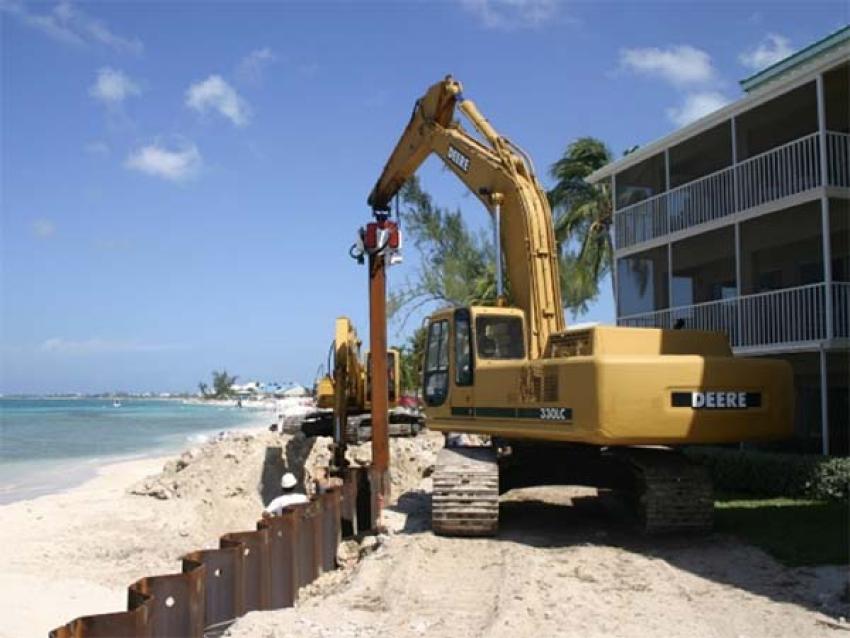
Sheet piles are a common structural component. Their edges interlock, forming an interlocking continuous wall when driven into the ground. They are widely used in retaining walls, cofferdams, and other earth-retaining and water-retaining structures.
What are the common methods for driving sheet piles?
There are many ways to install sheet piles. Common methods include vibratory driving, static pressure driving, impact driving, and underwater-assisted pile driving. Different methods are suitable for different geological conditions, construction environments, and engineering requirements.
1. Vibratory Driving
Vibratory driving is one of the most common and classic methods for sheet pile construction. During construction, a vibratory hammer generates high-frequency vibrations, loosening the soil structure and reducing the frictional resistance around the sheet pile, thus allowing the sheet pile to gradually sink.
Vibratory driving has advantages such as high construction efficiency and speed, and is suitable for easily penetrable strata such as sand and backfill. However, vibratory driving generates significant noise and vibration, and its effectiveness is limited in complex strata such as clay and gravel layers.
2. Static Pressure Piling: Static pressure piling uses a hydraulic system to apply continuous pressure to sheet piles, slowly driving them into the soil instead of relying on vibration or impact.
Static pressure piling produces less noise and vibration, making it suitable for urban construction projects with strict noise and vibration control requirements. However, the equipment is more expensive, the construction speed is slower, and it has certain requirements regarding soil bearing capacity and construction space.
3. Impact Piling: Impact piling uses the impact force of a hammer to gradually drive sheet piles into the soil. The most commonly used hammer is a hydraulic hammer. This method has strong penetrating power in hard soil layers and is often used in strata where vibration methods are difficult.
Impact piling is suitable for relatively hard soil layers, locally sandy or gravelly strata, and has the advantage of strong penetration. The disadvantages are high noise and vibration, and a relatively high risk of damage to the pile body and interlocking joint. Impact piling is more suitable for projects where greater construction disturbance is permissible and strong penetration capability is required.
4. Water-Jet Assisted Pile Driving
Water-jetting assisted pile driving is not a primary method but rather a supplementary technique. During construction, high-pressure water is used to loosen the soil in front of the pile, reducing resistance, which is then combined with vibration or static pressure to drive the sheet pile in.
Water-jetting assisted pile driving is suitable for projects with thick sand layers, dense soil, and where reduced penetration resistance is required. It can improve pile driving efficiency, help penetrate some difficult-to-drive strata, and has a significant construction assistance effect. Disadvantages include potential impact on soil stability, excessively high requirements for construction organization and drainage, and unsuitability for all engineering environments. Water jetting is very practical as an auxiliary method in some special strata.
How to Choose the Appropriate Sheet Pile Driving Method?
When choosing a sheet pile driving method, one should not only consider the convenience of the equipment but also the engineering conditions. Generally, the following factors should be considered:
1. Geological Conditions: If the soil layer is mainly sandy soil or backfill, vibratory pile driving is usually more efficient; if the soil layer is harder, impact pile driving or other auxiliary measures need to be considered.
2. Environmental Requirements: If there are residential areas, office buildings, or precision equipment nearby, and noise and vibration control requirements are high, static pressure piling is more suitable.
3. Sheet Pile Specifications: Sheet piles with longer lengths and larger cross-sections require more advanced equipment and may necessitate the use of guide frames and auxiliary processes.
4. Construction Period: When the construction period is tight, vibratory piling, which is more efficient, is generally preferred; when the construction period allows but environmental requirements are high, static pressure piling can be chosen.
5. Construction Costs: Equipment rental, labor, auxiliary measures, and subsequent correction costs should all be considered comprehensively, rather than just looking at the price of a single piling operation.