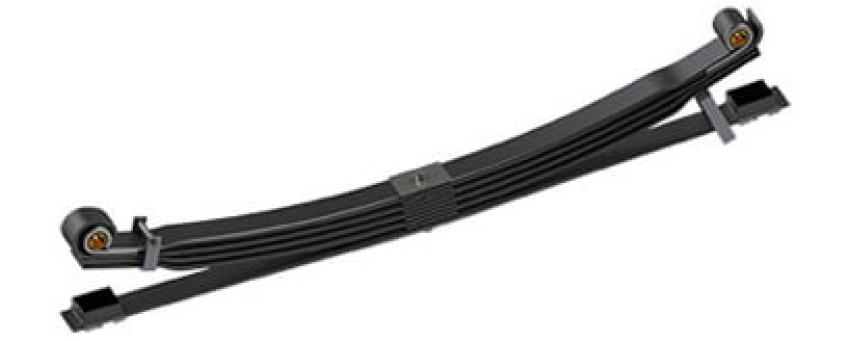
Parabolic leaf springs are a refined evolution of conventional multi-leaf spring systems, engineered to deliver improved ride quality, reduced weight, and better stress distribution. One of the most critical aspects that defines their performance is their load deflection characteristic—how the spring deforms under applied load.
Understanding this behavior is essential for engineers, manufacturers, and vehicle designers, as it directly impacts ride comfort, load-carrying capacity, durability, and overall vehicle dynamics.
What is Load Deflection in Leaf Springs?
Load deflection refers to the relationship between the force applied to a spring and the resulting deformation (deflection). In simple terms:
- Load = weight or force acting on the spring
- Deflection = how much the spring bends or compresses
This relationship is typically represented as a load vs deflection curve, which helps in determining the spring rate (stiffness).
- A steep curve indicates a stiffer spring
- A gentle slope indicates a more flexible spring
For suspension systems, achieving the right balance is crucial—too stiff leads to a harsh ride, too soft leads to instability.
Unique Design of Parabolic Leaf Springs
Unlike conventional leaf springs that consist of multiple leaves of equal thickness stacked together, parabolic leaf springs feature:
- Leaves with variable thickness (tapered ends)
- Typicallyfewer leaves (often 1–3)
- Minimal or no interleaf contact except at the center
This design fundamentally changes how load is distributed and how the spring deflects under stress.
Load Deflection Behavior: How Parabolic Springs Differ
1. Progressive Deflection Characteristics
Parabolic leaf springs exhibit a progressive load-deflection behavior. This means:
- At low loads, the spring is more flexible
- At higher loads, stiffness gradually increases
This progressive nature offers:
- Better comfort when the vehicle is lightly loaded
- Adequate support when carrying heavy loads
2. Lower Initial Spring Rate
Due to reduced interleaf friction and fewer leaves:
- The initial spring rate is lower
- The spring responds more easily to small road irregularities
This results in:
- Improved ride comfort
- Reduced vibration transmission
3. Reduced Interleaf Friction
In conventional springs, friction between leaves contributes to stiffness and damping. However, it also leads to:
- Energy loss
- Inconsistent performance
Parabolic springs minimize this friction, leading to:
- A smoother and more predictable deflection curve
- Better energy efficiency in suspension movement
4. Uniform Stress Distribution
The tapered (parabolic) profile ensures that stress is distributed more evenly along the length of the spring.
Impact on load deflection:
- Eliminates localized stress concentration
- Allows more controlled and uniform bending
- Enhances fatigue life
The Load vs Deflection Curve Explained
The load-deflection curve of a parabolic leaf spring is typically non-linear, especially when compared to traditional multi-leaf springs.
Key Regions of the Curve:
1. Initial Region (Low Load)
- High flexibility
- Small loads cause noticeable deflection
- Enhances comfort over minor road irregularities
2.Middle Region (Moderate Load)
- Gradual increase in stiffness
- Balanced performance between comfort and load-bearing
3. End Region (High Load)
- Increased resistance to deflection
- Prevents excessive sagging
- Maintains vehicle stability under heavy loads
Factors Affecting Load Deflection Characteristics
1. Material Properties
The type of steel or composite material used influences:
- Elastic modulus
- Yield strength
- Fatigue resistance
Higher strength materials allow:
- Greater load capacity
- Controlled deflection without permanent deformation
2. Thickness Profile (Parabolic Taper)
The defining feature of parabolic springs is their varying thickness:
- Thick at the center
- Gradually tapering toward the ends
This affects:
- Bending stiffness distribution
- Load response characteristics
A well-designed taper ensures:
- Smooth deflection
- Reduced stress concentration
3. Length of the Spring
Longer springs generally:
- Deflect more under the same load
- Provide a softer ride
Shorter springs:
- Are stiffer
- Offer higher load capacity
4. Number of Leaves
Parabolic springs usually have fewer leaves:
- Single-leaf designs → more flexible
- Multi-leaf parabolic → higher load capacity
The number of leaves directly impacts the load-deflection curve.
5. Eye Design and Mounting Geometry
The way the spring is mounted affects how load is transferred:
- Shackle length and position
- Fixed vs floating mounts
These influence:
- Effective spring length
- Deflection behavior under dynamic conditions
Advantages of Optimized Load Deflection
1. Improved Ride Comfort
The progressive deflection ensures that small bumps are absorbed effectively without transmitting shocks to the vehicle body.
2. Enhanced Load Handling
As load increases, the spring becomes stiffer, preventing:
- Excessive sagging
- Bottoming out
3. Better Vehicle Stability
Controlled deflection contributes to:
- Improved handling
- Reduced body roll
- Better traction
4. Reduced Weight
Parabolic springs are lighter, which:
- Improves fuel efficiency
- Reduces unsprung mass
5. Longer Fatigue Life
Uniform stress distribution and controlled deflection reduce the risk of:
- Cracks
- Premature failure
Comparison with Conventional Leaf Springs
Parameter
Conventional Leaf Spring
Parabolic Leaf Spring
Load Deflection
Mostly linear
Progressive (non-linear)
Interleaf Friction
High
Minimal
Comfort
Moderate
High
Weight
Heavy
Lightweight
Stress Distribution
Uneven
Uniform
Practical Applications
Parabolic leaf springs are widely used in:
- Commercial vehicles (trucks, buses)
- Light commercial vehicles
- Trailers
- Off-road vehicles
In these applications, their load-deflection characteristics help balance:
- Comfort for long-distance travel
- Strength for heavy-duty operations
Design Considerations for Engineers
When designing or selecting parabolic leaf springs, engineers must:
- Define expected load ranges
- Analyze deflection requirements
- Ensure compliance with safety standards
- Use simulation tools (like FEA) for accuracy
Accurate modeling of load-deflection behavior ensures optimal performance under real-world conditions.
Future Trends
Advancements in materials and design are further improving load-deflection characteristics:
- Composite parabolic springs for reduced weight
- Advanced coatings to reduce wear
- Smart suspension integration
These innovations aim to deliver even better comfort, efficiency, and durability.
Conclusion
The load deflection characteristicsof parabolic leaf springs are central to their superior performance in modern suspension systems. Their progressive behavior, reduced friction, and optimized stress distribution make them an ideal choice for applications requiring both comfort and strength.
By understanding and optimizing these characteristics, manufacturers and engineers can design suspension systems that not only meet performance demands but also enhance the overall driving experience.
In today’s evolving automotive landscape, parabolic leaf springs continue to prove that smart engineering can achieve the perfect balance between flexibility and resilience.