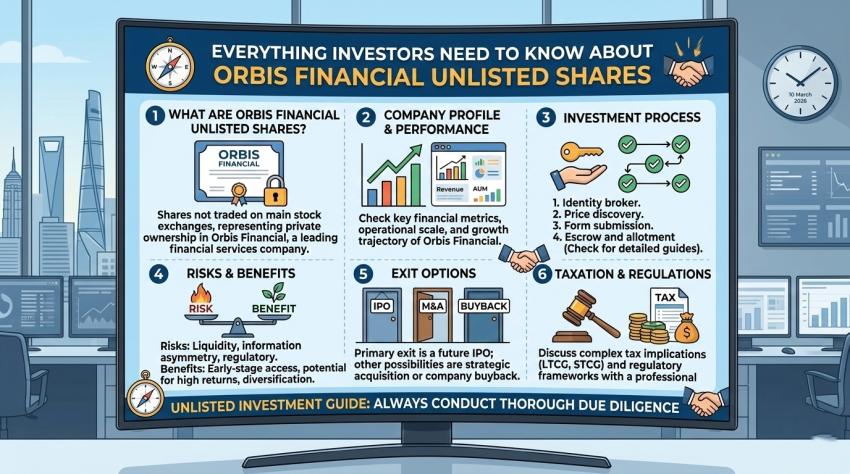
What is Orbis Financial Corporation and What Does It Do?
Orbis Financial Corporation is a SEBI-registered custodian of securities, established in 2009 and headquartered in Gurugram. Understanding what a custodian does is key to understanding why this company is so valuable.
When large institutional investors — foreign portfolio investors, insurance companies, pension funds, alternative investment funds — participate in Indian capital markets, they cannot simply hold their securities the way a retail investor holds shares in a demat account. They need a regulated, professional entity to safeguard those assets, handle settlements, manage corporate actions, and ensure that every rupee and every unit of every security is accounted for at all times. That entity is a custodian. Orbis Financial is exactly that.
The company serves an incredibly diverse client base that includes Foreign Portfolio Investors, insurance companies, high-net-worth individuals, AIFs, and several other institutional categories. It offers custodial services, fund accounting, depository services, professional clearing, FPI registration, and trustee services. These are not products that clients switch away from easily. The onboarding process is long, the regulatory requirements are deep, and once a client is embedded into Orbis's systems, the relationship tends to last for years. That is the kind of business model that generates compounding revenue — and that is exactly what Ashish Kacholia looks for.
Why Did Ashish Kacholia Invest Rs 102 Crore in Orbis Financial?
Ashish Kacholia is not an investor who acts on tips or momentum. He has spent more than three decades studying businesses from the inside out, and his track record includes early bets on companies like Ajanta Pharma, Mastek, Polycab India, and dozens of other names that delivered extraordinary returns long before the market noticed them.
His investment philosophy has always been rooted in one core idea — find businesses with strong fundamentals, good management, and a long growth runway, then stay patient while the compounding does its work. He does not rush. He does not chase headlines. When he backed Orbis Financial with Rs 111 crore in January 2023, it was already a signal. When he came back in December 2023 with another Rs 102 crore, it became a conviction call.
The numbers at the time told a compelling story. Orbis had been growing revenue at a pace that most listed mid-cap financial companies would envy. The EBITDA margins were running at around 55 percent, which is exceptional for any services business. Return on Capital Employed was hovering near 39 percent. The company was not burning cash to grow. It was generating strong profits, reinvesting them into expanding its client base and infrastructure, and delivering consistent improvements in every key metric year after year.
Kacholia's total investment in Orbis across both rounds crossed Rs 213 crore. That is not a passive allocation. That is a strategic bet on a company he clearly believes is undervalued relative to where it is going.
What Did Orbis Financial Plan to Do With the Funds?
The stated purpose of the Rs 102 crore fundraise was straightforward — to strengthen Orbis Financial's position in the financial securities market. But reading between the lines, the capital had a much broader ambition behind it.
India's custodial services industry is still in relatively early stages compared to global benchmarks. Assets Under Custody in India grew 36 times between FY02 and FY20, but the Indian market still represents less than 2 percent of the global custody market, even though India accounts for roughly 3.5 percent of global GDP. That gap is not a ceiling. It is an opportunity. Every new FPI that enters India, every new AIF that launches, every new institutional investor that deepens its exposure to Indian markets needs a custodian. Orbis was positioning itself to capture as much of that growth as possible.
The funding allowed Orbis to deepen its technology infrastructure, expand its team, scale its GIFT City operations, and continue building the client relationships that form the backbone of its recurring revenue. The company also received provisional IFSCA approval to set up a finance company in GIFT City, which opened an entirely new line of business in one of India's most strategically important financial hubs.
All of this was made possible by the capital infusion — and by the credibility that comes with having an investor like Ashish Kacholia on your cap table.
How Has the Orbis Financial Unlisted Share Price Responded?
The funding rounds had a visible effect on investor interest in the unlisted market. Before the first Kacholia investment in January 2023, Orbis Financial's unlisted share price was trading at a fraction of where it eventually went. In the months that followed, as the market digested what two large-scale investments from one of India's sharpest investors meant, the unlisted share price climbed significantly.
The 52-week high for the Orbis Financial unlisted share touched Rs 594 per share. As of March 30, 2026, the current price stands at Rs 414 per share, with a 52-week low of Rs 410. The face value remains Rs 10 per share. The minimum lot size for transactions is 200 shares, and all trades are settled securely through NSDL and CDSL.
The current price sitting near its yearly low is not necessarily a negative signal. In the unlisted market, price movements are driven by supply and demand dynamics in a thin, private trading environment. When broader market sentiment softens, unlisted prices tend to correct regardless of how well the underlying business is performing. For long-term investors, these corrections often represent the best entry points — the same entry points that Kacholia himself targets in his listed portfolio.
What Makes This Investment a Signal for Pre-IPO Investors?
There is a well-established pattern in the Indian unlisted market. When a credible institutional or high-profile individual investor takes a large position in a private company, it accelerates the company's journey toward becoming public-ready. The reasons are practical. A prominent investor brings governance improvements, financial discipline, expanded networks, and a level of visibility that attracts further institutional interest. Orbis Financial has all of that working in its favour.
The company's revenue from operations crossed Rs 556 crore in its most recent financial year. Net profit came in at Rs 204 crore. These are not the numbers of a startup still searching for a business model. This is a mature, profitable, growing company operating in a sector that is structurally tied to the long-term growth of India's capital markets.
For pre-IPO investors, the logic is simple. Kacholia entered at a price that, in hindsight, looks like a very early chapter of this company's story. The unlisted share price today at Rs 414 may well look like the same kind of early chapter a few years from now — especially if an IPO materialises and the public market values the business at the multiples that comparable custodial and financial infrastructure businesses command globally.
Who Is Ashish Kacholia and Why Does His Backing Matter?
Ashish Kacholia began his career at Prime Securities in 1993 and built his expertise through years at Edelweiss before founding his own firm, Lucky Securities, in 1995. He co-founded Hungama Digital alongside the legendary Rakesh Jhunjhunwala in 1999, and since 2003 has been building one of the most closely watched individual investor portfolios in India.
His net worth stands at approximately Rs 2,700 to Rs 2,800 crore, derived almost entirely from his investment portfolio. He has been called the "Big Whale of Dalal Street" — a title that reflects not just the size of his bets but the precision with which he makes them. Stocks like Ajanta Pharma, which he bought at Rs 250 and which touched Rs 2,000 within three years, are the kind of outcomes his portfolio has delivered repeatedly.
His investment style is not about chasing growth stories everyone already knows. It is about finding businesses that are fundamentally strong but not yet on the mainstream radar — and waiting for the market to catch up. His double commitment to Orbis Financial within a single year suggests that he sees Orbis in exactly that light. A strong business, an underappreciated sector, and a long runway ahead.
What Does This Mean for the Orbis Financial IPO Story?
The Rs 102 crore funding round was explicitly described as being earmarked for strengthening Orbis Financial's position in the financial securities market. Companies that raise capital at this stage — after proving their business model, after generating strong profits, after attracting credible investors — are typically on a path that either leads to an IPO or continues compounding as a private entity with growing institutional ownership.
Either outcome is positive for investors who hold unlisted shares. An IPO would provide liquidity and potentially a listing premium if the market prices the business at appropriate multiples. Continued growth as a private company, with expanding revenue and profits, would continue to drive the unlisted share price upward over time.
What the Kacholia investment did was essentially put Orbis Financial on the map for a much wider investor audience. It created a reference point — a credible, well-researched validation from someone who has spent thirty years getting these calls right.
At the Orbis Financail unlisted share price of Rs 414, with a proven high of Rs 594 already on the books and a business that keeps growing quarter after quarter, the Orbis Financial story is one that any serious pre-IPO investor should understand fully before deciding whether or not to act. The window that Ashish Kacholia identified in 2023 may still be open. But windows like this rarely stay open forever.