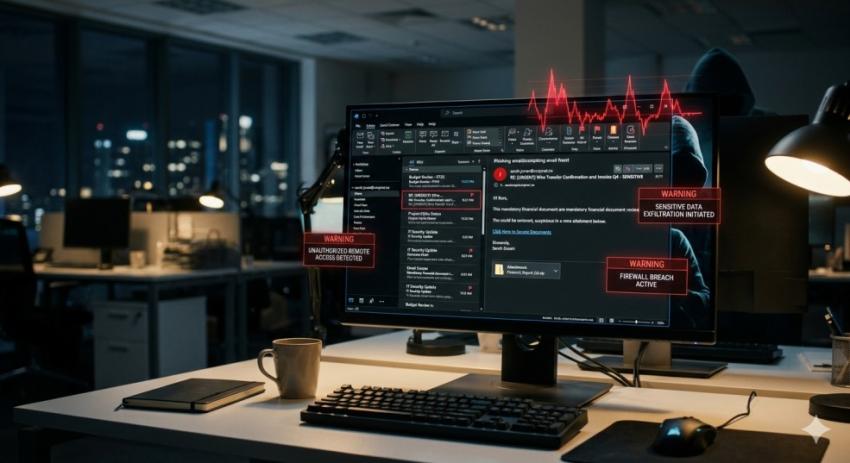
Cyber security threats are continuously changing at an alarming rate in today’s digital-first society. Although large corporations spend substantial amounts of money on security to protect their networks, employees’ email accounts represent one of the least protected areas of the corporate network, even though they have the potential to incur high damage costs if compromised.
A case in point is the Cetera Financial Group data breach, which serves as a prime example of how a potentially simple compromise to one employee’s email account can turn into a large-scale data breach. With only a one-month-old compromise on one employee’s email account, which gave an unauthorized individual access to employee emails, all potentially sensitive personal and financial information were compromised.
Email accounts are typically thought of as less valuable assets compared to the primary banking systems and secure data storage areas of firms that provide financial service. In addition, email constitutes a significant portion of service-level transactions on a daily basis. Therefore, email is frequently used to electronically transmit documents, account numbers and communicate about sensitive matters between financial service firms, their clients and their employees; therefore, the potential of an email account to be a high-value target for attack also exists.
Once an attacker has breached an email account, there are many ways for them to utilize their success. They can read emails and attachments that are stored in the account, as well as impersonate the legitimate user of the email account to gather additional information. In some cases, the activities of an attacker may look completely natural, making it nearly impossible to detect the initial compromise of the email account.
One of the main issues with breaches originating from a victim's email with through the use of an attacker to compromise an email account is that there can be long periods of time that an unauthorized user can compromise the email account with little to no detection from the account holder. Attacks against email are very often not overtly disruptive to the email user's day to day activities or usage of the email account.
The type of information that is accessed during these breaches of email account will continue to evolve as we see new methods of delivering data being created; as is the case with the financial services industry. Financial services companies are a major part of the problem because they have so many different types of sensitive data that relate to individuals (Social Security Number, Driver's License Number and Financial Account Numbers) and when someone uses the account and accesses to email, the information will be included in a variety of areas - both emails and attachments - as the attackers compile a complete profile of that individual.
Human behavior is another major challenge when it comes to cyber security. Employees may unintentionally click on phishing links, reuse passwords, or fail to detect suspicious logins. Even with advanced security measures, employee error is still a leading cause of data breaches.
This points to a need for organizations to rethink their approach to cyber security. It’s no longer enough to protect your networks; email systems must also be treated as potentially high-risk environments. Possible solutions include using multi-factor authentication on emails, monitoring email logs for unusual activity, restricting access to sensitive attachments, and providing regular employee training.
The risk to individuals from email-based breaches is also significant. Personal and financial information can be used for identity theft, fraudulent transactions, and targeted scams. Education regarding identifying unusual emails, monitoring bank account activity, and responding quickly when receiving a notification of a breach are all critical to minimizing potential harm.
The increase in email-related breaches illustrates a larger shift in how cyber criminals conduct their attacks; where their previous emphasis was on breaching large and complex systems to gain access to desirable and valuable information, they have now begun to attack the low-hanging fruit of email accounts that are relatively easy to break into but offer the potential for great rewards.
In many cases, that low-hanging fruit can be found in someone's inbox.