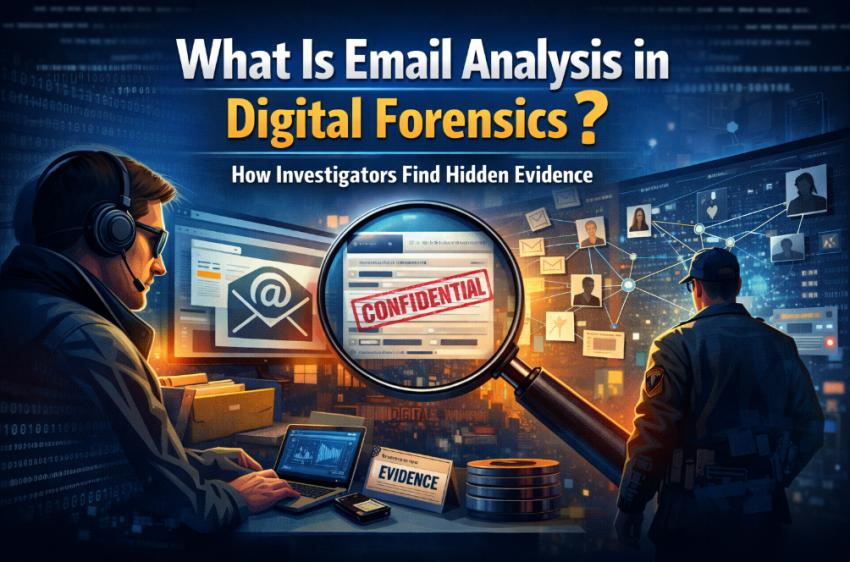
You are an investigator who have to analyze thousands of emails. Somewhere inside, one message holds the truth but it’s buried deeply under noise, attachments, and hidden data. Time is running out, and manual searching isn’t working.
This is exactly where most investigations slow down. In this blog, you’ll clearly understand what is email analysis in digital forensics and how professionals solve it step-by-step.
What Is Email Analysis in Digital Forensics and Why It Matters Today
What is email analysis in digital forensics? It is the process of collecting, examining, and interpreting emails to find digital evidence for investigations.
Think of it like a mission briefing before takeoff. An email is not just a message it carries hidden routes, timestamps, sender paths, and attachments. Investigators study all of this to uncover truth, intent, and connections.
Email evidence plays a major role in fraud cases, insider threats, and cybercrime investigations. Courts rely on properly analyzed emails to establish facts. That’s why accuracy is not optional it’s critical.
Why Email Evidence Is Hard to Analyze
The Volume Problem
Modern investigations involve massive data. One case can contain thousands or even millions of emails.
Finding one important message is like searching for a single fingerprint in an entire city. Without a structured approach, things get missed.
The Complexity Problem
Emails are layered. What you see is only the surface.
An email contains:
Message body (visible text)
Metadata (hidden details like time and sender path)
Attachments (documents, images, files)
It’s like reading a letter, checking the envelope, and tracking the delivery route—all at once.
What Is Email Analysis in Digital Forensics (Step-by-Step)
Step 1 - Collecting Emails Safely
Investigators first gather email data from sources like cloud accounts, backups, or devices.
This must be done carefully so the data is not changed. Think of it like collecting fingerprints at a crime scene, any mistake can damage evidence.
Step 2 - Examining Email Structure
Next, they analyze headers, timestamps, and sender details.
Headers act like a travel history of the email. They show where the email came from and how it reached the receiver.
Step 3 - Finding Hidden Connections
Investigators look for patterns.
They track:
Who communicated with whom
Frequency of emails
Suspicious links between users
This is similar to a war room map where threads connect different suspects.
Step 4 - Presenting Evidence
Finally, findings are organized into clear reports.
These reports must be easy to understand and strong enough to be used in court.
A Simple Case
Imagine an employee sends a harmless-looking email. But its header reveals it was routed through an unusual server.
Further analysis shows repeated communication with an external domain. That single clue exposes a data leak.
This is how small details lead to big breakthroughs.
Where Manual Analysis Fails
Manual email analysis may work for small cases, but it breaks under pressure.
It takes too much time
Important details get missed
Data handling becomes messy
Even skilled investigators can overlook hidden patterns when data grows large.
Risks You Should Not Ignore
Missing deleted emails
Ignoring metadata
Accidentally altering evidence
These mistakes can weaken a case. In legal scenarios, even a small error can lead to rejection of evidence.
Quick Reality Check
If you had to analyze 50,000 emails today:
Would you rely only on manual reading?
Or use a structured approach that ensures nothing is missed?
This moment of choice defines the outcome of your investigation.
The Shift Modern Investigators Have Made
Experienced investigators no longer rely only on manual effort.
They follow a smarter approach like:
Organize emails before analyzing
Focus on patterns, not just content
Preserve every detail as evidence
It’s like moving from searching blindly to using a radar system.
Where Professional Tools Fits In
In real-world investigations, tools like MailXaminer are used when cases involve large volumes of data and require precision.
It helps investigators view email relationships, examine hidden details, and manage large datasets without losing clarity.
Instead of struggling with scattered data, professionals can focus on understanding the case.
A Simple Decision That Changes Everything
Imagine two investigators working on the same case:
Investigator A: Reads emails one by one, misses hidden links, takes days.
Investigator B: Uses a structured approach, sees patterns instantly, solves faster.
The difference is not skill, it’s the approach.
Why Accuracy Matters in Legal Use
Email evidence must meet strict standards to be accepted in court.
Investigators ensure:
Data remains unchanged
Evidence can be verified
Findings are clearly documented
Think of it like sealing evidence in a lab. If the seal is broken, trust is lost.
This is why structured email analysis is essential.
Final Thoughts – From Confusion to Clarity
Email analysis is no longer just reading messages. It is a structured process of uncovering truth hidden inside digital communication.
When done right, it turns chaos into clarity. It helps investigators move with confidence, knowing no detail is missed.
Understanding what is email analysis in digital forensics gives you the foundation. Applying the right approach gives you the results.