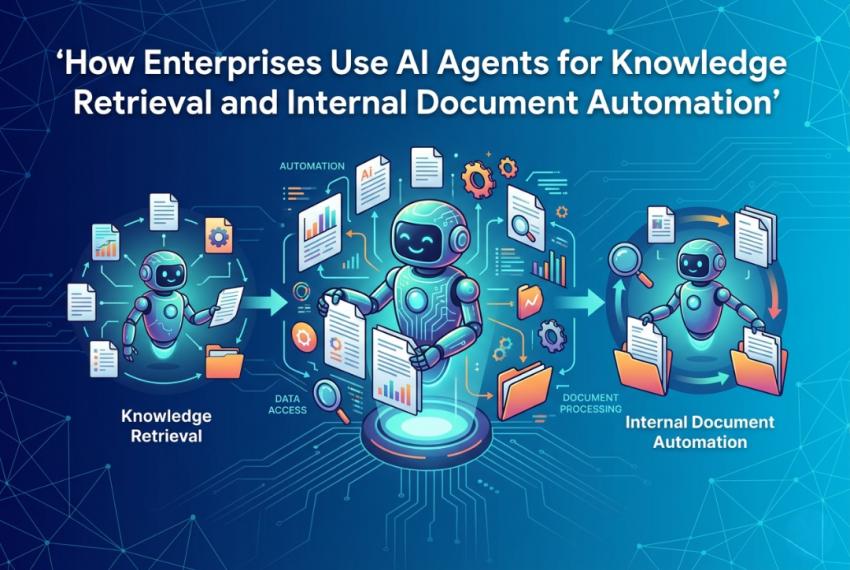
Major enterprises deal with gigantic amounts of internal knowledge. The policies, the technical documentation, compliance documentation, project files, and operational manuals can be found in disparate systems. Surprisingly, employees consume a lot of time in an attempt to get information that is already available. This lack of efficiency slows down the decision-making process and lowers productivity among teams in most enterprises.
AI agents are coming up to provide a viable solution to this issue. Rather than compelling workers to search through complicated document archives, intelligent systems are able to access information, summarize data and automate document processes. Firms that embrace AI Agent Development Services are starting to change the internal knowledge flow within their companies.
In the case of the enterprises and well-financed startups, experimentation is not the purpose of the endeavor. The objective is efficiency in operations, quicker availability of institutional knowledge, and less administrative overhead.
This paper discusses the ways that organizations are leveraging AI agents to become more efficient in knowledge retrieval and automate document workflows, and why a large number of companies today are engaging a dedicated AI Agent Development Company to deploy AI agent-based systems.
The Knowledge Management Problem in Modern Enterprises
There is hardly a place where enterprise knowledge can be found. Records are frequently disseminated through various systems such as internal databases, cloud drives, collaboration systems, and legacy systems. Even in the cases of well-organized documentation, employees still cannot find the right answers in time.
Studies have shown that employees waste almost 20 per cent of their working days searching internally or locating people who might have the solution.
This inefficiency affects several core functions:
Teams of engineers in search of technical documentation.
Customer services seeking policy directions.
Compliance record reviews by legal teams.
The sales teams who retrieve product or price documentation.
Another problem with traditional search tools is that they are mostly weak since they are based on matching a keyword to search, but not the context. AI agents take an alternative approach to the problem. They perceive the intention of a question and access the most appropriate information from several sources.
What AI Agents Do in Enterprise Knowledge Systems
AI agents are smart assistants, and they engage with enterprise data environments. These agents are used to combine large language models with retrieval systems and workflow automation to do what used to be done manually.
Modern Conversational AI Agents can:
- Search over structured databases and unstructured data.
- Decipher natural language queries.
- Search through documents or pieces of knowledge.
- Concisely summarise long reports or policies.
- Automate the procedure for documents.
- Help workers using conversational interfaces.
For example, an employee might ask:
"What do European customers need to know about the current data privacy?"
The AI agent searches through compliance documents on the inside, finds the necessary sections, and provides a summary with references to sources.
Companies using AI Agent Development Services usually attach these agents to knowledge bases, CRM, internal wikis, document management systems, and cloud storage.
AI Agents for Enterprise Knowledge Retrieval
Intelligent knowledge retrieval is one of the most useful areas where Generative AI Agents can be utilized.
Conventional search tools demand that the employee be aware of where to search. AI agents offload such a burden by serving as a single knowledge interface.
Unified Knowledge Access
The information that is gathered by AI agents covers several internal systems, such as:
- SharePoint repositories
- Cloud storage and Google Drive.
- Intranet systems.
- CRM and ERP systems
- Project management tools
The employees are dealing with a one-conversation interface as the agent does the complex search in the background.
Contextual Search
AI agents comprehend meaning and context, unlike keyword search tools. They are able to respond to complicated questions such as:
- "What was the outcome of the last security audit?"
- "Which policy covers remote work reimbursement?"
- "Summarize the architecture guidelines for our payment platform."
The system also finds information and does not provide a list of irrelevant documents, but gives a brief answer.
Knowledge Summarization
Big documents can bring highly important information, which is buried in hundreds of pages. Report summarization, key insights, and presentation can be provided by AI agents in a few seconds.
The ability is especially important in the executive teams that require rapid access to credible information.
Companies investigating these possibilities usually use the services of Generative AI Consulting to create retrieval architectures that are accurate and keep data safe.
Automating Internal Document Workflows
In addition to the retrieval of knowledge, AI agents also automate document-based processes that take a lot of time in terms of their operation.
Most of the activities of an enterprise are based on the creation, review, classification and routing of documents. Automation with AI lowers the number of people working in the office and enhances consistency in the processes.
Document Classification
AI agents can automatically categorize incoming documents such as:
- Contracts
- Invoices
- Compliance forms
- HR documents
- Customer submissions
The system does not require manual tagging but searches the contents of documents to classify them appropriately.
Intelligent Document Routing
After classification, documents may be sent to a department or a stage of the workflow.
For example:
- Legal contracts are forwarded for legal review.
- HR documents are transferred to the records of employees.
- Procurement invoices would join finance approval workflows.
This automation gets rid of the delays that are brought about by manual handling.
Policy and Compliance Monitoring
Business organizations in the regulated sectors should make sure documentation is done in strict compliance with the rules. AI agents are able to read documents, identify missing information, and detect the presence of necessary clauses or fields.
Companies that apply AI Agent Development Services usually incorporate automated workflows and compliance validation to minimize legal risk.
Conversational Interfaces for Enterprise Employees
The emergence of Conversational AI Agents is changing the interaction between employees and internal systems.
Users do not have to navigate through complicated interfaces or search across several platforms; they just have to ask questions in natural language.
Examples include:
- "Show the onboarding checklist for new employees."
- "Find the latest sales presentation template."
- "What are the cybersecurity guidelines for remote devices?"
The AI agent will access the information and display it in the same conversational interface.
This will greatly minimize training needs and enhance interdepartmental adoption.
Why Enterprises Partner with an AI Agent Development Company
Creating AI agents used in enterprises takes more than just linking a language model to internal data. Any organization is supposed to create powerful systems that deal with security, scalability, and accuracy.
The development of a dedicated AI Agent Company is usually an area of expertise in a number of areas.
Enterprise Data Integration
The AI agents should be able to reach more than one enterprise system with no interruption to the current infrastructure. Integration often includes:
- CRM platforms
- ERP systems
- document repositories
- internal APIs
- cloud storage environments
A team of experienced individuals would guarantee secure and reliable connectivity.
Retrieval-Augmented Generation Architecture
A successful retrieval of knowledge relies on properly developed retrieval systems. A common model used by many companies that applies retrieval-augmented generation is a model that integrates language models with search pipelines in their enterprise.
The architecture enhances precision and makes sure that the responses obtained by AI are based on validated internal information.
Security and Governance
Enterprise knowledge systems often contain sensitive information. AI agents must follow strict security controls including:
- Role-based access control.
- encrypted data handling
- AI interaction audit trails.
- adherence to regulatory systems.
Companies that recruit Skilled AI Agent Developers enjoy developed security practices that secure sensitive information.
ROI of AI Agents for Knowledge Automation
Organisations will seldom explore AI projects without definite operational advantages. Document automation and knowledge retrieval are quantifiable.
Common outcomes include:
Productivity improvements
Employees use less time searching for information and more time in strategic activities.
Faster onboarding
New employees can enter the company with access to the institutional knowledge due to the AI-based guidance systems.
Reduced operational overhead
Document processes are automated instead of being manually controlled.
Improved decision speed
Managers and executives get the right insights within a short period.
Enterprise AI adoption studies show that the companies implementing the knowledge automation systems report increased productivity of up to 30 percent in the knowledge-intensive positions.
The Future of Enterprise Knowledge Systems
The main interface of enterprise knowledge is becoming AI agents. With more complex tasks, these systems will be able to perform, including:
- computerised interpretation of policies.
- intelligent report generation.
- proactive knowledge suggestions.
- interdepartmental orchestration of workflow.
In the case of organizations that handle big bodies of knowledge, AI agents are an improvement on the conventional document archives to the dynamic knowledge assistant.
Businesses offering this change usually start their strategy with a strategic implementation by specialized CD services of AI agents.
The first step that companies typically undertake before adopting enterprise-level solutions is to engage mature development teams that build scalable AI infrastructures.
Having the appropriate architecture and development skills, AI agents have the ability to transform disconnected information systems into an intelligent knowledge environment that can not only respond quickly to queries but can also improve operational performance.