An investigator opens a mailbox linked to fraud. One careless export changes a timestamp. One missing log weakens chain of custody. The evidence is real but now its integrity is questioned.
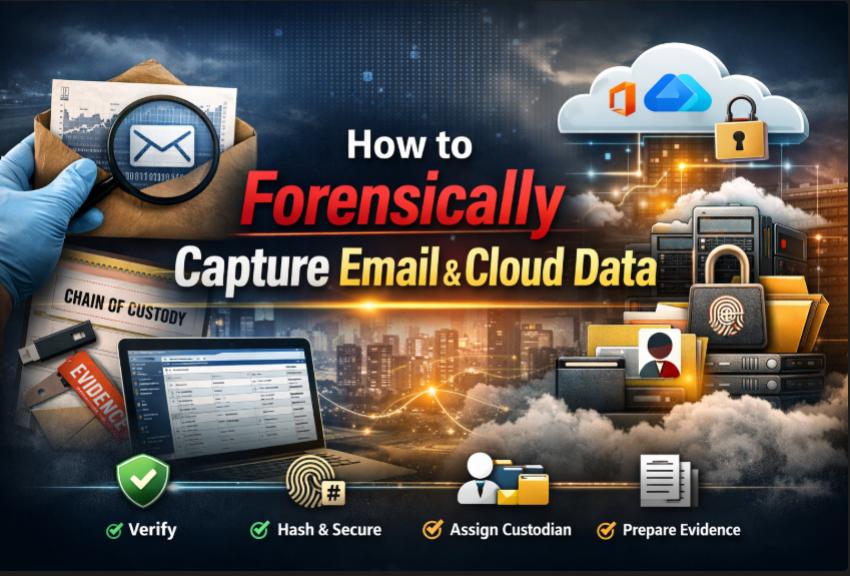
If you want to know how to forensically capture email and cloud data without risking admissibility, this guide walks you through it clearly and practically.
Why Email and Cloud Evidence Gets Rejected
Digital evidence is fragile. Not because it breaks easily, but because it can change silently.
Many teams follow a basic forensic email capture process that looks simple: export a PST, download mailbox data, save cloud content locally. It feels complete. But it is not forensic.
Downloading is not capturing. Exporting is not preserving. Think of it like collecting fingerprints without gloves. The evidence exists, but the defence can argue contamination. Cloud environments make this more complex. Data lives across servers, sync layers, and user permissions. Without documented authentication, verified integrity, and custodian tracking, the collection can be challenged.
This is why email evidence collection best practices require structure, documentation, and integrity validation from the first click. To do this, professional email forensic tools are required.
How to Forensically Capture Email and Cloud Data Correctly
Learning how to forensically capture email and cloud data means understanding one principle: capture must preserve, verify, and defend.
A proper forensic workflow includes controlled ingestion, hash validation, authentication logging, and structured export. It follows the same discipline used in digital investigations worldwide.
Let’s break it down step by step.
Step 1: Securely Ingest On-Premise Email Evidence
On-premise evidence includes Outlook files (PST/OST), disk images, and local email clients. Imagine a forensic lab receiving physical evidence. The first step is sealing it in tamper-proof packaging before examination. Digital evidence works the same way.
A structured forensic email capture process begins by adding the source into a controlled environment. During ingestion:
The original structure remains intact.
A custodian is assigned for clear ownership.
MD5 hashing is applied.
Hashing is like placing a unique wax seal on a letter. If even one character changes, the seal changes. That seal proves integrity.
Without hashing, you cannot confidently say the data remained untouched.
Step 2: Capture Cloud Data with Proper Authorisation
Cloud forensic data acquisition requires more discipline than local capture. Cloud platforms use authentication layers, permission scopes, and API-based access. Simply downloading content does not document who accessed what and when.
Think of cloud data like a secure archive room. You must log entry, validate authorisation, and record activity.
A proper workflow includes:
Admin-level authentication
Defined permission scopes
Workload selection (email, chat, files)
Date filtering for targeted collection
Fetching and validating user accounts before ingestion
This ensures the evidence is defensible and complete. Cloud evidence must be both preserved and explainable. If you cannot explain your access path, your capture may be challenged.
Step 3: Preserve Integrity with Hash Verification
Integrity is the backbone of digital forensics. MD5 hashing creates a digital fingerprint of every file during ingestion. If the file changes, even slightly, the fingerprint changes.
This step protects against:
Accidental modification
Metadata alteration
Transfer corruption
Professional investigations follow recognised electronic discovery frameworks to maintain defensibility. Integrity checks align with these structured models and protect the chain of custody. Skipping hash validation is like flying without a flight recorder. If questioned later, there is no proof of what truly happened.
Step 4: Prepare Evidence for Legal Review
Capture is not the end. Presentation matters. Once data is ingested and verified, it must be prepared for structured review. This includes:
Organized dashboards
Search and filtering
Bates numbering for unique page identification
Controlled export formats
Bates numbering works like labelling every page in a classified case file. Each page receives a unique number, making referencing precise during litigation.
Evidence is not just collected. It is prepared to tell a defensible story.
The Manual Capture Trap
Manual methods feel fast. Export mailbox. Save locally. Analyse later.
But manual capture often skips hash validation, custodian tagging, and authentication logging. It increases the risk of:
Metadata inconsistencies
Timezone conflicts
Partial
Chain of custody gaps
In court or compliance review, these gaps can weaken your case. Convenience is not defensibility.
A Structured Forensic Solution
This is where a dedicated platform plays a role.
Professional tools are built specifically for email investigation and forensic analysis. It supports ingestion from multiple email clients and cloud environments while preserving integrity during capture.
It allows:
Controlled evidence ingestion
MD5 hash validation
Custodian assignment
Secure cloud authentication
Structured export with Bates numbering
Instead of juggling manual exports, investigators work within a unified forensic workflow designed to support defensibility.
The goal is not complexity. The goal is clarity and control.
Quick Self-Check for Investigators
Ask yourself:
Do you verify hash values before analysis?
Do you document authentication during cloud forensic data acquisition?
Can you explain your capture process clearly under scrutiny?
If the answer is uncertain, your workflow may need reinforcement.
Final Thought
A mission commander studies terrain, verifies instruments, and confirms communication before takeoff. Digital investigators must do the same.
Learning how to forensically capture email and cloud data is not about tools alone. It is about discipline, structure, and integrity.
When evidence matters, process matters more.
If your investigations depend on email and cloud evidence, structured forensic capture is not optional. It is essential.