Modern NLP systems don’t fail because of models.
They fail because teams underestimate process rigor.
An end-to-end NLP development workflow is the difference between a demo that works once and a production system that scales, adapts, and delivers ROI. This guide breaks down how professional teams build NLP systems from raw data to live deployment and where most companies get it wrong.
What Is the NLP Development Process?
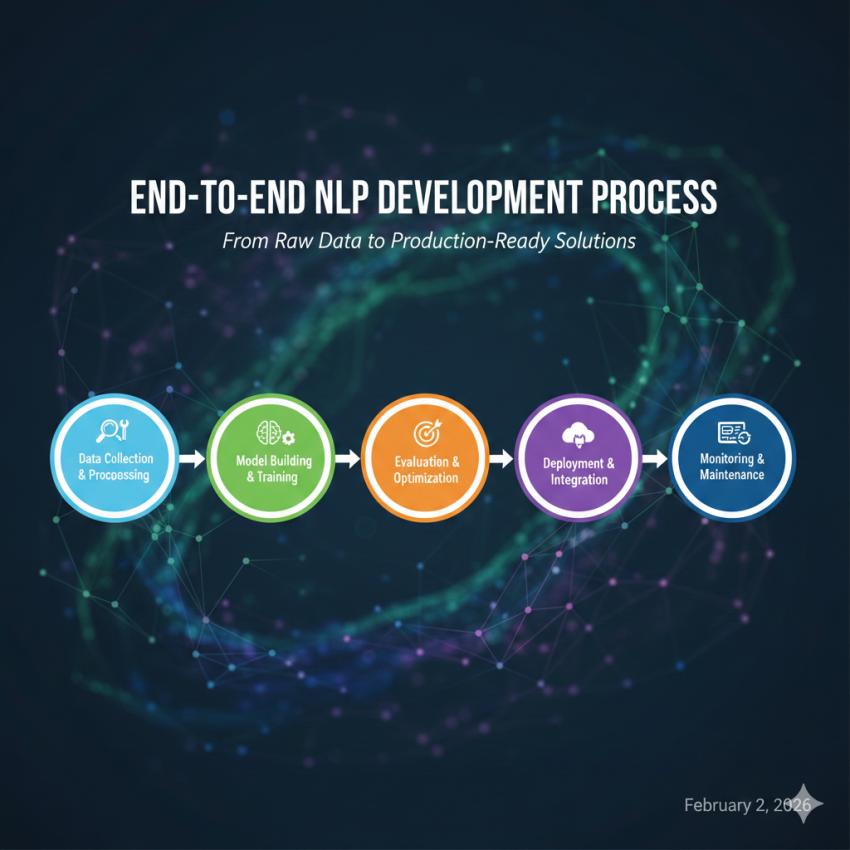
The NLP development process is a structured pipeline that transforms unstructured language data into deployable, monitored, and continuously improving AI systems.
At a production level, it includes:
Data strategy and acquisition
Data cleaning and annotation
Model selection and training
Evaluation and bias control
Deployment architecture
Monitoring, retraining, and optimization
This is the backbone of enterprise-grade NLP Development services, not just model fine-tuning.
Stage 1: Data Strategy (Where NLP Projects Are Won or Lost)
What experts do differently
Most teams start with “What model should we use?”
Experienced NLP teams start with data intent mapping.
Key decisions:
What language phenomena matter? (intent, sentiment, entities, syntax)
What failure is acceptable vs unacceptable?
What data reflects real user behavior?
Common mistake: Using generic datasets for domain-specific problems (legal, healthcare, fintech).
High-performing NLP systems are trained on behavioral data, not theoretical language samples.
Stage 2: Data Collection & Annotation
Raw data sources
Customer support logs
Product reviews
Search queries
Transcripts (calls, meetings)
Documents (PDFs, contracts, policies)
Annotation is not labeling it’s modeling reality
Annotation quality defines model ceiling.
Professional NLP teams:
Use multi-annotator consensus
Track inter-annotator agreement
Continuously refine annotation guidelines
Why this matters:
LLMs amplify annotation errors. They don’t correct them.
Stage 3: Text Preprocessing & Feature Engineering
Even with transformer models, preprocessing is not optional.
Key steps include:
Language normalization (case, punctuation, emojis)
Tokenization strategy selection
Stop-word handling (task-specific)
Domain term preservation
Advanced teams also:
Inject metadata (timestamps, user roles)
Preserve formatting signals for documents
Handle multilingual code-switching explicitly
Stage 4: Model Selection & Training
The real question isn’t “Which model?”
It’s “Which trade-offs matter?”
ConstraintModel Choice Impact
Latency: Smaller or distilled models
AccuracyFine-tuned transformers
ExplainabilityHybrid rule + ML
CostOpen-source vs API LLMs
Training approaches:
Classical ML (for constrained tasks)
Fine-tuned transformers
Retrieval-augmented generation (RAG)
Hybrid symbolic + neural systems
This is where experienced NLP Development services create differentiation not by chasing hype, but by engineering fit.
Stage 5: Evaluation, Bias & Robustness Testing
Accuracy is table stakes
Production NLP requires stress testing of language.
Evaluation goes beyond F1 score:
Edge-case handling
Adversarial prompts
Demographic bias analysis
Domain drift simulation
Expert insight:
If your NLP model hasn’t failed loudly in testing, it will fail quietly in production.
Stage 6: Deployment & Integration
NLP deployment is a systems problem
Not a data science problem.
Deployment considerations:
API vs embedded models
Real-time vs batch inference
Autoscaling and cost controls
Security and PII handling
Most enterprise NLP systems deploy as:
Microservices
Event-driven pipelines
Embedded inference layers
This is where many internal teams lean on external NLP Development services to avoid architectural debt.
Stage 7: Monitoring, Retraining & Continuous Improvement
Language changes. Users adapt. Models decay.
Production NLP requires:
Input drift detection
Output confidence monitoring
Human-in-the-loop correction
Scheduled or trigger-based retraining
Without monitoring, NLP accuracy always declines.
The only question is how fast.
What Separates Enterprise NLP from Experiments
Hobby NLP
One-off training
Static datasets
No monitoring
Model-centric thinking
Production NLP
Continuous data pipelines
Annotation feedback loops
Cost-aware inference
Business-aligned evaluation
This is why serious organizations invest in structured NLP Development services instead of isolated model builds.
Final Takeaway:
End-to-end NLP development is not about building smarter models; it’s about building systems that understand language reliably at scale.