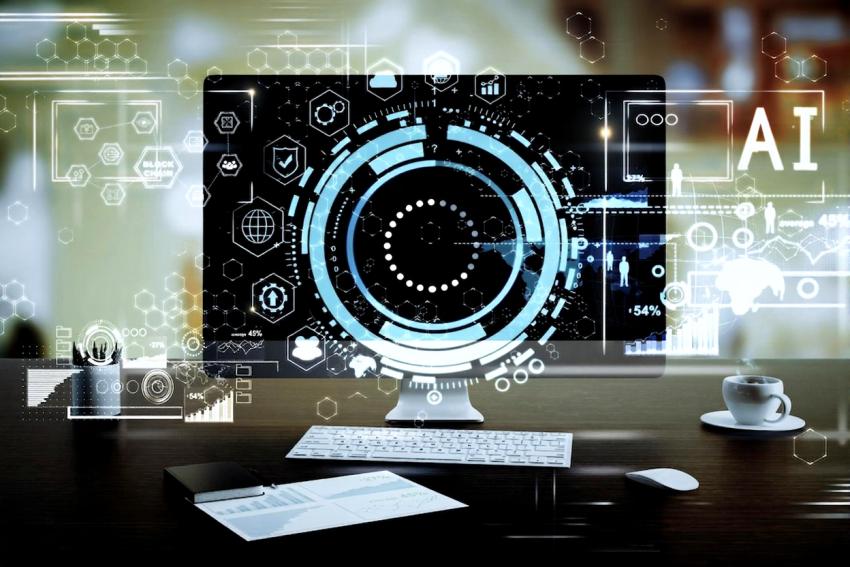
Over the last ten years, artificial intelligence (AI) has penetrated numerous industries and changed all aspects of healthcare to entertainment. The software development environment has not been an exception. With businesses now attempting to keep up with the competition, AI is becoming a central element related to the automation of mundane tasks, code enhancement, teamwork, and even rapid delivery. In the case of those companies that provide custom software development services in Saudi Arabia, AI is providing an unprecedented opportunity to be innovative and provide the best solutions to their clients.
However, what exactly is the AI revolutionizing about software development? This blog will discuss the various applications of AI in improving the whole development process, which includes design and coding, testing, and deployment.
1. AI-Powered Code Generation: Streamlining Development Processes
Code generation is one of the most innovative AI contributions to the software development. Software developers have traditionally consumed a lot of time in writing software code of applications. Even though such an activity demands expertise, it may be time consuming and can also be subject to human error. Code generators based on AI, such as GitHub Copilot and the Codex by OpenAI, can be used to assist in creating boilerplate code and provide suggestions or even entire pieces of code when given a description in natural language.
These AI software are trained on massive code collections using deep learning models that result in the prediction and generation in real time of code snippets. This will enable developers to stick on more intricate issues and innovative assignments and make the developmental procedure quicker.
Besides time-saving, AI-based code generation may also enhance consistency and quality of code. The tools factor in the best practices and the coding standards, which may assist the developers to prevent the pitfalls and limit the technical debt. This leads to more maintainable and cleaner code and speed to market.
2. Automated Testing: AI in Quality Assurance
One of the most time-consuming and important processes of the software development is testing. To developers and the quality assurance (QA) team, the system of writing the test cases, executing tests and detecting bugs can be tiresome and monotonous. Most of these processes can be automated by AI which increases the efficiency and precision of the testing procedures.
The code-testing powered by AI involves machine-learning algorithms that identify the patterns in the code and suggest the potential problems even before they exist. These tools are able to automatically create test cases and simulate user interactions, and can even determine edge cases that can be overlooked by human testers. With the help of AI to perform regression testing, functional testing, and even the performance testing, developers can determine the robustness and reliability of the software before the software reaches the production stage.
Moreover, AI can help to improve the process of testing to identify the problems in a more accurate and faster way.. This saves time as well as assists developers to ensure high-quality standards across the development lifecycle. The automation of AI in QA tools is a way to have a comprehensive and scalable testing; less subject to human bias.
3. Predictive Analytics: Enhancing Project Management
Software development management is a complicated field that involves predicting the possible obstacles, resource allocation, and delivery on time. A project manager can use AI to make decisions based on the historical project data and predict it to make informed decisions using data as the basis of forecasting.
Predictive analytics (based on the AI) can be employed to generate forecasts of risk of delays, budget increase or other technical complications by relying on historical trends in the project. These lessons can help project managers be proactive, adjust schedules and allocate resourcesin a better way.
Moreover, AI will allow optimizing teamwork. Through performance metrics, AI tools can indicate the most optimal team makeups in accordance with the strengths and weaknesses of individual developers. This will provide assurance that appropriate expertise is used in the appropriate tasks thereby enhancing productivity of the team.
4. AI for Code Review: Automating the Review Process
Code reviews form a very critical aspect of software development life cycle. They assist in preserving information quality in the code, making sure that it conforms to the standards of a code, and decreasing bugs. Conventionally, code reviews have been conducted in a manual way by colleagues or with seniors that may be durative and subjective.
This can be automated by AI-driven code review tools in a number of ways. These tools apply machine learning models to scan code in the case of possible problems, which may include syntax errors, inefficient algorithms, and best practice breaches. There are even AI-powered tools that can make code improvement suggestions to aid the developer to learn and develop their coding habits.
Automated code reviews can hasten the process making sure that the code is reviewed and optimized at any given time. This will enable the developers not to be stunted on routine work but sort out innovation and problem solving.
5. Enhanced Collaboration with AI-Driven Project Management Tools
The collaboration of development teams in the software projects is also changing due to AI. With AI, project management tools may be used to simplify the working process, monitor development, and real-time task management. Such tools are based on natural language processing (NLP) to enable the team members to communicate with the software in simple terms, and so it is easier to communicate and collaborate.
As an example, the project management software that is based on AI can automatically update the status of tasks, assign tasks depending on workload and expertise, and provide notifications to meet deadlines. They can also come up with reports of team performance, which would help the managers to know the bottlenecks and the areas to be improved.
Increasing the degree of collaboration and communication, AI-based project management applications contribute to increasing the speed of the process and make it more productive, which means that the team members are less likely to be able to postpone or not understand each other.
6. AI in Continuous Integration and Continuous Deployment (CI/CD)
Continuous integration (CI) and continuous deployment (CD) are the keywords in the contemporary software development. These practices include a common practice of adding code changes to a common repository and automatically releasing new software versions into production.
AI supplements CI/CD pipelines with the automation of code merging, automated testing, and early detection of the problem. Artificial intelligence will have the capability to monitor the entire development cycle, determine performance bottlenecks and suggest optimization. At the larger level, the AI algorithms will be in a position to predict when a specific feature or fix will lead to any integration issues, and the developers can correct the problem before it goes out of hand.
Moreover, AI will be able to assist in optimizing end-user deployment through analyzing their usage patterns. This will enable the teams to implement the updates when it is best suited and less chances of downtime or inconvenience to the users.
7. The Role of AI in DevOps: Automation at Scale
DevOps represents a model, which focuses on the integration of software development and IT operations to produce high-quality software within a short period of time. AI has the potential to improve the DevOps process by automating menial operations, e.g. infrastructure provisioning, monitoring, and incident response.
Infrastructure failures can be predicted using AI on the basis of real-time performance metrics of the system. This enables proactive approach to vulnerabilities by DevOps teams, to scale the resources or fix vulnerabilities before they affect users. Automated incident response can also assist in automating the process of incident response to ensure that the mean time to recover (MTTR) is reduced, and the security and stability of the system would be ensured.
The implementation of AI into DevOps will provide businesses with a chance to achieve their working efficiency, minimize costs, and provide more frequent and reliable software changes.
8. Ethical Implications and Challenges of AI in Software Development
Irrespective of all its advantages, AI is connected with ethical issues in the case when the implementation of AI in software development occurs. Such problems as data privacy, bias in the algorithms, and transparency are the important challenges that have to be tackled by the developers and companies.
To illustrate, AI models that are trained with biased data can be used to generate software with discriminatory results. Developers should exercise great caution when curating training data and audit AI models on a regular basis to address bias to ensure fairness. Besides, developers have a duty to be open about the utilization of AI within their applications, and in this regard, they would give their users an explicit understanding of how their data is processed and used to make a decision.
The development of AI in an ethical manner is essential in the establishment of trust amongst the end-users, and also the usefulness of AI technology to the society. In the current development of AI, developers and companies should be responsible to minimize the possible risks.
9. The Future of AI in Software Development
In the future, the presence of AI in software development is bound to increase. With more advanced and able AI models, they will be capable of performing more advanced tasks, including real-time debugging, adaptive code, and intelligent problem-solving. These improvements will result in further streamlined development process where developers will develop better software at a faster rate.
There is also the future possibility of AI helping in more creative parts of the development, which includes user experience (UX) design and product ideation. The predictive trends and insights offered by AI following the analysis of user feedback will provide the developers with more opportunities to develop more intuitive and personalized software solutions.
Conclusion
AI is surely changing the landscape of the software development process, automating its routine and increasing the efficiency of collaboration and code quality. To business and developers, the adoption of AI in software development lifecycle may result in faster development cycles, improved quality of software, and market advantage.
The use of AI in the development of personalized software services provides a strong opportunity to develop innovative scaled solutions in Saudi Arabia as digital transformation is among the priorities of the country. With the further development of AI, the prospects of the software development of this tool will expand, providing developers and organizations all over the world with new opportunities.