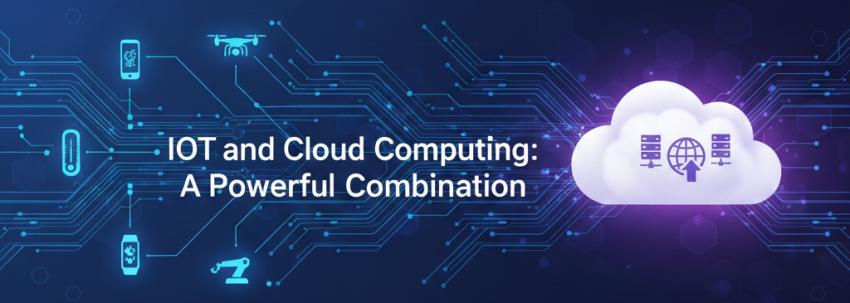
The Internet of Things has revolutionized the manner in which data is generated, shared, and reacted to by different devices. Just consider smart homes, wearables, manufacturing machinery, or health informatics—you can see that a vast amount of real-time data is being generated by IoT. However, this data is useless if it is not analyzed in an efficient manner. Cloud computing emerges as a key enabler here, because if you mix Internet of Things and cloud, you essentially have a combination that breeds innovation.
The Role of Cloud Computing and IoT in Enabling Scalability
A world of IoT can comprise thousands and millions of interconnected devices. This cannot be managed at an on-premise cost due to various hassles and expenditures. Cloud provides scalable resources which can be scaled up and down according to requirements. This suits the requirements of IoT.
Cloud platforms enable you to store large quantities of data from your devices, and you do not have to worry about exhausting the capacity. As more devices connect to the internet, the cloud is able to manage the data that comes in. Cloud platform capabilities include scalability.
Real-Time Data Processing and Analytics
Being associated with cloud computing, the full potential of real-time data is unleashed through IoT. IoT devices do not stop spewing data, and the cloud-based analysis tools are ready to decode this data at a faster pace. This will allow the business to track trends, predict failures, and optimize processes while they occur.
Just think of manufacturing: cloud-based processing of sensor readings can alert a problem with the equipment before a problem happens. Take the medical field: real-time information on patients allows doctors to monitor the patient’s status remotely. Normal “processing” of information, such as this, yields greater efficiency.
Increased Flexibility & Accessibility from Anywhere
As a result of the application of cloud concepts, it is possible to control IoT solutions from anywhere. Additionally, the use of cloud hosting enables real-time monitoring of system operations.
Such flexibility is greatly advantageous in distributed environments, such as smart cities, large logistics, and large energy infrastructures. With cloud management, admins can apply firmware updates, configure, and even debug without increasing downtimes and expenditures. Moreover, cloud management allows easy integration with other applications and services.
Security and Data Management Benefits
Security in IoT often seems to be an obstacle, whereas cloud platforms fortify protection with strong tools. It includes encryption, identity management, access control, and continuous monitoring that make sensitive IoT data secure.
Vendors manage updates and keep systems aligned with evolving security standards, thereby taking some of the workload from internal IT. Centralized data management makes policy enforcement, anomaly detection, and threat response more manageable. When implemented correctly, security in the cloud engenders trust and increases the dependability of systems.
Driving Innovation Through AI and Automation
Such a combination of cloud computing and IoT opens doors to more advanced technologies, including artificial intelligence and machine learning. Cloud platforms supply the computing power needed to train models and automate decisions using IoT data.
This enables predictive maintenance, wiser traffic management, energy optimization, and personalization of user experience. As AI-driven insights grow more accurate, businesses can automate intricate workflows and design smarter and more adaptable systems.
Conclusion
Put together, IoT and cloud computing form a powerful digital backbone for any enterprise in the modern-day world. Cloud amplifies IoT capabilities with scale, real-time analytics, secure data management, and various other forms of advanced intelligence. The duality will remain central to innovation, operational efficiency, and sustainable growth across industries for as long as their connected technologies are being adopted by organizations.
Frequently Asked Questions (FAQs)
1. Why is cloud computing essential for IoT solutions?
Cloud computing provides scalable storage, processing power, and analytics needed to handle large volumes of IoT data efficiently.
2. How does cloud computing improve IoT data analytics?
It enables real-time data processing, advanced analytics, and AI-driven insights that help businesses make faster decisions.
3. Is IoT data secure in the cloud?
Yes, when best practices are followed, cloud platforms offer robust security features such as encryption, access control, and monitoring.
4. Which industries benefit most from IoT and cloud integration?
Industries like healthcare, manufacturing, smart cities, logistics, and energy benefit significantly from this powerful combination.