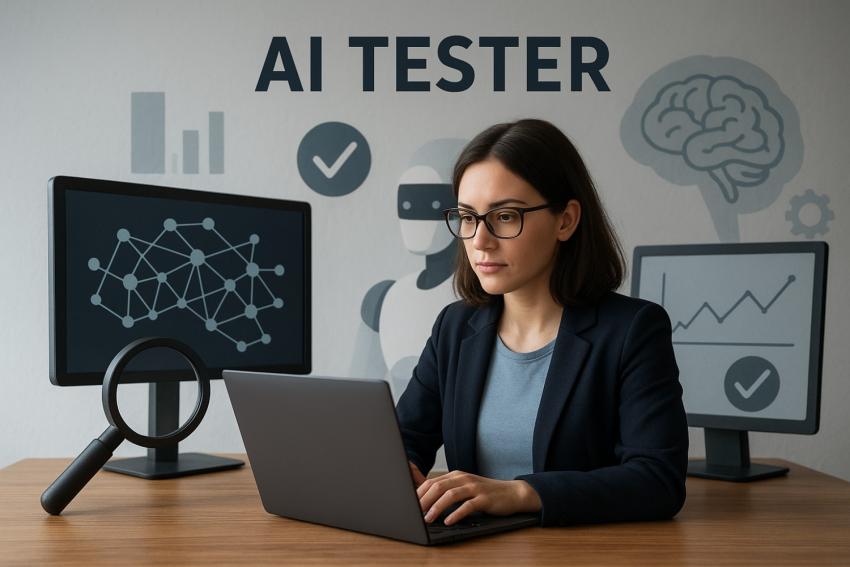
AI Tester: The Future of Quality Assurance in the Age of Intelligent Software
Have you ever wondered who checks whether AI systems actually work — and do so reliably, fairly, and safely? Welcome to the world of the AI Tester — a role that’s quietly becoming one of the most exciting and future-proof careers in tech.
Unlike traditional software testing, AI testing isn’t about checking if a button clicks or a form submits. AI systems learn from data, make decisions, and even evolve behaviors over time. To ensure they do so responsibly, we need testers who understand both AI logic and human expectations — enter the AI Tester.
What Is an AI Tester?
An AI Tester is a professional who specializes in evaluating artificial intelligence-driven systems — not just traditional software. Think of them as quality assurance specialists for a world where machines learn patterns, not just follow instructions.
So what makes AI testing different?
- AI systems aren’t always deterministic — the same input might produce different outcomes.
- AI learns from data, so quality isn’t just about code; it’s about data integrity.
- Testers need to think beyond “does it work?” to questions like “is it fair?”, “Is it explainable?”, and “Is it robust against unexpected inputs?”
This isn’t your typical QA job — it’s more like a mix of data science, critical thinking, and ethics, all wrapped in testing expertise.
Why AI Testing Matters More Than Ever
Trying to use old testing methods on AI systems is just like using a flip phone to stream movies — something’s going to break.
AI Testers focus on:
- Bias & fairness – ensuring AI decisions aren’t skewed by flawed data.
- Explainability – making sense of why a model outputs a particular result.
- Robustness – knowing how the AI performs under edge cases or noisy data.
- Transparency – tracking how the AI learns and adapts.
In an era where AI influences everything from healthcare diagnostics to driverless cars, overlooking quality and safety isn’t just risky — it’s irresponsible.
What Skills Does an AI Tester Bring to the Table?
An AI Tester isn’t just clicking buttons all day. Their job blends analytical minds with creative problem-solving:
- Critical thinking — to evaluate AI decisions that may not have one correct answer
- Understanding machine learning basics — knowing what training, validation, and testing datasets are.
- Attention to data quality — because insufficient data means bad AI outcomes
- Communication skills — working closely with data scientists, developers, and product owners
In simpler terms, they think like a detective, test like an engineer, and explain like a teacher.
Getting Certified: Why It Helps
If you’re serious about becoming an AI Tester, one of the big stepping stones in this space is the ISTQB AI Testing (CT-AI) certification. It’s geared toward professionals who want to master the nuances of testing AI systems and using AI effectively in testing processes.
This certification helps you:
- Understand AI fundamentals and lifecycle
- Learn how to craft AI-centric test strategies
- Recognize special infrastructure needs for AI testing
- Execute useful test cases that go beyond traditional QA
For many employers, this certificate signals that you get it — and that you’re ready to ensure quality in a data-driven world.
Real Talk: Is AI Testing Just a Buzzword?
Here’s an honest perspective: some people argue that certifications alone won’t make you a top expert. Real experience matters — but certifications help open doors and give you a language to talk about AI challenges confidently. Real-world testing of AI is still emerging, and being equipped to bridge gaps between developers, stakeholders, and AI models is what makes an AI Tester truly valuable.
The Future Is About Intelligent Quality
The rise of AI has changed how software behaves, and it has also redefined how we ensure quality. AI Testers don’t just look for defects — they help make AI trustworthy.
Whether you’re a seasoned QA pro or someone who is dreaming of stepping into this field, the role of an AI Tester isn’t just relevant — it’s essential.
Think of it like this:
“In a world full of smart machines, someone still needs to check if they’re smart in the right way.”
And that someone might just be you.