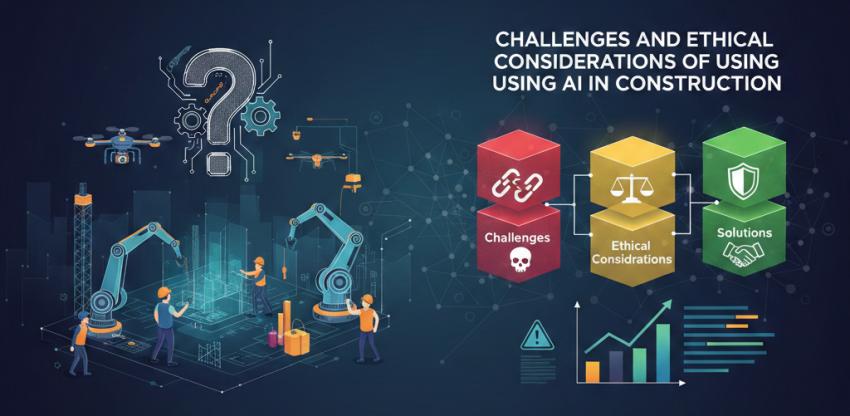
Artificial Intelligence (AI) is swiftly changing the construction sector making it predictive in the maintenance of equipment and machinery but also autonomous and alert of safety concerns. The advantages are substantial; however, along with the benefits, the emergence of AI also implies certain challenges and ethical considerations that businesses should take into account to be able to be responsible in introducing AI. The knowledge of these problems can assist the builders, engineers, and the decision-makers make effective use of AI without undermining the safety, fairness, and trust.
1. Data Quality and Reliability Problems.
The AI systems are critical on the information gathered using sensors, equipment records, construction plan, and project management software.
Nonetheless, construction sites are dynamic places wherein incomplete, inconsistent or inaccurate data can occur.
Risks include:
- Poor data Inaccurate forecasting as a result of poor data.
- Incorrect risk assessments
- Wrong decisions made automatically in order to deceive project managers.
In case the input data is not reliable, AI-based insights may result in expensive or even harmful mistakes.
2. Privacy and Surveillance Issues.
In the process of modern construction, drones, cameras, and wearable sensors are employed to enhance safety, as well as to track productivity.
As much as these tools help improve oversight, they also create privacy issues to the workers.
Ethical questions arise:
- Are workers conscious of the level of surveillance?
- What is the duration of surveillance data retention?
- Who can access such information?
It is a significant issue to balance the safety with the consideration of personal privacy.
3. Job Displacement and Employment Effect.
Machines based on AI, robotics, and automated workflows potentially enable the elimination of some manual work.
Though automation enhances efficiency, it can also result in the workers having fear of being laid off.
Key considerations:
- Re-skilling of the present employees.
- New positions of human-AI cooperation.
- Automation should not be done to the detriment of human judgment which is important.
Morally, businesses need to assist employees during the transition in the industry.
4. Bias in AI Models
Artificial intelligence is based on past events, which can be biased.
In construction the outcome of this may be unfair decisions like:
- Biased safety predictions
- Misplaced allocation of resources.
- Biased recruitment or appraisals.
Unsupervised biased algorithms can either enhance inequality or make unsafe suggestions.
5. Accountability and Liability Problems.
In case an AI-controlled system makes a mistake, e.g. the wrong structural analysis or an equipment failure, who is liable?
Challenges include:
- Under specify the complexity of the construction sites.
- The issue of identifying liability between AI tool providers, contractors, and developers.
- Insurance of the AI products to be checked by skilled professionals.
There should be clear accountability structures to ensure reduced risks.
6. Cybersecurity Threats
BIM (Building Information Modeling) and IoT sensors, automated machines are some of the interconnected systems that construction companies use.
This predisposes them to cyberattacks.
An AI system that has been hacked may result in:
- Manipulated project data
- Equipment malfunction
- Major safety hazards on-site
Effective cybersecurity is no longer a choice, it is a necessity.
7. Overreliance on Technology
AI can be used in decision-making, yet it must not be fully substituted with human knowledge.
In trusting algorithms too much, engineers would tend to ignore their mistakes, misread outcomes, or not challenge the automated suggestions.
It is important to ensure the balance between human judgment and AI assistance; this concerns site safety.
Conclusion
AI can revolutionize the industry of construction industry by automating, predicting, and providing greater safety. Nonetheless, to adopt responsibly, one needs to pay special attention to the issues of data quality, privacy of workers, cybersecurity, and algorithmic bias. The construction industry can use the benefits of AI to be fair, safe, and trustworthy, focusing on transparency and ethical decision-making and human-centered practices.