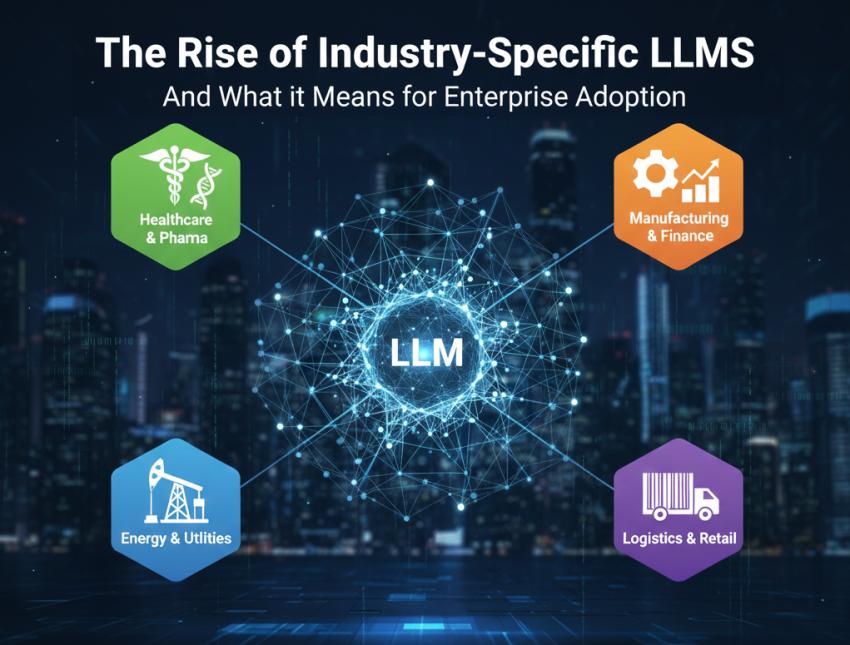
Industry-specific large language models are becoming a core part of enterprise AI strategy. Unlike general AI models, these systems are trained on domain-rich datasets that reflect real business processes, regulatory constraints, and operational language. The shift has been driven by the need for precision, speed, and predictability at scale. Enterprises and well-funded startups are increasingly turning to an experienced LLM Development Company to align AI capabilities with sector-specific requirements. As AI continues to evolve, industry-focused modeling is becoming the standard for organizations that expect measurable outcomes and long-term transformation.
Why enterprises are moving toward domain-trained language models
Enterprises no longer view AI as a tool for experimentation. They expect models that understand the nuances of their sector and provide reliable results. General-purpose models often struggle with specialized terminology or compliance-driven processes, which creates friction during adoption.
Industry-specific models help reduce errors and support faster decision-making. They provide context-rich responses that mirror real operational environments. Leaders who work in finance, healthcare, manufacturing, energy, and legal services are finding that industry-trained systems deliver stronger outcomes with fewer workflow disruptions.
Enterprises typically pursue this direction for several reasons:
Need for improved accuracy in internal workflows
Higher demand for compliance-ready AI systems
Greater reliance on automation during scaling
Faster access to insights from large internal datasets
Reduced risk exposure for knowledge-intensive tasks
This shift marks a new phase of enterprise AI maturity, where decision-makers prefer targeted solutions instead of broad, generic platforms.
How industry-focused models are reshaping adoption strategies
When organizations build or integrate a domain-trained model, they begin designing strategies around business outcomes rather than model capabilities. This is where Custom LLM Development plays a central role. Instead of adapting teams to fit general AI behavior, enterprises work with models that reflect their data, vocabulary, and operating standards.
This approach changes how companies plan AI ownership. The emphasis moves from experimentation to sustainable, measurable implementation. The result is a more confident adoption curve that reduces resistance across technical and non-technical teams.
Key improvements appear in areas such as:
Documentation analysis and data classification
Internal knowledge retrieval
Compliance tracking
Customer-facing interactions
Multi-department process alignment
Long-term workflow optimization
As more enterprises transition from pilot projects to long-term AI programs, domain-driven modeling will become a core part of modernization strategies.
Where custom LLM solutions generate their strongest ROI
Organizations often discover the highest value when they integrate AI into workflows that rely on large volumes of internal data. In these situations, models that understand domain language and recurring patterns outperform general AI tools.
The best results appear when the model becomes part of an ongoing operational cycle. The more it interacts with business processes, the more value it provides.
Benefits typically include:
Higher precision during repetitive or detail-heavy tasks
Stronger alignment with regulatory guidelines
Reduced manual review cycles
Better consistency across departments
Lower operational error rates
Improved decision-making for complex scenarios
These gains are especially relevant in sectors where documentation, compliance, and structured decision support impact daily operations.
The role of integration in long-term enterprise adoption
For many enterprises, the biggest challenge is not the model itself but the complexity of making it work across existing systems. This is where LLM Integration Services become essential. Legacy platforms, private databases, identity systems, and compliance modules must all interact with the model smoothly.
Integration determines whether an LLM becomes a reliable tool for teams or remains limited to isolated use cases. Long-term adoption requires clean data pipelines, access controls, monitoring, and strong performance management.
Most enterprise integration workflows involve:
API-level communication between the model and internal systems
Security-driven access governance
Automated monitoring and quality checks
Performance tuning for high-volume tasks
Multi-environment testing before rollout
Scalability assessments for cross-department usage
A strong integration plan ensures that future expansion is easier, more cost-efficient, and aligned with enterprise-wide goals.
Why enterprises often begin with LLM Consulting Services
Leaders rarely jump straight into full-scale deployment. Instead, they rely on early discovery sessions to validate use cases, examine data readiness, and estimate potential ROI. This is where LLM Consulting Services guides strategic planning.
Consulting provides structure in areas such as:
Identifying high-value opportunities for automation
Reviewing existing data quality and availability
Recommending the right architectural approach
Creating risk-aware governance frameworks
Designing proof-of-concept experiments
Aligning implementation with long-term business goals
This preparation helps enterprises avoid costly misalignment, technical debt, and compliance complications later in the deployment cycle.
With this foundation, leaders gain clarity on their AI roadmap and understand the resource investments required for scale.
How enterprises expand once LLM-Powered Solutions show early results
Once the initial deployment proves effective, organizations begin to scale usage across departments. This expansion is often driven by real-world results, such as reduced workloads for human reviewers, faster document processing, or improved customer support experiences.
Growth paths typically include:
Extending the model to additional operational workflows
Increasing model context windows with domain-specific data
Running periodic training cycles to maintain accuracy
Building internal AI competency through ongoing education
Expanding integration into new departments
This steady rollout strengthens organizational trust and encourages broader digital transformation.
FAQs
1. What sets industry-focused models apart for enterprise adoption?
Industry-focused models are trained with domain-specific data that reflect real business processes and regulatory expectations. This improves precision and reduces misinterpretation. Many enterprises prefer them over general models because they deliver more predictable outcomes in high-stakes environments supported by LLM Development Services.
2. How does a business know if it should invest in Custom LLM Development?
A business should consider custom development when general AI tools struggle with accuracy, specialized terminology, or compliance workflows. It becomes a strong option when internal teams rely heavily on complex documentation or regulated processes. A structured evaluation helps determine whether the investment can produce measurable gains.
3. What types of enterprises gain the most from custom LLM solutions?
Industries with heavy documentation or regulatory requirements see the strongest advantages. Finance, healthcare, legal, energy, and logistics benefit from models that can understand sector-specific language and improve operational consistency.
4. Why are LLM Integration Services important during deployment?
Integration ensures the model works smoothly with enterprise systems such as databases, identity tools, and compliance modules. It supports stable performance, controlled access, and scalability. Without strong integration, the model cannot be used effectively across daily operations.
5. How do enterprises plan long-term success with LLM-Powered Solutions?
Enterprises plan long-term success by monitoring performance, retraining periodically, and maintaining strong governance practices. This approach helps the model adapt as data changes. Ongoing refinement ensures it continues delivering reliable results as business needs evolve.
Conclusion
Industry-specific LLMs are shaping the future of enterprise AI by delivering higher precision, stronger compliance alignment, and more reliable operational support. Their growth reflects a wider shift toward domain-driven transformation rather than experimental deployment. As global enterprises and strong startups evaluate their next steps, many are choosing structured strategies that lead to measurable performance gains. Organizations that explore LLM Development Services early often enjoy stronger outcomes, faster adoption, and more competitive positioning in their market.