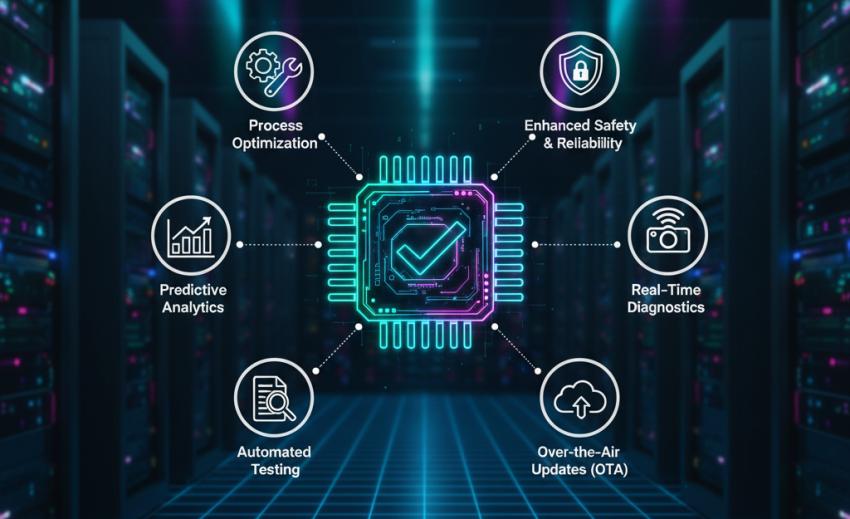
Technology and smart software systems have brought the automotive industry to a new level of precision. Carmobiles are no longer machines but rather, complicated systems of sensors, algorithms and digital controls that interact to deliver safety, reliability as well as efficiency. Since the industry is still advancing in innovations, automotive software has played a major role in the minimization of error and a general increase in accuracy in each phase of vehicle development and functionality.
Smart Design and manufacturing.
The automotive software is essential even at the stage of design and manufacturing. Advanced simulation tools enable the engineers to test the parts virtually and thereby minimizing the chances of design failures before constructing the prototypes. With the use of AI-based quality control systems, thousands of components may be examined with respect to their defects, where every part was produced according to the set criteria.
To manufacturers, this translates to a reduced number of production mistakes and shortened development period as well as a greater quality of cars that come out of the assembly line. Smart software-driven automation and robotics have ensured manufacturing is uniform and less likely to contain humans and manufacturing errors.
Accuracy in Diagnostic of Vehicles.
With traditional vehicles, it was usually a manual inspection of the vehicle and the time-consuming testing of the problem. Software based diagnostic systems are currently in use constantly checking engine performance, fuel economy and sensor data.
Once something goes wrong the system is able to detect the fault at real-time and can give elaborate error codes and even propose remedial measures. This saves time and minor problems are avoided to turn into big failures. It is possible to provide technicians and service centers with the real-time data that will allow them to make faster and more accurate repairs.
Improved Driver Assistance Systems.
Advanced Driver Assistance Systems (ADAS) are provided to modern vehicles, and it is a significant success of automotive software. These systems operate based on AI and real-time information to assist the drivers avoid accidents and make safer choices in the road.
Such features like lane-keeping assist, adaptive cruise control, and automatic emergency braking are based on the accurate data interpretation. The software uses radar signals, camera signals, and sensor signals to respond in milliseconds- much quicker than human response. This degree of precision has minimized the issue of human error which is one of the greatest causes of road carnage.
Anticipatory Maintenance and Efficiency.
Predictive maintenance is also made possible by automotive software and this is used to identify the presence of a problem and fix it in advance before it results in a failure. Through performance data, the system will be able to predict when a component is bound to fail, therefore during time, servicing is done.
This is not only a method of cutting down the cost of repairing but also increasing the life time and performance accuracy of the vehicle. It makes the difference that each system, including the engine control system or the battery control system, is working at maximum efficiency.
Enhancing Accuracy and Safety of Data.
Cars are becoming more and more interconnected producing vast quantities of data. A car software will make sure that this data is gathered, processed and shared in a right way. It has also assisted in upholding cybersecurity by ensuring that vehicle systems are not interfered with or manipulated with malicious intentions.
Proper data processing will enable car manufacturers and service providers to improve their data using data, which will result in improved vehicle performance and user experience.
The Future of the Automotive Accuracy.
Due to the emergence of autonomous vehicles, the need to have error-free and high-accuracy software systems is increasing exponentially. The future of automotive software will be a synthesis of artificial intelligence, machine learning, and edge computing, which will provide an almost perfect control and decision-making process.
This extension will not only enhance the safety of driving- it is going to transform the way cars communicate, how they work and how they integrate into the environment.
Conclusion
The modern innovation is vested in the automotive software that turns vehicles into intelligent and self-correcting systems. It is leading towards safer and more reliable transportation by cutting down on the human factor, improving accuracy, and real-time accuracy.
With the automotive industry still ahead, with more and more sophisticated software solutions being developed by companies such as tech.us, there is a future ahead that makes the automotive industry smarter, more efficient and a place where not only precision drives the automotive industry but also every action.