Introduction
In today’s competitive retail and supply chain environment, effective category management is essential for businesses looking to optimize their product offerings, improve customer satisfaction, and maximize profitability. Category management software has emerged as a critical tool that helps retailers and suppliers streamline these processes by providing advanced analytics, automation, and collaboration capabilities. This article delves into what category management software is, its core features, and how it functions to drive better business outcomes.
Definition
Category Management Software is a digital tool designed to help businesses strategically manage product categories as individual business units. It streamlines processes such as assortment planning, pricing, promotions, and supplier collaboration to optimize sales, improve inventory efficiency, and enhance customer satisfaction.
What is Category Management Software?
Software specifically created to help suppliers and retailers manage product categories as strategic business units is known as category management software. Instead of looking at products individually, category management groups related products into categories that can be managed collectively to enhance sales, reduce costs, and improve inventory efficiency.
This software integrates various data sources such as sales data, inventory levels, customer behavior, and market trends to deliver insights and actionable recommendations. It supports decision-making processes around assortment planning, pricing, promotions, and supplier negotiations.
Why Category Management Software Matters
Traditional category management involved manual processes, spreadsheets, and subjective decisions, which could be time-consuming and error-prone. Category management software automates much of this workflow, allowing companies to:
Gain data-driven insights for better decision-making
Improve collaboration between retailers and suppliers
Enhance category performance and profitability
Optimize inventory and reduce waste
Core Features of Category Management Software
Data Integration and Analytics:
At the heart of category management software lies its ability to aggregate and analyze vast amounts of data. This comprises market research, client preferences, inventory records, and sales data. Advanced analytics tools within the software help identify trends, customer buying patterns, and product performance within each category.
The software typically supports:
Real-time data updates: Ensuring that the most recent data is used to guide choices.
Predictive analytics: Forecasting future demand and sales trends.
Performance dashboards: Visual summaries of category health metrics.
Assortment Planning:
For each category to have the proper mix of products, assortment planning must be done well. Category management software provides tools to:
Analyze product performance and profitability.
Find any product range overlaps or gaps.
Make the best product assortment recommendations based on consumer demand and industry trends.
Manage product lifecycle stages (introduction, growth, maturity, decline).
By optimizing assortments, businesses can reduce excess inventory and improve sales conversion rates.
Pricing and Promotion Management:
Pricing is a key lever in category management. The software helps businesses set competitive and profitable prices by analyzing competitor pricing, historical sales, and customer sensitivity. Promotion management features allow for planning, executing, and measuring the impact of discounts, bundles, and marketing campaigns.
Key functions include:
Price elasticity modeling
Promotion effectiveness analysis
Scenario planning for pricing strategies
Automated price optimization suggestions
Supplier Collaboration and Management:
Category management software often includes tools to facilitate better communication and collaboration with suppliers. By sharing data and insights, retailers and suppliers can jointly plan assortments, negotiate contracts, and coordinate promotions.
Features supporting supplier management:
Vendor performance tracking
Shared category plans and forecasts
Automated order management and replenishment triggers
Contract and compliance management
Inventory Optimization:
Maintaining the right inventory levels is crucial to avoid stockouts and overstock situations. The software analyzes sales velocity, lead times, and seasonality to recommend optimal reorder points and quantities.
Inventory optimization functions:
Demand forecasting
Safety stock calculations
Automated replenishment alerts
Inventory turnover monitoring
Reporting and Compliance:
Comprehensive reporting capabilities provide stakeholders with actionable insights. Customizable reports can track category performance against KPIs, profitability, market share, and compliance with regulatory requirements.
Typical reports include:
Sales and margin analysis by category
Product performance reports
Promotion ROI
Supplier compliance reports
How Category Management Software Functions: The Workflow
Category management software supports a structured workflow, typically following these stages:
Step 1: Data Collection and Integration
The software pulls data from multiple sources—POS systems, ERP, market research, customer loyalty programs, and supplier databases—into a centralized platform.
Step 2: Category Analysis and Segmentation
Using analytics tools, the software segments products into logical categories and subcategories. It analyzes performance metrics such as sales volume, margins, customer preferences, and market trends to identify opportunities and challenges.
Step 3: Strategy Development
Category managers create customised plans for every category based on insights. This includes assortment planning, pricing, promotional activities, and supplier engagement strategies. The software helps simulate different scenarios to predict outcomes.
Step 4: Execution and Collaboration
Category plans are shared with cross-functional teams and suppliers for execution. The software facilitates collaboration by enabling real-time updates, communication, and joint decision-making.
Step 5: Monitoring and Adjustment
Post-execution, the software continuously monitors category performance. Automated alerts and dashboards notify managers of deviations from plans, allowing timely adjustments to pricing, inventory, or promotions.
Benefits of Using Category Management Software
Implementing category management software offers multiple advantages:
Improved Profitability: By optimizing assortments, pricing, and promotions, businesses can boost margins and sales.
Enhanced Customer Satisfaction: Delivering the right product mix and prices improves the shopping experience.
Operational Efficiency: Automation reduces manual workload and errors, speeding up decision-making.
Stronger Supplier Relationships: Collaborative planning builds trust and improves supply chain responsiveness.
Agility: Real-time insights allow quick responses to market changes and consumer behavior shifts.
Choosing the Right Category Management Software
When selecting category management software, businesses should consider:
Integration capabilities: How well it connects with existing systems like ERP, CRM, and POS.
User-friendliness: Intuitive interfaces and ease of use for cross-functional teams.
Scalability: Ability to support growing product lines and expanding markets.
Support and Training: Vendor support, onboarding assistance, and continuous updates
Future Trends of Category Management Software Market
AI and Machine Learning Integration:
The adoption of artificial intelligence (AI) and machine learning (ML) is transforming category management software by enabling predictive analytics, demand forecasting, and automated decision-making. These technologies help identify emerging customer trends and optimize assortments and pricing strategies in real-time.
Cloud-Based and SaaS Solutions:
As businesses move towards digital transformation, cloud-based and Software-as-a-Service (SaaS) platforms are becoming more popular. These solutions offer scalability, lower upfront costs, and easier integration with other enterprise systems.
Enhanced Collaboration Tools:
Future software platforms will focus more on collaboration features, enabling seamless communication between retailers, suppliers, and internal teams. Shared dashboards, real-time data sharing, and workflow automation will improve coordination and decision-making.
Focus on Sustainability and Compliance:
With growing emphasis on ethical sourcing and environmental responsibility, future category management tools will include features to monitor sustainability metrics, supplier compliance, and carbon footprints across the product lifecycle.
Personalized and Omnichannel Capabilities:
Category management software will evolve to support personalized customer experiences and unified management across online and offline channels. This guarantees uniform pricing, promotions, and product offerings throughout all touchpoints.
Growth Rate of Category Management Software Market
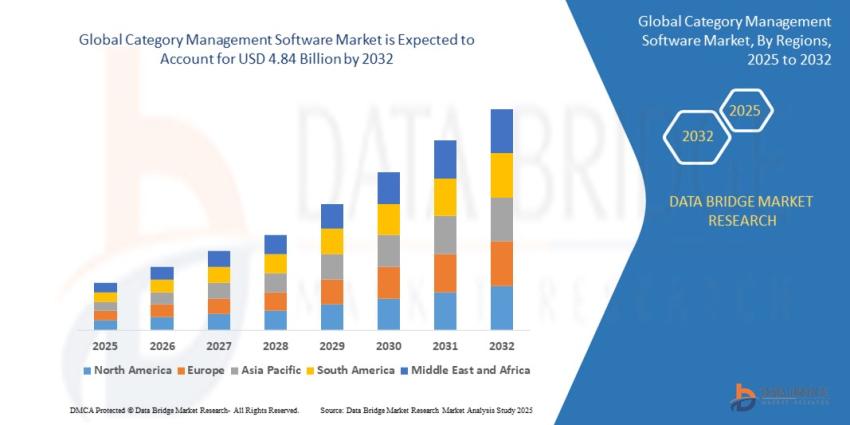
The global category management software market was estimated to be worth USD 2.10 billion in 2024 and is expected to reach USD 4.84 billion by 2032, growing at a compound annual growth rate (CAGR) of 11.0 percent, according to Data Bridge Market Research.
Conclusion
Category management software is a powerful enabler for retailers and suppliers aiming to compete effectively in today’s dynamic market. By leveraging its robust features—ranging from data integration and analytics to supplier collaboration and inventory optimization—businesses can transform how they manage product categories. The result is improved profitability, better customer experiences, and streamlined operations.