In the global economy, people and businesses increasingly care about who and how goods are produced, and whether they are produced ethically and sustainably. So how can businesses be fully informed of their supply chains? How are consumers supposed to know where and who the goods come from?
Supply chain transparency is a requirement today but remains an impenetrable barrier due to traditional opaque systems, multiple middlemen, and paper-based reporting. Blockchain development promises to change that by providing a decentralized and hacker-proof record store for instant access and security. In combination with mobile app and development, blockchain helps businesses monitor, verify, and share all stages of the supply chain chain easily and transparently. In this blog, we will discuss how blockchain will rethink supply chain transparency and its mobile apps and real-world applications, as well as potential obstacles and implications.
Understanding Supply Chain Transparency and Blockchain:
Supply chain transparency means determining and checking every product that moves from start to finish. This visibility makes companies run ethically, sustainably, and efficiently and allows customers to make better buying choices. But supply chain management in the old fashions is made of many layers of middlemen, manual filing, and opaque processes that can easily lead to errors, fraud, and inefficiencies.
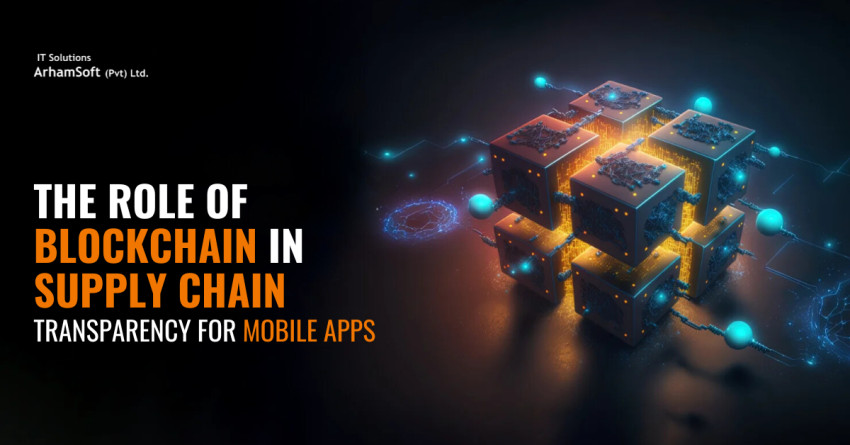
Blockchain development resolves these problems by providing a decentralized ledger system where every transaction is documented in real-time. Immutability, decentralization, and transparency are its three hallmarks and they transform supply chain management. Blockchain, in contrast to traditional systems, provides a centralized, tamper-proof historical record for every person involved in the supply chain. When mobile apps and developers add blockchain to their solutions, they can give companies and consumers instant access to real-time supply chain data in easy-to-use interfaces.
Blockchain Applications in Supply Chain Tracking
Blockchain can help change supply chain tracking in many ways, offering visibility and transparency across the chain. Here are some key applications:
Product Provenance and Authenticity Verification
Through blockchain, each product has a digital history back to the source. This is especially important in industries where counterfeits are frequent, like luxury products, pharmaceuticals, and food production. Blockchain-based mobile apps can enable users to scan a QR code and instantly authenticate the history of a product.
Real-Time Tracking
Blockchain – by monitoring what moves in real-time, blockchain enables organizations to keep track of shipments and stock. This minimizes delay, theft, and loss of shipments while improving the logistics and customer experience. Mobile apps can display this information visually to consumers, offering visibility at all points of the supply chain.
Smart Contracts for Automated Processes
Smart contracts are auto-executing contracts where the rules are written in code. As part of supply chains, smart contracts can automate payment, quality inspection, and fulfillment of orders under a specific set of conditions. This prevents human interference thereby avoiding errors and accelerating the operation.
Compliance and Auditing
Blockchain provides a secure audit trail that can easily be verified for industries that have stringent regulations. It proves everything from ethical origins to environmental certifications blockchain creates defensible records for everyone.
Integrating Blockchain in BUSINESS APPs for Enhanced Transparency:
Blockchain technology can make for a huge boost for BUSINESS APPs dealing with supply chain management. With blockchain components, secure sharing of data, transparency of reporting, and automated process automation, such apps can deliver a new standard of trust and visibility.
Supplier and Vendor Management
BUSINESS APPs can also utilize blockchain to validate suppliers’ backgrounds and credentials. This makes sure that all partners are ethically and sustainably qualified. Blockchain ratings and reputation can also help businesses make better choices when it comes to choosing suppliers.Enhanced Inventory Management`
ItEW can give you real-time inventory visibility so companies can manage stock efficiently and reduce waste. When bundled into mobile apps and development projects, firms can provide customers access to inventory data on the go.Secure Data Sharing
In conventional supply chains, confidential information gets transmitted via unreliable networks, resulting in tampering or leaks. The cryptographic security on Blockchain allows only designated people to access certain data, ensuring business intelligence and customer information.
Real-World Cases of Blockchain-Based Supply Chain Apps
There are several industries and companies already adopting blockchain mobile apps for their supply chain management:
IBM Food Trust
The IBM Food Trust network is based on blockchain and creates transparency and traceability in the food supply chain. It enables consumers to track every aspect of the food chain from farm to grocery shelf for food security and authenticity. Mobile applications that are connected to the network allow companies and consumers to check product information within minutes.Everledger
This blockchain solution is applied to trace the origin of diamonds to ensure ethically sourced diamonds. Everledger’s open record of all transactions prevents conflict diamonds and establishes consumer confidence by providing the data behind every transaction. Users can also view this data through mobile applications, enabling access and visibility.Provenance
Provenance leverages the blockchain to give you supply chain visibility for any consumer goods. The platform lets companies share ethical origins with customers via mobile apps, which helps to build brand and trust.
Challenges and Future Outlook
The opportunities for blockchain’s use in supply chain management are huge, but not without challenges:
Scalability Issues: Blockchain networks are subject to scalability limitations when processing large amounts of data. This increases transaction time, which might be a problem for high-volume supply chains and mobile apps that require big data to process.
Integration Complexity: Blockchain integrations into existing supply chain infrastructure are often intractable and time-consuming. Small companies need to pay for the tech and expertise to build it into their existing infrastructure in a way that allows for easy integration.
Regulatory Uncertainty: Blockchain regulations are not completely set, and businesses need to keep pace with strict data usage, privacy, and compliance laws. When it comes to iPhone iPad apps or other mobile platforms whose applications can span across many different geographical areas, regulatory compliance can be overwhelming.
Adoption Resistance: Businesses might not want to embrace blockchain because they are unaware of it or believe it is dangerous. Training stakeholders and demonstrating the merits of blockchain-enabled supply chains will be crucial to wider adoption.
Conclusion
Blockchain technology can revolutionize supply chain management, providing unimaginable transparency, security, and effectiveness. Blockchain will help companies establish trust, make operations easier, and ensure fair supply by embedding it into mobile apps and projects. Blockchain’s capacity to reimagine supply chains, ranging from BUSINESS APPS to iPhone iPad apps, is enormous. Although there is still much work to do, innovation and collaboration can continue to realize the full potential of this potent technology, changing the global supply chain landscape for years to come.