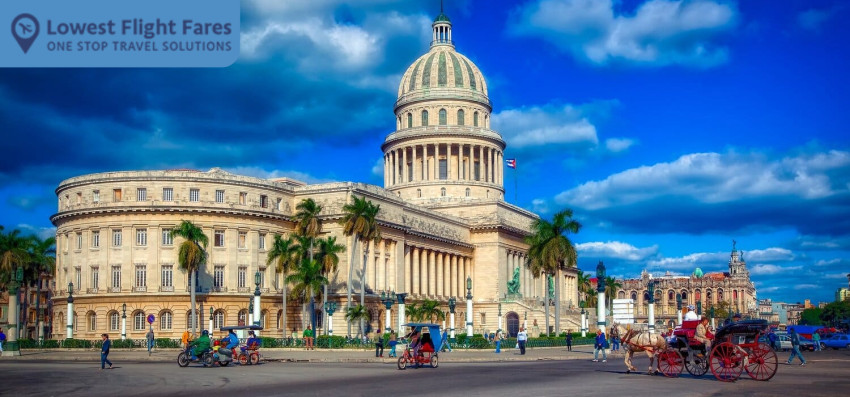
Havana museums don't get the recognition they deserve. When you think of Cuba you are thinking of music, old American cars, colonial buildings smooth rum, an exciting nightlife, as well as other things. However, Havana offers so much more to offer in terms in the realm of art.
Here's a comprehensive listing most renowned museums in Havana with stunning masterpieces of art, to the quirky to the historical These museums are a delight.
Hence, to enjoy a classic holiday, book your cheap flights to Havana soon.
National Museum of Fine Arts
At par with the best museums around the world This museum boasts an extensive and varied collection. It is certainly one of the most prestigious museum in Havana.
Two impressive buildings are housed there with one of them specifically dedicated for Cuban Arts (the Palacio de Bellas Artes) and the other to Universal Arts in the International Gallery, this is the most important museum in Havana.
The National Museum of Fine Arts of Havana has exhibits that range from the colonial period to the present day art of internationally renowned artists.
Napoleonic Museum
If you're interested in the 19th century, then you must add this to the list of places located in Havana, Cuba to see. It is home to one of the most extensive collections of Napoleon Bonaparte's personal belongings and other period artifacts that are not in France. The museum is situated in a gorgeous setting inside an old mansion. The gardens and rooms are models of the mansion's appearance at the time.
It is important to note that unless you're fluent in Spanish it is necessary to have an interpreter or guide since most of the content can be made in Spanish.
Church and Convent of St. Francis of Assisi
It is located at Plaza San Francisco, the Church and Convent of St. Francis of Assisi was constructed at in the late 16th century. It was later renovated in the 17th century, in it's Baroque style. Although it is no longer the convent, it's now an exhibition hall and museum with some of the most impressive audio-quality in the city.
If you're comfortable with the heights, then you must go up the steps up to the top of the tower bell which is 138 feet. high. You'll be able to enjoy some of the most stunning panoramas of downtown.
Taquechel Pharmacy Museum
The most intriguing museum located in Havana, Cuba is the Tequechel Pharmacy Museum. Rewind time and discover what a pharmacy from the past might look like. With wooden shelves surrounded by ceramic jars and flasks stuffed with herbal recipes, this pharmacy owned by the family was established around 1898 and owned was run by Francisco Taquechel was restored in 1996, and is now an art gallery and functioning pharmacy.
You can find many restored pharmacies similar to this one in Havana For instance, Drogueria Johnson and Museo de la Farmacia Habanera with one with an Skeleton.
Rum Museum
One of the most renowned museums in Havana that you should visit includes The Museo del Ron Havana Club which is located in an 18th century palace that is located in the middle of Old Havana, is a museum designed to reveal the history of everything that is connected to the past and production of the rum. It showcases the traditional rum-making process as well as a shop with an excellent selection of older spirits.
Museum of the Revolution
In 1920, the president Mario Garcia Menocal, the then Presidential Palace was designed by the Cuban architect Rodolfo Maruri and the Belgian architect Paul Belau, who also created what is now called the Gran Teatro de La Habana. It was as the Presidential Palace until the Cuban Revolution in 1959.
The exhibits are mainly dedicated to the story that led to Cuba and the Cuban Revolution of 1959, however, there are some exhibits dedicated to the pre-revolutionary history of Cuba as well as those from 1895-1898. War of Independence against Spain.
Chocolate Museum
It is advertised as a museum and a museum, it is actually a museum, but the Museo del Chocolate is more than a cafe/tasting room where the chocolate is something to die for! The area you'd think of as a museum is the exhibits on the history of cacao production, and commercialization. For those who love chocolate, you will be amazed by the collection of materials provided from Belgian museums, such as posts from long-gone Belgian chocolate companies like Martougin.
The Museum of the City of Havana
The entire west side in Plaza de Armas, one of the four main squares in Havana there is also The Museum of the City of Havana. This impressive structure was the main office for Havana's Spanish administration in Cuba and was also the home of the Viceroys who ruled the island. Following Cuban declaration of independence, in 1898 the building served as the headquarters for the U.S. military administration.
The building today is an impressive museum that displays the rich history of Havana from its beginning. Inside, you can see objects that relate to every aspect of the city's evolution through the ages. The most fascinating exhibits are the living quarters for the Spanish governors with furniture and tables that bear the family's the family's crest.
A large portion of the exhibits in the museum in Havana is military-related, such as automobiles, uniforms, and even weapons. There's also a magnificent space for the throne of the visiting Spanish monarch - but he has never visited.
Finca Vigia
Finca Vigia Ernest Hemingway's residence in the outskirts Havana is a spacious and spacious residence with a spectacular views, situated on an incline within the Cuban countryside. Hemingway resided in the Finca Vigia from 1939 until 1960 after which he was diagnosed with a disease and returned in his home in the United States.
In this humble but elegant home Hemingway wrote his masterpiece, The Old Man and the Sea as well as a portion from For Whom the Bell Tolls.
In the year Hemingway came back to United States, the Cuban government took over the farm. After a decade of neglect, which put the farm at risk of falling apart, the government made it a reality in 2007 and reopened it to visitors. The museum is a pleasant excursion from the city and is well worth a visit.
Museo de Arte Colonial
Oft overlooked, oft-forgotten, Museo de Arte Colonial is one of the Havana museums that should not be not missed. Here you will be able to see the way of life to the wealthy Cubans during the colonial time. The huge two-story yellow home is surrounded by a huge courtyard. The rooms are brimming with furniture, clothes china as well as other antiques each depicting the aristocratic lifestyle.
Museo Historico de Guanabacoa
If you're fascinated by your fascination with Santeria religion, the one introduced to Cuba by slaves Africans and their descendants, then this museum is worth visiting. It's a tiny but interesting exhibit from Afro Cuban items that have religious significance. It's important to know it's presented in Spanish and you'll require an introduction to understand the full significance of the exhibits. It's also enjoyable to go there, as you'll need to take the ferry from Havana. It's an amazing experience, with only a few tourists. It's "authentic Cuba."